[ECCV 2020] Reimplementation of 3DDFAv2, including face mesh, head pose, landmarks, and more.

Overview

Stable Head Pose Estimation and Landmark Regression via 3D Dense Face Reconstruction
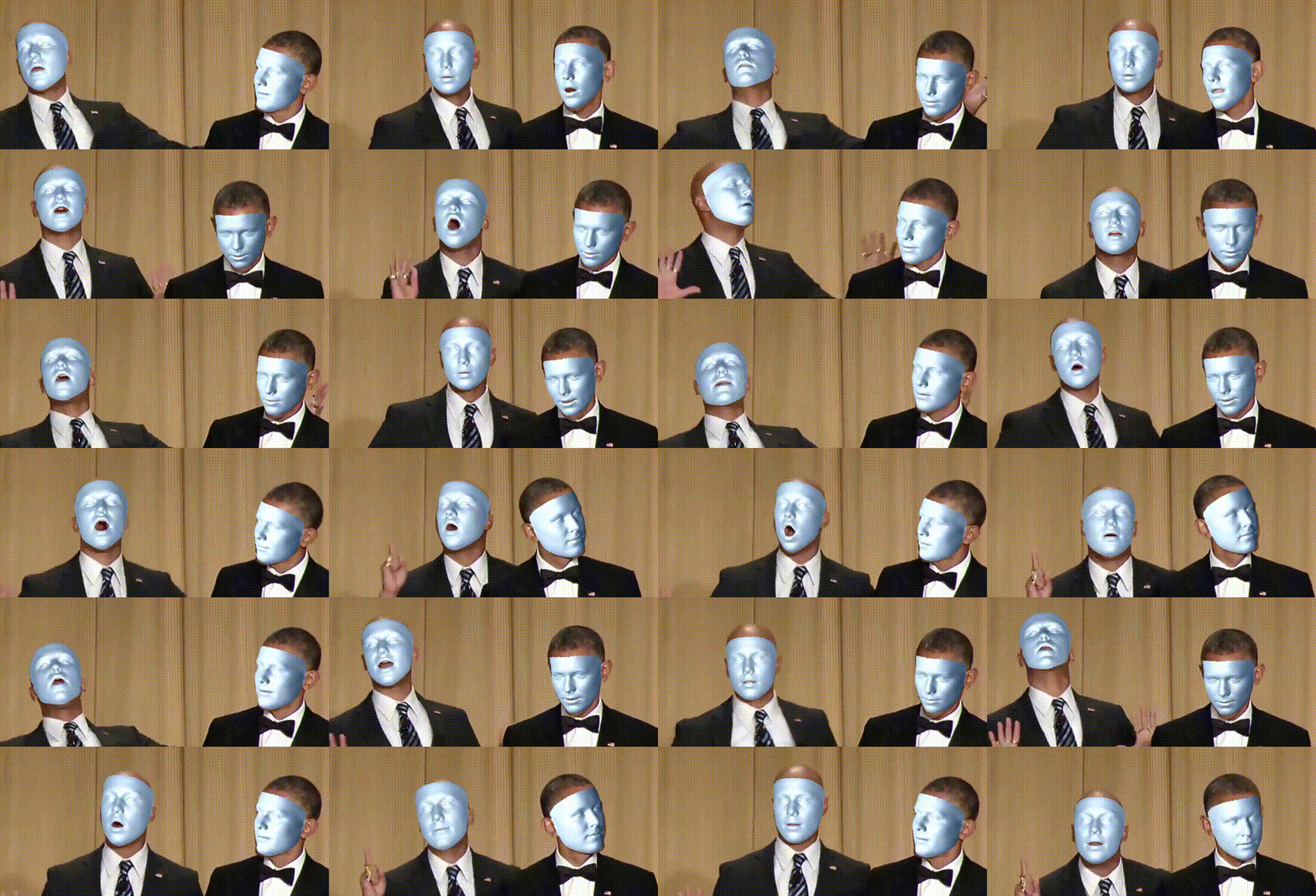

FaceReconstructionDemo

Language grade: Python License ECCV

Reimplementation of (ECCV 2020) Towards Fast, Accurate and Stable 3D Dense Face Alignment via Tensorflow Lite framework, face mesh, head pose, landmarks, and more.

  • CPU real-time face deteciton, alignment, and reconstruction pipeline.
  • Lightweight render library, 5x faster (3ms vs 15ms) than the Sim3DR tools.
  • Camera matrix and dense/sparse landmarks prediction via a single network.
  • Generate facial parameters for robust head pose and expression estimation.

Setup

Basic Requirements

  • Python 3.6+
  • pip3 install -r requirements.txt

Render for Dense Face

  • GCC 6.0+
  • bash build_render.sh
  • (Cautious) For Windows user, please refer to this tutorial for more details.

3D Facial Landmarks

In this project, we perform dense face reconstruction by 3DMM parameters regression. The regression target is simplified as camera matrix (C, shape of 3x4), appearance parameters (S, shape of 1x40), and expression variables (E, shape of 1x10), with 62 dimensions in total.

The sparse or dense facial landmarks can be estimated by applying these parameters to a predefined 3D model, such as BFM. More specifically, the following formula describes how to generate a face through parameters:

Generate Face

where U and W are from pre-defined face model. Combine them linearly with parameters to generate sparse or dense faces. Finally, we need to integrate the posture information into the result:

With matrix

where R (shape of 3x3) and T (shape of 3x1) denote rotation and translation matrices, respectively, which are fractured from the camera matrix C.

Sparse
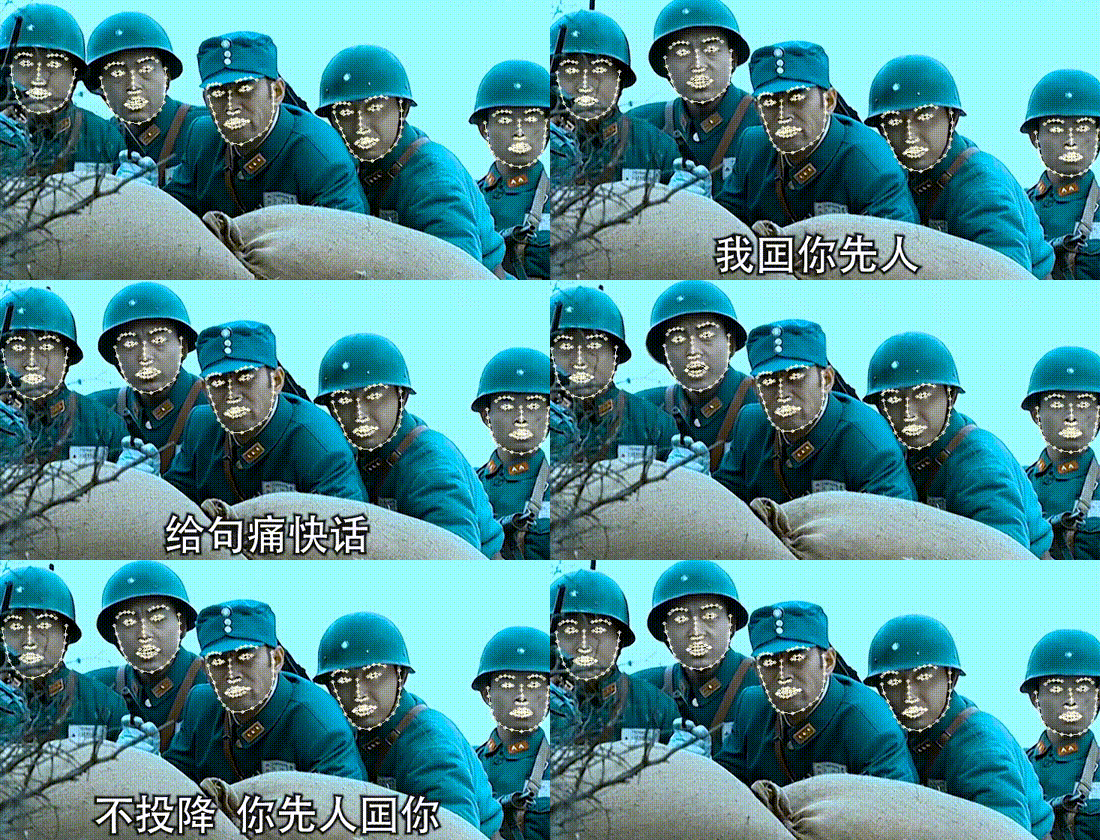
sparse demo

Since we have reconstructed the entire face, the 3D face alignment can be achieved by selecting the landmarks at the corresponding positions. See [TPAMI 2017] Face alignment in full pose range: A 3d total solution for more details.

Comparing with the method of first detecting 2D landmarks and then performing depth estimation, directly fitting 3DMM to solve 3D face alignment can not only obtain more accurate results in larger pose scenes, but also has obvious advantages in speed.

We provide a demonstration script that can generate 68 landmarks based on the reconstructed face. Run the following command to view the real-time 3D face alignment results:

python3 demo_video.py -m sparse -f <your-video-path>

Dense
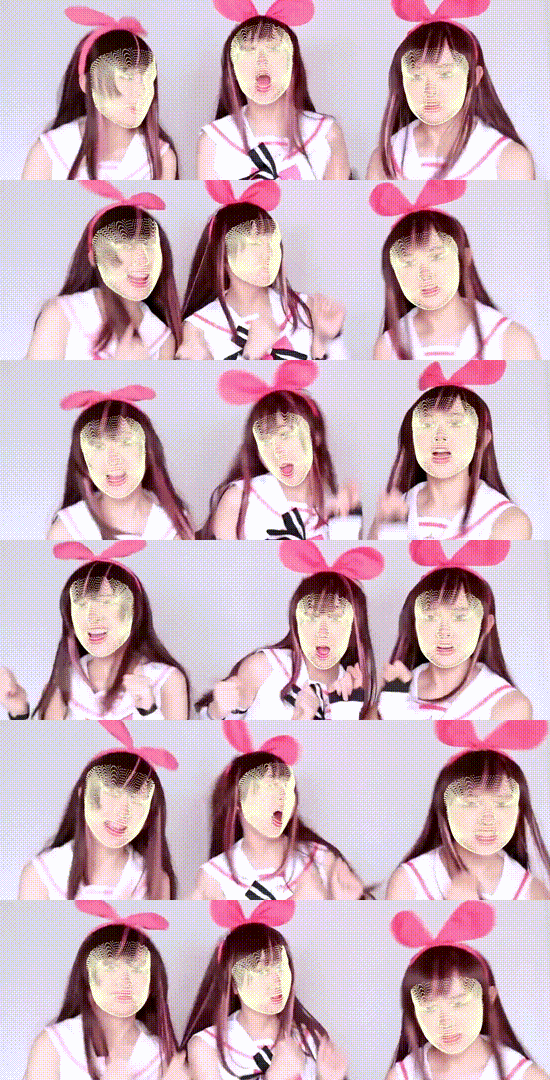
dense demo

Currently, our method supports up to 38,365 landmarks. We draw landmarks every 6 indexes for a better illustration. Run the demonstrate script in dense mode for real-time dense facial landmark localization:

python3 demo_video.py -m dense -f <your-video-path>

Face Reconstruction

Our network is multi-task since it can directly regress 3DMM params from a single face image for reconstruction, as well as estimate the head pose via R and T prediction. During training, the predicted R can supervise the params regression branch to generate refined face mesh. Meanwhile, the landmarks calculated via the params are provided as the labeled data to the pose estimation branch for training, through the cv2.solvePnP tool.

Theoretically speaking, the head pose estimation task in our model is weakly supervised, since only a few labeled data is required to activate the training process. In detail, the loss function at the initial stage can be described as follows:

Init Pose Loss

After the initialization process, the ground truth can be replaced by the prediction results of other branches. Therefore, the loss function will be transformed to the following equation in the later stage of the training process:

Pose Loss

In general, fitting the 3D model during the training process dynamically can avoid the inaccurate head pose estimation results caused by the coarse predefined model.

Head Pose
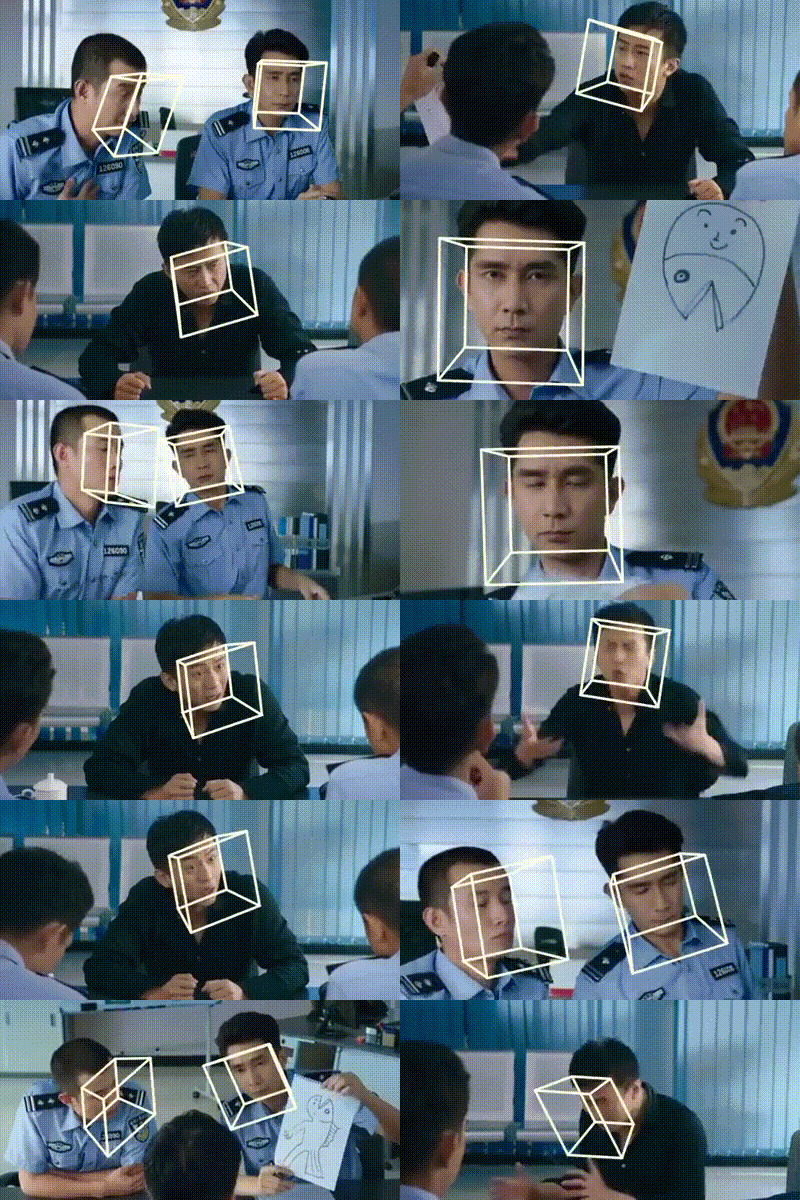
pose demo

Traditional head pose estimation approaches, such as Appearance Template Models, Detector Arrays, and Mainfold Embedding have been extensively studied. However, methods based on deep learning improved the prediction accuracy to meet actual needs, until recent years.

Given a set of predefined 3D facial landmarks and the corresponding 2D image projections, the SolvePnP tool can be utilized to calculate the rotation matrix. However, the adopted mean 3D human face model usually introduces intrinsic error during the fitting process. Meanwhile, the additional landmarks extraction component is also kind of cumbersome.

Therefore, we designed a network branch for directly regress 6DoF parameters from the face image. The predictions include the 3DoF rotation matrix R (Pitch, Yaw, Roll), and the 3DoF translation matrix T (x, y, z), Compared with the landmark-based method, directly regression the camera matrix is more robust and stable, as well as significantly reduce the network training cost. Run the demonstrate script in pose mode to view the real-time head pose estimation results:

python3 demo_video.py -m pose -f <your-video-path>

Expression
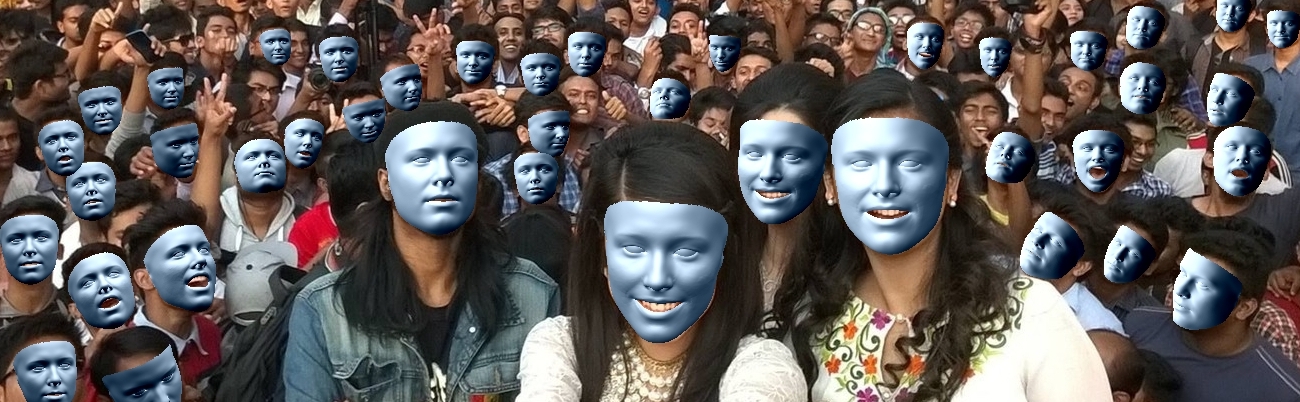
Expression

Coarse expression estimation can be achieved by combining the predefined expressions in BFM linearly. In our model, regression the E is one of the tasks of the params prediction branch. Obviously, the accuracy of the linear combination is positively related to the dimension.

Clipping parameters can accelerate the training process, however, it can also reduce reconstruction accuracy, especially details such as eye and mouth. More specifically, E has a greater impact on face details than S when emotion is involved. Therefore, we choose 10-dimension for a tradeoff between the speed and the accuracy, the training data can be found at here for refinement.

In addition, we provide a simple facial expression rendering script. Run the following command for illustration:

python3 demo_image.py <your-image-path>

Mesh
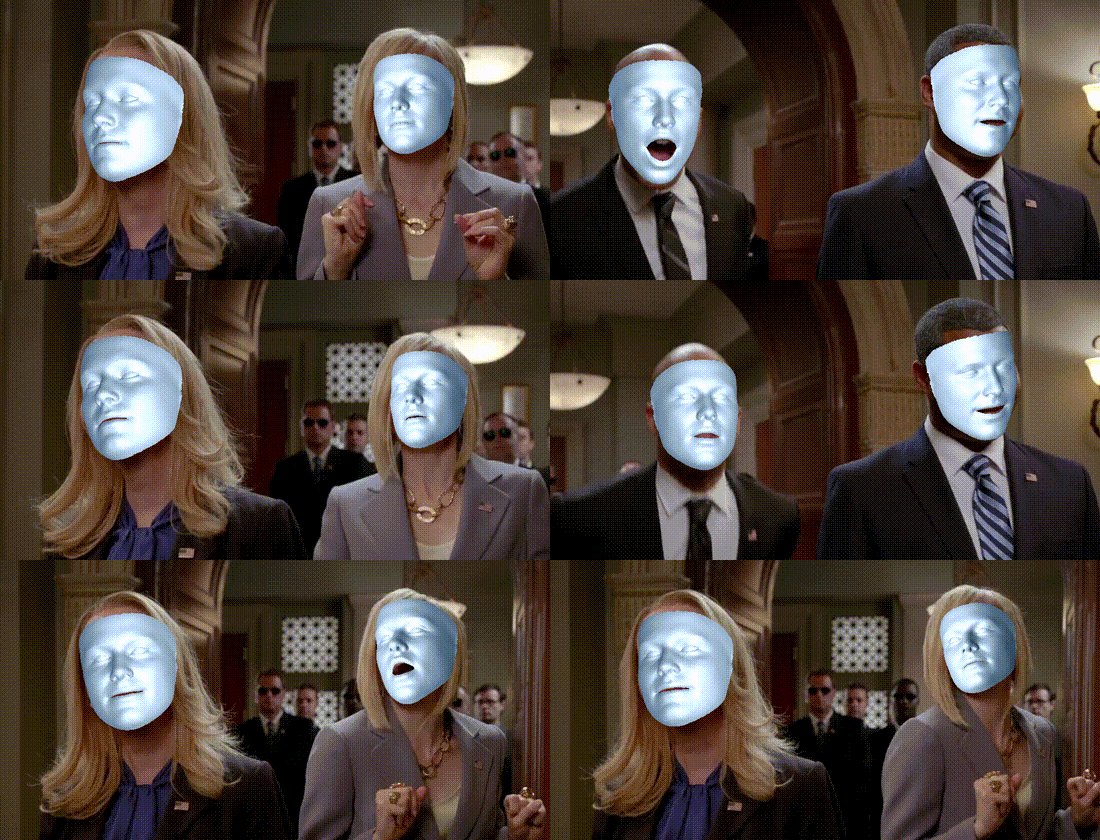
mesh demo

According to the predefined BFM and the predicted 3DMM parameters, the dense 3D facial landmarks can be easily calculated. On this basis, through the index mapping between the morphable triangle vertices and the dense landmarks defined in BFM, the renderer can plot these geometries with depth infomation for mesh preview. Run the demonstrate script in mesh mode for real-time face reconstruction:

python3 demo_video.py -m mesh -f <your-video-path>

Benchmark

Our network can directly output the camera matrix and sparse or dense landmarks. Compared with the model in the original paper with the same backbone, the additional parameters yield via the pose regression branch does not significantly affect the inference speed, which means it can still be CPU real-time.

Scheme THREAD=1 THREAD=2 THREAD=4
Inference 7.79ms 6.88ms 5.83ms

In addition, since most of the operations are wrapped in the model, the time consumption of pre-processing and post-processing are significantly reduced. Meanwhile, the optimized lightweight renderer is 5x faster (3ms vs 15ms) than the Sim3DR tools. These measures decline the latency of the entire pipeline.

Stage Preprocess Inference Postprocess Render
Each face cost 0.23ms 7.79ms 0.39ms 3.92ms

Run the following command for speed benchmark:

python3 video_speed_benchmark.py <your-video-path>

Citation

@inproceedings{guo2020towards,
    title={Towards Fast, Accurate and Stable 3D Dense Face Alignment},
    author={Guo, Jianzhu and Zhu, Xiangyu and Yang, Yang and Yang, Fan and Lei, Zhen and Li, Stan Z},
    booktitle={Proceedings of the European Conference on Computer Vision (ECCV)},
    year={2020}
}
Comments
  • __init__() got an unexpected keyword argument 'num_threads'

    __init__() got an unexpected keyword argument 'num_threads'

    While running "python3 demo_video.py -m mesh -f I receive the following ERROR: File "demo_video.py", line 53, in main(args) File "demo_video.py", line 16, in main fa = service.DenseFaceReconstruction("weights/dense_face.tflite") File "/home/happy/PycharmProjects/Dense-Head-Pose-Estimation/service/TFLiteFaceAlignment.py", line 11, in init num_threads=num_threads) TypeError: init() got an unexpected keyword argument 'num_threads'

    opened by berylyellow 2
  • asset/render.so not found

    asset/render.so not found

    While running "python3 demo_video.py -m mesh -f I receive the following ERROR OSError: asset/render.so: cannot open shared object file: No such file or directory I can successfully run the other three modes (sparse, dense, pose)

    opened by fisakhan 2
  • How can i get Depth

    How can i get Depth

    hi, I want to get information about the depth of the face, how do I calculate it? i don't need rendering but only need depth map. like https://github.kakaocorp.com/data-sci/3DDFA_V2_tf2/blob/master/utils/depth.py thank you in advance!

    opened by joongkyunKim 1
  • there is no asset/render.so

    there is no asset/render.so

    Ignore above cudart dlerror if you do not have a GPU set up on your machine. Traceback (most recent call last): File "demo_video.py", line 53, in main(args) File "demo_video.py", line 18, in main color = service.TrianglesMeshRender("asset/render.so", File "/home/xuhao/workspace/Dense-Head-Pose-Estimation-main/service/CtypesMeshRender.py", line 17, in init self._clibs = ctypes.CDLL(clibs)

    opened by hitxuhao 1
  • asset/render.so: cannot open shared object file: No such file or director

    asset/render.so: cannot open shared object file: No such file or director

    It worked well with: $ python3 demo_video.py -m pose -f ./re.mp4 $python3 demo_video.py -m sparse -f ./re.mp4 $ python3 demo_video.py -m dense -f ./re.mp4

    but with mesh not as you see here:

    $python3 demo_video.py -m mesh -f ./re.mp4 2022-12-05 17:03:03.713207: I tensorflow/stream_executor/platform/default/dso_loader.cc:48] Successfully opened dynamic library libcudart.so.10.1 Traceback (most recent call last): File "demo_video.py", line 55, in main(args) File "demo_video.py", line 21, in main color = service.TrianglesMeshRender("asset/render.so", "asset/triangles.npy") File "/home/redhwan/2/HPE/tensorflow/Dense-Head-Pose-Estimation-main/service/CtypesMeshRender.py", line 17, in init self._clibs = ctypes.CDLL(clibs) File "/usr/lib/python3.8/ctypes/init.py", line 373, in init self._handle = _dlopen(self._name, mode) OSError: asset/render.so: cannot open shared object file: No such file or directory

    opened by Algabri 0
  • Memory usage

    Memory usage

    hi @1996scarlet

    Is it expected that the model uses around 18GB of video RAM? Or does it maximises the RAM available to help with speed? (I got a 24GB ram GPU, and usage goes up to 22.2GB while inferencing) Thanks for this amazing MIT license repo btw.

    opened by Tetsujinfr 0
Releases(v1.0)
  • v1.0(Feb 1, 2021)

    Stable Head Pose Estimation and Landmark Regression via 3D Dense Face Reconstruction

    • CPU real-time face deteciton, alignment, and reconstruction pipeline.
    • Lightweight render library, 5x faster (3ms vs 15ms) than the Sim3DR tools.
    • Camera matrix and dense/sparse landmarks prediction via a single network.
    • Generate facial parameters for robust head pose and expression estimation.
    Source code(tar.gz)
    Source code(zip)
Owner
Remilia Scarlet
Remilia Scarlet
PaddleViT: State-of-the-art Visual Transformer and MLP Models for PaddlePaddle 2.0+

PaddlePaddle Vision Transformers State-of-the-art Visual Transformer and MLP Models for PaddlePaddle πŸ€– PaddlePaddle Visual Transformers (PaddleViT or

1k Dec 28, 2022
Original code for "Zero-Shot Domain Adaptation with a Physics Prior"

Zero-Shot Domain Adaptation with a Physics Prior [arXiv] [sup. material] - ICCV 2021 Oral paper, by Attila Lengyel, Sourav Garg, Michael Milford and J

Attila Lengyel 40 Dec 21, 2022
code for "AttentiveNAS Improving Neural Architecture Search via Attentive Sampling"

code for "AttentiveNAS Improving Neural Architecture Search via Attentive Sampling"

Facebook Research 94 Oct 26, 2022
Image-to-Image Translation with Conditional Adversarial Networks (Pix2pix) implementation in keras

pix2pix-keras Pix2pix implementation in keras. Original paper: Image-to-Image Translation with Conditional Adversarial Networks (pix2pix) Paper Author

William Falcon 141 Dec 30, 2022
MADE (Masked Autoencoder Density Estimation) implementation in PyTorch

pytorch-made This code is an implementation of "Masked AutoEncoder for Density Estimation" by Germain et al., 2015. The core idea is that you can turn

Andrej 498 Dec 30, 2022
[ICCV 2021] Target Adaptive Context Aggregation for Video Scene Graph Generation

Target Adaptive Context Aggregation for Video Scene Graph Generation This is a PyTorch implementation for Target Adaptive Context Aggregation for Vide

Multimedia Computing Group, Nanjing University 44 Dec 14, 2022
TCNN Temporal convolutional neural network for real-time speech enhancement in the time domain

TCNN Pandey A, Wang D L. TCNN: Temporal convolutional neural network for real-time speech enhancement in the time domain[C]//ICASSP 2019-2019 IEEE Int

ε‡Œι€†ζˆ˜ 16 Dec 30, 2022
Active and Sample-Efficient Model Evaluation

Active Testing: Sample-Efficient Model Evaluation Hi, good to see you here! πŸ‘‹ This is code for "Active Testing: Sample-Efficient Model Evaluation". P

Jannik Kossen 19 Oct 30, 2022
SpecAugmentPyTorch - A Pytorch (support batch and channel) implementation of GoogleBrain's SpecAugment: A Simple Data Augmentation Method for Automatic Speech Recognition

SpecAugment An implementation of SpecAugment for Pytorch How to use Install pytorch, version=1.9.0 (new feature (torch.Tensor.take_along_dim) is used

IMLHF 3 Oct 11, 2022
DexterRedTool - Dexter's Red Team Tool that creates cronjob/task scheduler to consistently creates users

DexterRedTool Author: Dexter Delandro CSEC 473 - Spring 2022 This tool persisten

2 Feb 16, 2022
πŸ”₯ Cannlytics-powered artificial intelligence πŸ€–

Cannlytics AI πŸ”₯ Cannlytics-powered artificial intelligence πŸ€– πŸ—οΈ Installation πŸƒβ€β™€οΈ Quickstart 🧱 Development 🦾 Automation πŸ’Έ Support πŸ›οΈ License ?

Cannlytics 3 Nov 11, 2022
HyperPose is a library for building high-performance custom pose estimation applications.

HyperPose is a library for building high-performance custom pose estimation applications.

TensorLayer Community 1.2k Jan 04, 2023
Inhomogeneous Social Recommendation with Hypergraph Convolutional Networks

Inhomogeneous Social Recommendation with Hypergraph Convolutional Networks This is our Pytorch implementation for the paper: Zirui Zhu, Chen Gao, Xu C

Zirui Zhu 3 Dec 30, 2022
Cross Quality LFW: A database for Analyzing Cross-Resolution Image Face Recognition in Unconstrained Environments

Cross-Quality Labeled Faces in the Wild (XQLFW) Here, we release the database, evaluation protocol and code for the following paper: Cross Quality LFW

Martin Knoche 10 Dec 12, 2022
For IBM Quantum Challenge Africa 2021, 9 September (07:00 UTC) - 20 September (23:00 UTC).

IBM Quantum Challenge Africa 2021 To ensure Africa is able to apply quantum computing to solve problems relevant to the continent, the IBM Research La

Qiskit Community 48 Dec 25, 2022
Official PyTorch implementation of "Synthesis of Screentone Patterns of Manga Characters"

Manga Character Screentone Synthesis Official PyTorch implementation of "Synthesis of Screentone Patterns of Manga Characters" presented in IEEE ISM 2

Tsubota 2 Nov 20, 2021
smc.covid is an R package related to the paper A sequential Monte Carlo approach to estimate a time varying reproduction number in infectious disease models: the COVID-19 case by Storvik et al

smc.covid smc.covid is an R package related to the paper A sequential Monte Carlo approach to estimate a time varying reproduction number in infectiou

0 Oct 15, 2021
[CVPR-2021] UnrealPerson: An adaptive pipeline for costless person re-identification

UnrealPerson: An Adaptive Pipeline for Costless Person Re-identification In our paper (arxiv), we propose a novel pipeline, UnrealPerson, that decreas

ZhangTianyu 70 Oct 10, 2022
Hunt down social media accounts by username across social networks

Hunt down social media accounts by username across social networks Installation | Usage | Docker Notes | Contributing Installation # clone the repo $

1 Dec 14, 2021
Source code for deep symbolic optimization.

Update July 10, 2021: This repository now supports an additional symbolic optimization task: learning symbolic policies for reinforcement learning. Th

Brenden Petersen 290 Dec 25, 2022