

Summarization, translation, sentiment-analysis, text-generation and more at blazing speed using a T5 version implemented in ONNX.

Overview

ONNX T5 Actions Status Actions Status Version Downloads Slack

Summarization, translation, Q&A, text generation and more at blazing speed using a T5 version implemented in ONNX.

This package is still in alpha stage, therefore some functionalities such as beam searches are still in development.

Installation

ONNX-T5 is available on PyPi.

pip install onnxt5

For the dev version you can run the following.

git clone https://github.com/abelriboulot/onnxt5
cd onnxt5
pip install -e .

Usage

The simplest way to get started for generation is to use the default pre-trained version of T5 on ONNX included in the package.

NOTE: Please note that the first time you call get_encoder_decoder_tokenizer, the models are being downloaded which might take a minute or two.

from onnxt5 import GenerativeT5
from onnxt5.api import get_encoder_decoder_tokenizer
decoder_sess, encoder_sess, tokenizer = get_encoder_decoder_tokenizer()
generative_t5 = GenerativeT5(encoder_sess, decoder_sess, tokenizer, onnx=True)
prompt = 'translate English to French: I was a victim of a series of accidents.'

output_text, output_logits = generative_t5(prompt, max_length=100, temperature=0.)
# output_text: "J'ai été victime d'une série d'accidents."

Other tasks just require to change the prefix in your prompt, for instance for summarization:

prompt = 'summarize: <PARAGRAPH>'
output_text, output_logits = generative_t5(prompt, max_length=100, temperature=0.)

If you want to get the embeddings of text, you can run the following

from onnxt5.api import get_encoder_decoder_tokenizer, run_embeddings_text

decoder_sess, encoder_sess, tokenizer = get_encoder_decoder_tokenizer()
prompt = 'Listen, Billy Pilgrim has come unstuck in time.'
encoder_embeddings, decoder_embeddings = run_embeddings_text(encoder_sess, decoder_sess, tokenizer, prompt)

ONNXT5 also lets you export and use your own models. See the examples\ folder for more detailed examples.

T5 works with tokens such as summarize:, translate English to German:, or question: ... context:. You can see a list of the pretrained tasks and token in the appendix D of the original paper.

Functionalities

  • Run any of the T5 trained tasks in a line (translation, summarization, sentiment analysis, completion, generation)
  • Export your own T5 models to ONNX easily
  • Utility functions to generate what you need quickly
  • Up to 4X speedup compared to PyTorch execution for smaller contexts

Benchmarks

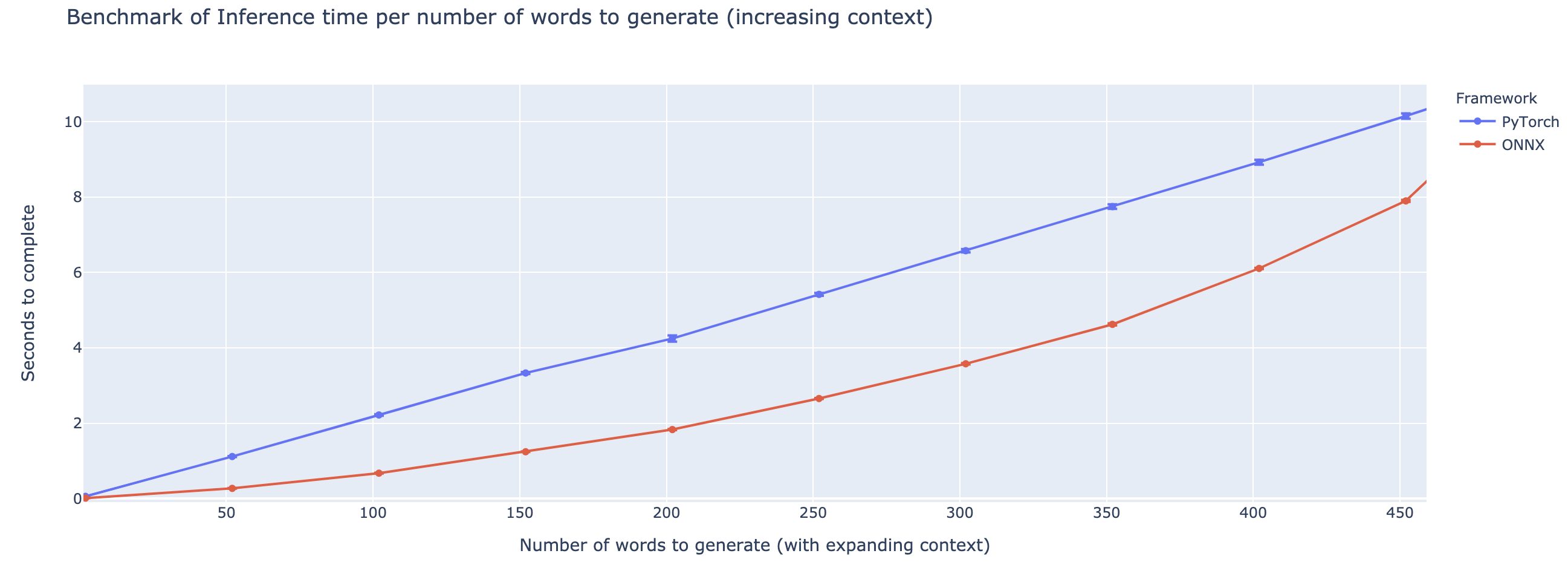
The outperformance varies heavily based on the length of the context. For contexts less than ~500 words, ONNX outperforms greatly, going up to a 4X speedup compared to PyTorch. However, the longer the context, the smaller the speedup of ONNX, with Pytorch being faster above 500 words.

GPU Benchmark, Embedding Task

Benchmark Embedding

GPU Benchmark, Generation Task

Benchmark Generation

Contributing

The project is still in its infancy, so I would love your feedback, to know what problems you are trying to solve, hear issues you're encountering, and discuss features that would help you. Therefore feel free to shoot me an e-mail (see my profile for the address!) or join our slack community.

Acknowledgements

This repo is based on the work of Colin Raffel and Noam Shazeer and Adam Roberts and Katherine Lee and Sharan Narang and Michael Matena and Yanqi Zhou and Wei Li and Peter J. Liu from Google, as well as the implementation of T5 from the huggingface team, the work of the Microsoft ONNX and onnxruntime teams, in particular Tianlei Wu, and the work of Thomas Wolf on generation of text.

Original T5 Paper

@article{2019t5,
  author = {Colin Raffel and Noam Shazeer and Adam Roberts and Katherine Lee and Sharan Narang and Michael Matena and Yanqi Zhou and Wei Li and Peter J. Liu},
  title = {Exploring the Limits of Transfer Learning with a Unified Text-to-Text Transformer},
  journal = {arXiv e-prints},
  year = {2019},
  archivePrefix = {arXiv},
  eprint = {1910.10683},
}

Microsoft onnxruntime repo

HuggingFace implementation of T5

Comments
  •  Given model could not be parsed while creating inference session. Error message: Protobuf parsing failed.

    Given model could not be parsed while creating inference session. Error message: Protobuf parsing failed.

    Hi there, I've run a guide code and it doesn't work. image I'm getting an error on the following line, decoder_sess, encoder_sess, tokenizer = get_encoder_decoder_tokenizer()

    image text is a text from Wikipedia about cars.

    onnxt5==0.1.4 protobuf==3.6.0 python==3.7

    opened by vladislavkoz 6
  • Default T5 summary contains <extra_id_2>.<extra_id_3>.<extra_id_4>

    Default T5 summary contains ..

    <extra_id_0> the company<extra_id_1> the company<extra_id_2>.<extra_id_3>.<extra_id_4>.<extra_id_5>.<extra_id_6>. <extra_id_7>.

    Do I need some postprocessing? Or it is an issue?

    opened by vladislavkoz 5
  • int() argument must be a string , when running exemple.

    int() argument must be a string , when running exemple.

    Hello , i can't run the first exemple ,

    from onnxt5 import GenerativeT5
    from onnxt5.api import get_encoder_decoder_tokenizer
    
    decoder_sess, encoder_sess, tokenizer = get_encoder_decoder_tokenizer()
    generative_t5 = GenerativeT5(encoder_sess, decoder_sess, tokenizer, onnx=True)
    prompt = 'translate English to French: I was a victim of a series of accidents.'
    
    output_text, output_logits = generative_t5(prompt, max_length=100, temperature=0.)
     # output_text: "J'ai été victime d'une série d'accidents." 
    

    the model begin calculation but before End, i have this error :

    TypeError                                 Traceback (most recent call last)
    <ipython-input-1-257f12b63043> in <module>
          5 prompt = 'translate English to French: I was a victim of a series of accidents.'
          6 
    ----> 7 output_text, output_logits = generative_t5(prompt, max_length=16, temperature=0.)
          8 # output_text: "J'ai été victime d'une série d'accidents."
    
    ~\Anaconda3\envs\onnxt5\lib\site-packages\torch\nn\modules\module.py in _call_impl(self, *input, **kwargs)
        720             result = self._slow_forward(*input, **kwargs)
        721         else:
    --> 722             result = self.forward(*input, **kwargs)
        723         for hook in itertools.chain(
        724                 _global_forward_hooks.values(),
    
    ~\Anaconda3\envs\onnxt5\lib\site-packages\onnxt5\models.py in forward(self, prompt, max_length, temperature, repetition_penalty, top_k, top_p, max_context_length)
        145                 new_tokens.append(next_token)
        146 
    --> 147             return self.tokenizer.decode(new_tokens), new_logits
    
    ~\Anaconda3\envs\onnxt5\lib\site-packages\transformers\tokenization_utils_base.py in decode(self, token_ids, skip_special_tokens, clean_up_tokenization_spaces, **kwargs)
       3000             skip_special_tokens=skip_special_tokens,
       3001             clean_up_tokenization_spaces=clean_up_tokenization_spaces,
    -> 3002             **kwargs,
       3003         )
       3004 
    
    ~\Anaconda3\envs\onnxt5\lib\site-packages\transformers\tokenization_utils.py in _decode(self, token_ids, skip_special_tokens, clean_up_tokenization_spaces, spaces_between_special_tokens)
        730         spaces_between_special_tokens: bool = True,
        731     ) -> str:
    --> 732         filtered_tokens = self.convert_ids_to_tokens(token_ids, skip_special_tokens=skip_special_tokens)
        733 
        734         # To avoid mixing byte-level and unicode for byte-level BPT
    
    ~\Anaconda3\envs\onnxt5\lib\site-packages\transformers\tokenization_utils.py in convert_ids_to_tokens(self, ids, skip_special_tokens)
        708         tokens = []
        709         for index in ids:
    --> 710             index = int(index)
        711             if skip_special_tokens and index in self.all_special_ids:
        712                 continue
    
    TypeError: int() argument must be a string, a bytes-like object or a number, not 'list
    

    `

    and i have no idea how to find solution , if you have any solution !? thx !

    opened by AZE38 3
  • Inference time on gpu vs onnxt5-gpu

    Inference time on gpu vs onnxt5-gpu

    @abelriboulot , @Ki6an , @brymck .
    I have finetuned t5 model for paraphrasing task like this: Paraphrase with t5

    I want to reduce inference time, so I exported finetuned t5 model using onnxt5, here I get time taken more in case where I use onnx model on gpu than pytorch model on gpu.

    gpu: time taken = 0.2357314471155405 time taken = 0.24958523781970143 time taken = 0.20342689706012607 time taken = 0.5490081580355763 time taken = 0.10756197292357683

    onnxt5-gpu time taken = 0.5277913622558117 time taken = 0.6335883080027997 time taken = 0.6975196991115808 time taken = 1.9159171842038631 time taken = 0.7938353712670505

    Did I make mistake in exporting/loading model ? gpu code onnxt5-gpu code

    opened by priyanksonis 1
  • Add progress bar

    Add progress bar

    This adds a progress bar using tqdm.

    The files this library downloads are about 500 MB in size, so I'd like to have some feedback on what's happening. Originally I wasn't clear what was the cause of the delay when running get_encoder_decoder_tokenizer.

    opened by brymck 0
  • Add download progress bar

    Add download progress bar

    This adds a progress bar using tqdm.

    The files this library downloads are about 500 MB in size, so I'd like to have some feedback on what's happening. Originally I wasn't clear what was the cause of the delay when running get_encoder_decoder_tokenizer.

    opened by brymck 0
  • CVE-2007-4559 Patch

    CVE-2007-4559 Patch

    Patching CVE-2007-4559

    Hi, we are security researchers from the Advanced Research Center at Trellix. We have began a campaign to patch a widespread bug named CVE-2007-4559. CVE-2007-4559 is a 15 year old bug in the Python tarfile package. By using extract() or extractall() on a tarfile object without sanitizing input, a maliciously crafted .tar file could perform a directory path traversal attack. We found at least one unsantized extractall() in your codebase and are providing a patch for you via pull request. The patch essentially checks to see if all tarfile members will be extracted safely and throws an exception otherwise. We encourage you to use this patch or your own solution to secure against CVE-2007-4559. Further technical information about the vulnerability can be found in this blog.

    If you have further questions you may contact us through this projects lead researcher Kasimir Schulz.

    opened by TrellixVulnTeam 0
  • Add dtype to new_tokens tensor to avoid an error when decoding

    Add dtype to new_tokens tensor to avoid an error when decoding

    Thanks for the repo!

    I was having an error message come up when running the code after my initial install.

    Small code example:

    import os
    
    import torch
    from onnxt5 import GenerativeT5
    from onnxt5.api import get_sess
    from transformers import AutoTokenizer
    
    model_dir = <path-to-tokenizer-and-onnx-files>
    model_name = <name-of-model>
    
    tokenizer = AutoTokenizer.from_pretrained(
        model_dir,
    )
    
    decoder_sess, encoder_sess = get_sess(
        os.path.join(model_dir, model_name)
    )
    
    model = GenerativeT5(
        encoder_sess,
        decoder_sess,
        tokenizer,
        onnx=True,
        cuda=torch.cuda.is_available(),
    )
    
    sentences = [
        "I has good grammar.",
        "I have bettr grammur."
    ]
    
    corrected_sentences = [
        model(f"grammar: {sentence}",
              max_length=512,
              temperature=1,
              )[0]
        for sentence in sentences
    ]


    The error

    Traceback (most recent call last):
      File "/Users/jamiebrandon/Code/inferentia-test/onnx_example/compiled-t5-base-grammar-correction/code/inference.py", line 133, in <module>
        main()
      File "/Users/jamiebrandon/Code/inferentia-test/onnx_example/compiled-t5-base-grammar-correction/code/inference.py", line 125, in main
        prediction_output = predict_fn(input_data=input_tokens,
      File "/Users/jamiebrandon/Code/inferentia-test/onnx_example/compiled-t5-base-grammar-correction/code/inference.py", line 95, in predict_fn
        corrected_sentences = [model(f"grammar: {sentence}",
      File "/Users/jamiebrandon/Code/inferentia-test/onnx_example/compiled-t5-base-grammar-correction/code/inference.py", line 95, in <listcomp>
        corrected_sentences = [model(f"grammar: {sentence}",
      File "/Users/jamiebrandon/Code/inferentia-test/venv/lib/python3.9/site-packages/torch/nn/modules/module.py", line 1130, in _call_impl
        return forward_call(*input, **kwargs)
      File "/Users/jamiebrandon/Code/inferentia-test/onnx_example/compiled-t5-base-grammar-correction/onnxt5/onnxt5/models.py", line 154, in forward
        return self.tokenizer.decode(new_tokens), new_logits
      File "/Users/jamiebrandon/Code/inferentia-test/venv/lib/python3.9/site-packages/transformers/tokenization_utils_base.py", line 3367, in decode
        return self._decode(
      File "/Users/jamiebrandon/Code/inferentia-test/venv/lib/python3.9/site-packages/transformers/tokenization_utils_fast.py", line 548, in _decode
        text = self._tokenizer.decode(token_ids, skip_special_tokens=skip_special_tokens)
    TypeError: 'float' object cannot be interpreted as an integer
    

    It seems the tensor for new tokens is of type float instead of long. Adding dtype=torch.long to the instantiation of the tensor resolved my issue, so I thought I'd share.

    opened by jambran 0
  • Running example

    Running example "export_pretrained_model.py" as-is fails (See details)

    86%|████████▌ | 18/21 [00:00<00:00, 44.29it/s]
    ---------------------------------------------------------------------------
    TypeError                                 Traceback (most recent call last)
    <ipython-input-4-f543e3365977> in <module>()
         27 # Generating text
         28 generative_t5 = GenerativeT5(encoder_sess, decoder_sess, tokenizer, onnx=True)
    ---> 29 generative_t5('translate English to French: I was a victim of a series of accidents.', 21, temperature=0.)[0]
    
    3 frames
    /usr/local/lib/python3.7/dist-packages/transformers/tokenization_utils_fast.py in _decode(self, token_ids, skip_special_tokens, clean_up_tokenization_spaces, **kwargs)
        505         if isinstance(token_ids, int):
        506             token_ids = [token_ids]
    --> 507         text = self._tokenizer.decode(token_ids, skip_special_tokens=skip_special_tokens)
        508 
        509         if clean_up_tokenization_spaces:
    
    TypeError: 'float' object cannot be interpreted as an integer
    

    Any possible version conflicts that you know of?

    opened by PrithivirajDamodaran 2
  • How to suppress output

    How to suppress output

    How to suppress output? Setting verbosity logging level does nothing 5%|█████████▊ | 16/300 [00:01<00:18, 15.65it/s]

    opened by 127 0
  • Can this model suitable for multilingual-t5 accelerate?

    Can this model suitable for multilingual-t5 accelerate?

    Recently, I use the chinese function of multilingual-t5 model to accomplish the Chinese NLG tasks. However, the inference speed might be slow, could this model be used for multilingual-t5? How can I do?

    opened by williamwong91 2
Releases(0.1.9)
Owner
Abel
Repentant portfolio manager, turned data scientist. I'm one Vonnegut quote away from figuring out this whole life thing.
Abel
DELTA is a deep learning based natural language and speech processing platform.

DELTA - A DEep learning Language Technology plAtform What is DELTA? DELTA is a deep learning based end-to-end natural language and speech processing p

DELTA 1.5k Dec 26, 2022
Pipeline for fast building text classification TF-IDF + LogReg baselines.

Text Classification Baseline Pipeline for fast building text classification TF-IDF + LogReg baselines. Usage Instead of writing custom code for specif

Dani El-Ayyass 57 Dec 07, 2022
🤗 Transformers: State-of-the-art Machine Learning for Pytorch, TensorFlow, and JAX.

English | 简体中文 | 繁體中文 | 한국어 State-of-the-art Machine Learning for JAX, PyTorch and TensorFlow 🤗 Transformers provides thousands of pretrained models

Hugging Face 77.1k Dec 31, 2022
Text Normalization(文本正则化)

Text Normalization(文本正则化) 任务描述:通过机器学习算法将英文文本的“手写”形式转换成“口语“形式,例如“6ft”转换成“six feet”等 实验结果 XGBoost + bag-of-words: 0.99159 XGBoost+Weights+rules:0.99002

Jason_Zhang 0 Feb 26, 2022
Unet-TTS: Improving Unseen Speaker and Style Transfer in One-shot Voice Cloning

Unet-TTS: Improving Unseen Speaker and Style Transfer in One-shot Voice Cloning English | 中文 ❗ Now we provide inferencing code and pre-training models

164 Jan 02, 2023
Code for the paper PermuteFormer

PermuteFormer This repo includes codes for the paper PermuteFormer: Efficient Relative Position Encoding for Long Sequences. Directory long_range_aren

Peng Chen 42 Mar 16, 2022
Klexikon: A German Dataset for Joint Summarization and Simplification

Klexikon: A German Dataset for Joint Summarization and Simplification Dennis Aumiller and Michael Gertz Heidelberg University Under submission at LREC

Dennis Aumiller 8 Jan 03, 2023
An Analysis Toolkit for Natural Language Generation (Translation, Captioning, Summarization, etc.)

VizSeq is a Python toolkit for visual analysis on text generation tasks like machine translation, summarization, image captioning, speech translation

Facebook Research 409 Oct 28, 2022
ELECTRA: Pre-training Text Encoders as Discriminators Rather Than Generators

ELECTRA Introduction ELECTRA is a method for self-supervised language representation learning. It can be used to pre-train transformer networks using

Google Research 2.1k Dec 28, 2022
Contains links to publicly available datasets for modeling health outcomes using speech and language.

speech-nlp-datasets Contains links to publicly available datasets for modeling various health outcomes using speech and language. Speech-based Corpora

Tuka Alhanai 77 Dec 07, 2022
Meta learning algorithms to train cross-lingual NLI (multi-task) models

Meta learning algorithms to train cross-lingual NLI (multi-task) models

M.Hassan Mojab 4 Nov 20, 2022
The first online catalogue for Arabic NLP datasets.

Masader The first online catalogue for Arabic NLP datasets. This catalogue contains 200 datasets with more than 25 metadata annotations for each datas

ARBML 94 Dec 26, 2022
Convolutional Neural Networks for Sentence Classification

Convolutional Neural Networks for Sentence Classification Code for the paper Convolutional Neural Networks for Sentence Classification (EMNLP 2014). R

Yoon Kim 2k Jan 02, 2023
Mycroft Core, the Mycroft Artificial Intelligence platform.

Mycroft Mycroft is a hackable open source voice assistant. Table of Contents Getting Started Running Mycroft Using Mycroft Home Device and Account Man

Mycroft 6.1k Jan 09, 2023
A linter to manage all your python exceptions and try/except blocks (limited only for those who like dinosaurs).

Manage your exceptions in Python like a PRO Currently in BETA. Inspired by this blog post. I shared the building process of this tool here. “For those

Guilherme Latrova 353 Dec 31, 2022
Implementation / replication of DALL-E, OpenAI's Text to Image Transformer, in Pytorch

Implementation / replication of DALL-E, OpenAI's Text to Image Transformer, in Pytorch

Phil Wang 5k Jan 02, 2023
Implemented shortest-circuit disambiguation, maximum probability disambiguation, HMM-based lexical annotation and BiLSTM+CRF-based named entity recognition

Implemented shortest-circuit disambiguation, maximum probability disambiguation, HMM-based lexical annotation and BiLSTM+CRF-based named entity recognition

0 Feb 13, 2022
Random Directed Acyclic Graph Generator

DAG_Generator Random Directed Acyclic Graph Generator verison1.0 简介 工作流通常由DAG(有向无环图)来定义,其中每个计算任务$T_i$由一个顶点(node,task,vertex)表示。同时,任务之间的每个数据或控制依赖性由一条加权

Livion 17 Dec 27, 2022
Python library for parsing resumes using natural language processing and machine learning

CVParser Python library for parsing resumes using natural language processing and machine learning. Setup Installation on Linux and Mac OS Follow the

nafiu 0 Jul 29, 2021
SimCTG - A Contrastive Framework for Neural Text Generation

A Contrastive Framework for Neural Text Generation Authors: Yixuan Su, Tian Lan,

Yixuan Su 345 Jan 03, 2023