Convert tables stored as images to an usable .csv file

Overview

Convert an image of numbers to a .csv file

This Python program aims to convert images of array numbers to corresponding .csv files. It uses OpenCV for Python to process the given image and Tesseract for number recognition.
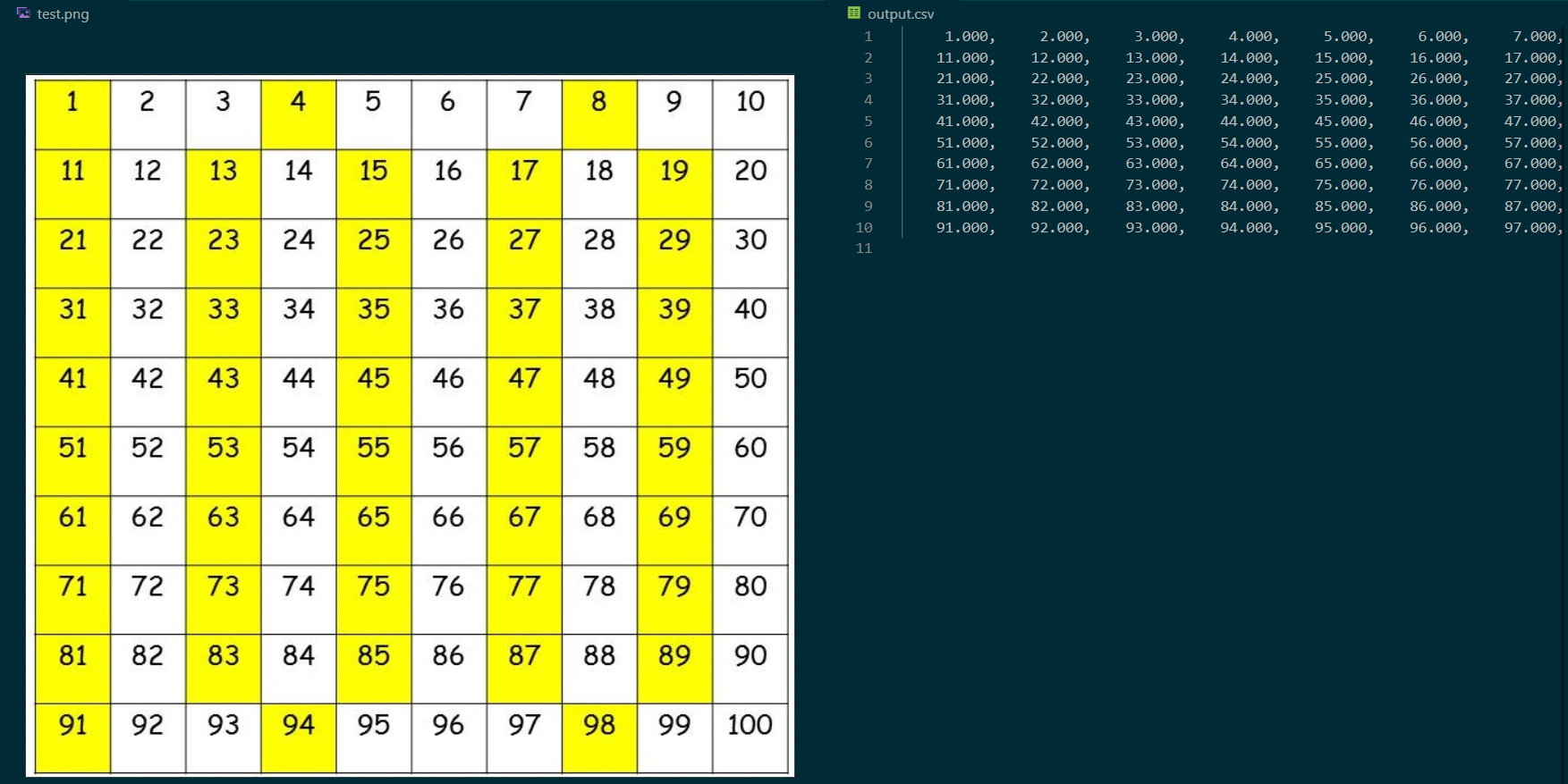
Output Example

The repository includes:

  • the source code of image2csv.py,
  • the tools.py file where useful functions are implemented,
  • the grid_detector.py file to perform automatic grid detection,
  • a folder with some files used for test.

The code is not well documented nor fully efficient as I'm a beginner in programming, and this project is a way for me to improve my skills, in particular in Python programming.

How to use the program

First of all, the user must install the needed packages:

$ pip install -r requirements.txt   

as well as Tesseract.

Then, in a python terminal, use the command line:

$ python image2csv.py --image path/to/image

There are a few optionnal arguments:

  • --path path/to/output/csv/file
  • --grid [False]/True
  • --visualization [y]/n
  • --method [fast]/denoize

and one can find their usage using the command line:

$ python image2csv.py --help

By default, the program will try to detect a grid automatically. This detection uses OpenCV's Hough transformation and Canny detection, so the user can tweak a few parameters for better processing in the grid_detector.py file.

When then program is running with manual grid detection, the user has to interact with it via its mouse and the terminal :

  1. the image is opened in a window for the user to draw a rectangle around the first (top left) number. As this rectangle is used as a base to create a grid afterward, keep in mind that all the numbers should fit into the box.
  2. A new window is opened showing the image with the drawn rectangle. Press any key to close and continue.
  3. Based on the drawn rectangle, a grid is created to extract each number one by one. This grid is controlled by the user via two "offset" values. The user has to enter those values in the terminal, then the image is opened in a window with the created grid. Press any key to close and continue. If the numbers does not fit into the grid, the user can change the offset values and repeat this step. When the grid matches the user's expectations, he can set both of the offset values to 0 to continue.
  4. The numbers are extracted from the image and the results are shown in the terminal. (be carefoul though, the indicated number of errors represents the number of errors encountered by Tesseract, but Tesseract can identify a wrong number which will not be counted as an error !)
  5. The .csv file is created with the numbers identified by Tesseract. If Tesseract finds an error, it will show up on the .csv file as an infinite value.

Hypothesis and limits

For the program to run correctly, the input image must verify some hypothesis (just a few simple ones):

  • for manual selection, the line and row width must be constants, as the build grid is just a repetition of the initial rectangle with offsets;
  • to use automatic grid detection, a full and clear grid, with external borders, must be visible;
  • it is recommended to have a good input image resolution, to control the offsets more easily.

At last, this program is not perfect (I know you thought so, with its smooth workflow and simple hypothesis, sorry to disappoint...) and does not work with decimal numbers... But does a great job on negatives ! Also the user must be careful with the slashed zero which seems to be identified by Tesseract as a six.

Credits

For image pre-processing in the tool.py file I used a useful function implemented by @Nitish9711 for his Automatic-Number-plate-detection (https://github.com/Nitish9711/Automatic-Number-plate-detection.git).

Owner
Beginning in the programming world with the help of @29jm, holy builder of the very special SnowflakeOS. Student at the École Centrale de Lille (FR).
Python script for transferring data between three drives in two separate stages

Waterlock Waterlock is a Python script meant for incrementally transferring data between three folder locations in two separate stages. It performs ha

David Swanlund 13 Nov 10, 2021
Using Python to derive insights on particular Pokemon, Types, Generations, and Stats

Pokémon Analysis Andreas Nikolaidis February 2022 Introduction Exploratory Analysis Correlations & Descriptive Statistics Principal Component Analysis

Andreas 1 Feb 18, 2022
Functional tensors for probabilistic programming

Funsor Funsor is a tensor-like library for functions and distributions. See Functional tensors for probabilistic programming for a system description.

208 Dec 29, 2022
A program that uses an API and a AI model to get info of sotcks

Stock-Market-AI-Analysis I dont mind anyone using this code but please give me credit A program that uses an API and a AI model to get info of stocks

1 Dec 17, 2021
Additional tools for particle accelerator data analysis and machine information

PyLHC Tools This package is a collection of useful scripts and tools for the Optics Measurements and Corrections group (OMC) at CERN. Documentation Au

PyLHC 3 Apr 13, 2022
VHub - An API that permits uploading of vulnerability datasets and return of the serialized data

VHub - An API that permits uploading of vulnerability datasets and return of the serialized data

André Rodrigues 2 Feb 14, 2022
Vaex library for Big Data Analytics of an Airline dataset

Vaex-Big-Data-Analytics-for-Airline-data A Python notebook (ipynb) created in Jupyter Notebook, which utilizes the Vaex library for Big Data Analytics

Nikolas Petrou 1 Feb 13, 2022
Geospatial data-science analysis on reasons behind delay in Grab ride-share services

Grab x Pulis Detailed analysis done to investigate possible reasons for delay in Grab services for NUS Data Analytics Competition 2022, to be found in

Keng Hwee 6 Jun 07, 2022
OpenDrift is a software for modeling the trajectories and fate of objects or substances drifting in the ocean, or even in the atmosphere.

opendrift OpenDrift is a software for modeling the trajectories and fate of objects or substances drifting in the ocean, or even in the atmosphere. Do

OpenDrift 167 Dec 13, 2022
Extract data from a wide range of Internet sources into a pandas DataFrame.

pandas-datareader Up to date remote data access for pandas, works for multiple versions of pandas. Installation Install using pip pip install pandas-d

Python for Data 2.5k Jan 09, 2023
DenseClus is a Python module for clustering mixed type data using UMAP and HDBSCAN

DenseClus is a Python module for clustering mixed type data using UMAP and HDBSCAN. Allowing for both categorical and numerical data, DenseClus makes it possible to incorporate all features in cluste

Amazon Web Services - Labs 53 Dec 08, 2022
The Master's in Data Science Program run by the Faculty of Mathematics and Information Science

The Master's in Data Science Program run by the Faculty of Mathematics and Information Science is among the first European programs in Data Science and is fully focused on data engineering and data a

Amir Ali 2 Jun 17, 2022
🌍 Create 3d-printable STLs from satellite elevation data 🌏

mapa 🌍 Create 3d-printable STLs from satellite elevation data Installation pip install mapa Usage mapa uses numpy and numba under the hood to crunch

Fabian Gebhart 13 Dec 15, 2022
Meltano: ELT for the DataOps era. Meltano is open source, self-hosted, CLI-first, debuggable, and extensible.

Meltano is open source, self-hosted, CLI-first, debuggable, and extensible. Pipelines are code, ready to be version c

Meltano 625 Jan 02, 2023
Feature Detection Based Template Matching

Feature Detection Based Template Matching The classification of the photos was made using the OpenCv template Matching method. Installation Use the pa

Muhammet Erem 2 Nov 18, 2021
pyETT: Python library for Eleven VR Table Tennis data

pyETT: Python library for Eleven VR Table Tennis data Documentation Documentation for pyETT is located at https://pyett.readthedocs.io/. Installation

Tharsis Souza 5 Nov 19, 2022
This repo contains a simple but effective tool made using python which can be used for quality control in statistical approach.

📈 Statistical Quality Control 📉 This repo contains a simple but effective tool made using python which can be used for quality control in statistica

SasiVatsal 8 Oct 18, 2022
Synthetic data need to preserve the statistical properties of real data in terms of their individual behavior and (inter-)dependences

Synthetic data need to preserve the statistical properties of real data in terms of their individual behavior and (inter-)dependences. Copula and functional Principle Component Analysis (fPCA) are st

32 Dec 20, 2022
Python Package for DataHerb: create, search, and load datasets.

The Python Package for DataHerb A DataHerb Core Service to Create and Load Datasets.

DataHerb 4 Feb 11, 2022
Python Implementation of Scalable In-Memory Updatable Bitmap Indexing

PyUpBit CS490 Large Scale Data Analytics — Implementation of Updatable Compressed Bitmap Indexing Paper Table of Contents About The Project Usage Cont

Hyeong Kyun (Daniel) Park 1 Jun 28, 2022