A PyTorch implementation of "Predict then Propagate: Graph Neural Networks meet Personalized PageRank" (ICLR 2019).

Overview

APPNP

Arxiv codebeat badge repo sizebenedekrozemberczki

A PyTorch implementation of Predict then Propagate: Graph Neural Networks meet Personalized PageRank (ICLR 2019).


Abstract

Neural message passing algorithms for semi-supervised classification on graphs have recently achieved great success. However, these methods only consider nodes that are a few propagation steps away and the size of this utilized neighborhood cannot be easily extended. In this paper, we use the relationship between graph convolutional networks (GCN) and PageRank to derive an improved propagation scheme based on personalized PageRank. We utilize this propagation procedure to construct personalized propagation of neural predictions (PPNP) and its approximation, APPNP. Our model's training time is on par or faster and its number of parameters on par or lower than previous models. It leverages a large, adjustable neighborhood for classification and can be combined with any neural network. We show that this model outperforms several recently proposed methods for semi-supervised classification on multiple graphs in the most thorough study done so far for GCN-like models.

A PyTorch and Tensorflow implementation is awailable [here.].

This repository provides a PyTorch implementation of PPNP and APPNP as described in the paper:

Predict then Propagate: Graph Neural Networks meet Personalized PageRank. Johannes Klicpera, Aleksandar Bojchevski, Stephan Günnemann. ICLR, 2019. [Paper]

Requirements

The codebase is implemented in Python 3.5.2. package versions used for development are just below.

networkx          2.4
tqdm              4.28.1
numpy             1.15.4
pandas            0.23.4
texttable         1.5.0
scipy             1.1.0
argparse          1.1.0
torch             1.1.0
torch-scatter     1.4.0
torch-sparse      0.4.3
torch-cluster     1.4.5
torch-geometric   1.3.2
torchvision       0.3.0

Datasets

The code takes the **edge list** of the graph in a csv file. Every row indicates an edge between two nodes separated by a comma. The first row is a header. Nodes should be indexed starting with 0. A sample graph for `Cora` is included in the `input/` directory. In addition to the edgelist there is a JSON file with the sparse features and a csv with the target variable.

The **feature matrix** is a sparse binary one it is stored as a json. Nodes are keys of the json and feature indices are the values. For each node feature column ids are stored as elements of a list. The feature matrix is structured as:

{ 0: [0, 1, 38, 1968, 2000, 52727],
  1: [10000, 20, 3],
  2: [],
  ...
  n: [2018, 10000]}

The target vector is a csv with two columns and headers, the first contains the node identifiers the second the targets. This csv is sorted by node identifiers and the target column contains the class meberships indexed from zero.

NODE ID Target
0 3
1 1
2 0
3 1
... ...
n 3

Options

Training an APPNP/PPNP model is handled by the src/main.py script which provides the following command line arguments.

Input and output options

  --edge-path       STR    Edge list csv.         Default is `input/cora_edges.csv`.
  --features-path   STR    Features json.         Default is `input/cora_features.json`.
  --target-path     STR    Target classes csv.    Default is `input/cora_target.csv`.

Model options

  --seed              INT     Random seed.                   Defailt is 42.
  --model             STR     Model exact or approximate.    Default is `exact`.
  --iterations        INT     APP iterations.                Default is 10.
  --alpha             FLOAT   Teleport parameter.            Default is 0.1
  --epochs            INT     Number of training epochs.     Default is 2000.
  --early-stopping    INT     Early stopping rounds.         Default is 5.
  --training-size     INT     Training set size.             Default is 1500.
  --test-size         INT     Test set size.                 Default is 500.
  --learning-rate     FLOAT   Adam learning rate.            Default is 0.01
  --dropout           FLOAT   Dropout rate value.            Default is 0.5
  --lambd             FLOAT   Rgularization parameter.       Default is 0.005.
  --layers            LST     Layer sizes in first layers.   Default is [64, 64]. 

Examples

The following commands learn a neural network and score on the test set. Training a model on the default dataset.

python src/main.py

Training a PPNP model for a 100 epochs.

python src/main.py --epochs 100

Training an APPNP model.

python src/main.py --model approximate

Increasing the learning rate and the dropout.

python src/main.py --learning-rate 0.1 --dropout 0.9

License


You might also like...
A PyTorch implementation of SlowFast based on ICCV 2019 paper
A PyTorch implementation of SlowFast based on ICCV 2019 paper "SlowFast Networks for Video Recognition"

SlowFast A PyTorch implementation of SlowFast based on ICCV 2019 paper SlowFast Networks for Video Recognition. Requirements Anaconda PyTorch conda in

Unofficial PyTorch Implementation of AHDRNet (CVPR 2019)

AHDRNet-PyTorch This is the PyTorch implementation of Attention-guided Network for Ghost-free High Dynamic Range Imaging (CVPR 2019). The official cod

Implementation of Geometric Vector Perceptron, a simple circuit for 3d rotation equivariance for learning over large biomolecules, in Pytorch. Idea proposed and accepted at ICLR 2021

Geometric Vector Perceptron Implementation of Geometric Vector Perceptron, a simple circuit with 3d rotation equivariance for learning over large biom

Pytorch implementation of BRECQ, ICLR 2021

BRECQ Pytorch implementation of BRECQ, ICLR 2021 @inproceedings{ li&gong2021brecq, title={BRECQ: Pushing the Limit of Post-Training Quantization by Bl

Implementation of 'lightweight' GAN, proposed in ICLR 2021, in Pytorch. High resolution image generations that can be trained within a day or two

512x512 flowers after 12 hours of training, 1 gpu 256x256 flowers after 12 hours of training, 1 gpu Pizza 'Lightweight' GAN Implementation of 'lightwe

This repo contains the pytorch implementation for Dynamic Concept Learner (accepted by ICLR 2021).

DCL-PyTorch Pytorch implementation for the Dynamic Concept Learner (DCL). More details can be found at the project page. Framework Grounding Physical

An implementation demo of the ICLR 2021 paper Neural Attention Distillation: Erasing Backdoor Triggers from Deep Neural Networks in PyTorch.

Neural Attention Distillation This is an implementation demo of the ICLR 2021 paper Neural Attention Distillation: Erasing Backdoor Triggers from Deep

Official PyTorch implementation of
Official PyTorch implementation of "Rapid Neural Architecture Search by Learning to Generate Graphs from Datasets" (ICLR 2021)

Rapid Neural Architecture Search by Learning to Generate Graphs from Datasets This is the official PyTorch implementation for the paper Rapid Neural A

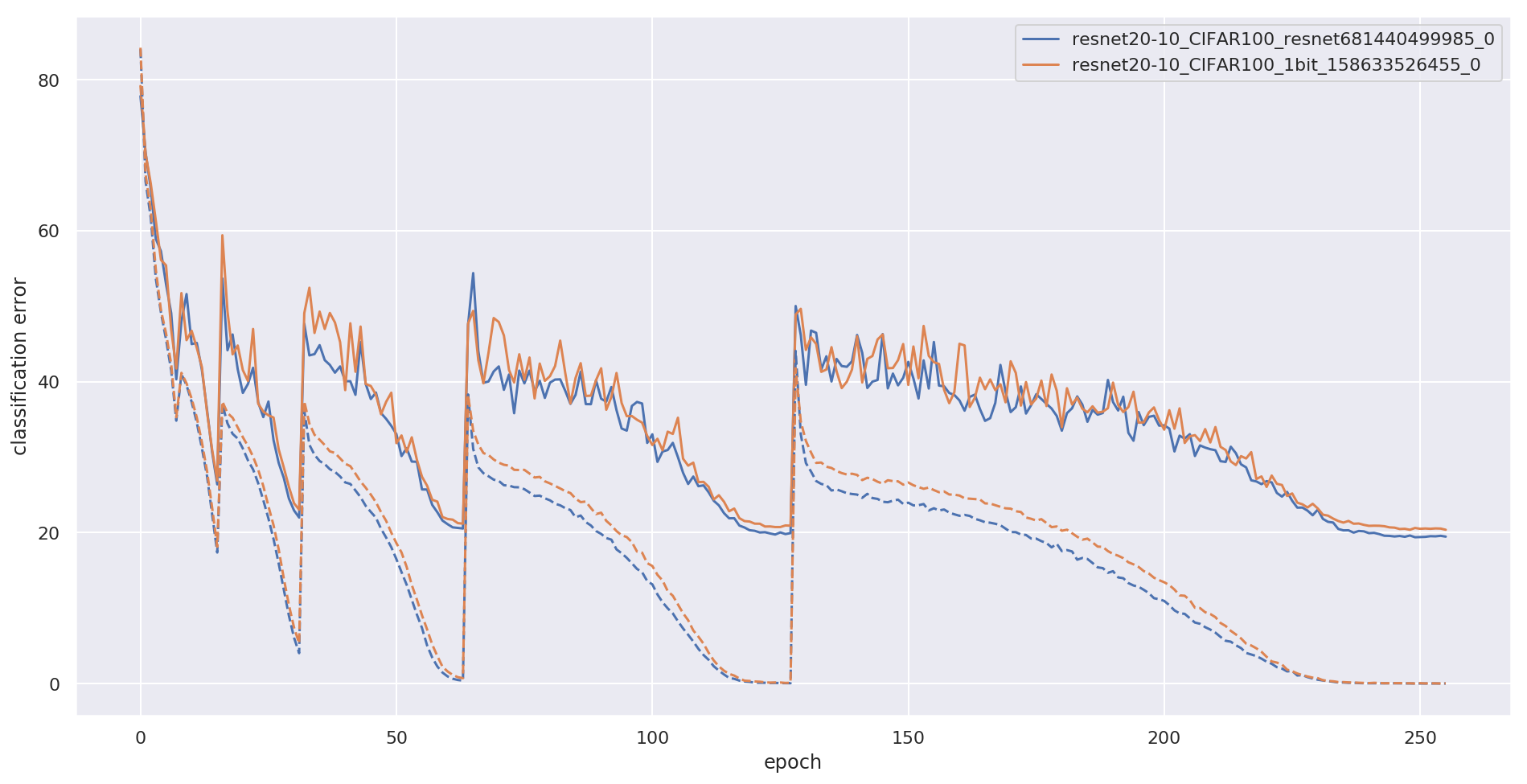
PyTorch implementation of Wide Residual Networks with 1-bit weights by McDonnell (ICLR 2018)

1-bit Wide ResNet PyTorch implementation of training 1-bit Wide ResNets from this paper: Training wide residual networks for deployment using a single

Comments
  • About training

    About training

    Hi, thanks for you sharing your nice work. I have a question when I run your code. Maybe I misunderstand the main point of this paper. It seems that when you train you model, you do not apply the graph information, which means your network is a normal fully connected network. After training, you apply PageRank to the output of the network when evaluate the model. Is my understanding correct?

    opened by Jianjin123 4
Releases(v_00001)
Owner
Benedek Rozemberczki
Machine Learning Engineer at AstraZeneca | PhD from The University of Edinburgh.
Benedek Rozemberczki
Audio Visual Emotion Recognition using TDA

Audio Visual Emotion Recognition using TDA RAVDESS database with two datasets analyzed: Video and Audio dataset: Audio-Dataset: https://www.kaggle.com

Combinatorial Image Analysis research group 3 May 11, 2022
基于YoloX目标检测+DeepSort算法实现多目标追踪Baseline

项目简介: 使用YOLOX+Deepsort实现车辆行人追踪和计数,代码封装成一个Detector类,更容易嵌入到自己的项目中。 代码地址(欢迎star): https://github.com/Sharpiless/yolox-deepsort/ 最终效果: 运行demo: python demo

114 Dec 30, 2022
Official codebase for Legged Robots that Keep on Learning: Fine-Tuning Locomotion Policies in the Real World

Legged Robots that Keep on Learning Official codebase for Legged Robots that Keep on Learning: Fine-Tuning Locomotion Policies in the Real World, whic

Laura Smith 70 Dec 07, 2022
No-Reference Image Quality Assessment via Transformers, Relative Ranking, and Self-Consistency

This repository contains the implementation for the paper: No-Reference Image Quality Assessment via Transformers, Relative Ranking, and Self-Consiste

Alireza Golestaneh 75 Dec 30, 2022
An efficient toolkit for Face Stylization based on the paper "AgileGAN: Stylizing Portraits by Inversion-Consistent Transfer Learning"

MMGEN-FaceStylor English | 简体中文 Introduction This repo is an efficient toolkit for Face Stylization based on the paper "AgileGAN: Stylizing Portraits

OpenMMLab 182 Dec 27, 2022
Predictive Modeling on Electronic Health Records(EHR) using Pytorch

Predictive Modeling on Electronic Health Records(EHR) using Pytorch Overview Although there are plenty of repos on vision and NLP models, there are ve

81 Jan 01, 2023
Implementation of Enformer, Deepmind's attention network for predicting gene expression, in Pytorch

Enformer - Pytorch (wip) Implementation of Enformer, Deepmind's attention network for predicting gene expression, in Pytorch. The original tensorflow

Phil Wang 235 Dec 27, 2022
PyTorch implementation of deep GRAph Contrastive rEpresentation learning (GRACE).

GRACE The official PyTorch implementation of deep GRAph Contrastive rEpresentation learning (GRACE). For a thorough resource collection of self-superv

Big Data and Multi-modal Computing Group, CRIPAC 186 Dec 27, 2022
Synthetic structured data generators

Join us on What is Synthetic Data? Synthetic data is artificially generated data that is not collected from real world events. It replicates the stati

YData 850 Jan 07, 2023
This repo holds code for TransUNet: Transformers Make Strong Encoders for Medical Image Segmentation

TransUNet This repo holds code for TransUNet: Transformers Make Strong Encoders for Medical Image Segmentation Usage

1.4k Jan 04, 2023
PyTorch implementation of the Deep SLDA method from our CVPRW-2020 paper "Lifelong Machine Learning with Deep Streaming Linear Discriminant Analysis"

Lifelong Machine Learning with Deep Streaming Linear Discriminant Analysis This is a PyTorch implementation of the Deep Streaming Linear Discriminant

Tyler Hayes 41 Dec 25, 2022
Code for our paper A Transformer-Based Feature Segmentation and Region Alignment Method For UAV-View Geo-Localization,

FSRA This repository contains the dataset link and the code for our paper A Transformer-Based Feature Segmentation and Region Alignment Method For UAV

Dmmm 32 Dec 18, 2022
a Lightweight library for sequential learning agents, including reinforcement learning

SaLinA: SaLinA - A Flexible and Simple Library for Learning Sequential Agents (including Reinforcement Learning) TL;DR salina is a lightweight library

Facebook Research 405 Dec 17, 2022
Pytorch implementation of XRD spectral identification from COD database

XRDidentifier Pytorch implementation of XRD spectral identification from COD database. Details will be explained in the paper to be submitted to NeurI

Masaki Adachi 4 Jan 07, 2023
Neural-PIL: Neural Pre-Integrated Lighting for Reflectance Decomposition - NeurIPS2021

Neural-PIL: Neural Pre-Integrated Lighting for Reflectance Decomposition Project Page | Video | Paper Implementation for Neural-PIL. A novel method wh

Computergraphics (University of Tübingen) 64 Dec 29, 2022
Facial Action Unit Intensity Estimation via Semantic Correspondence Learning with Dynamic Graph Convolution

FAU Implementation of the paper: Facial Action Unit Intensity Estimation via Semantic Correspondence Learning with Dynamic Graph Convolution. Yingruo

Evelyn 78 Nov 29, 2022
Advanced Signal Processing Notebooks and Tutorials

Advanced Digital Signal Processing Notebooks and Tutorials Prof. Dr. -Ing. Gerald Schuller Jupyter Notebooks and Videos: Renato Profeta Applied Media

Guitars.AI 115 Dec 13, 2022
An implementation demo of the ICLR 2021 paper Neural Attention Distillation: Erasing Backdoor Triggers from Deep Neural Networks in PyTorch.

Neural Attention Distillation This is an implementation demo of the ICLR 2021 paper Neural Attention Distillation: Erasing Backdoor Triggers from Deep

Yige-Li 84 Jan 04, 2023
Language models are open knowledge graphs ( non official implementation )

language-models-are-knowledge-graphs-pytorch Language models are open knowledge graphs ( work in progress ) A non official reimplementation of Languag

theblackcat102 132 Dec 18, 2022
KITTI-360 Annotation Tool is a framework that developed based on python(cherrypy + jinja2 + sqlite3) as the server end and javascript + WebGL as the front end.

KITTI-360 Annotation Tool is a framework that developed based on python(cherrypy + jinja2 + sqlite3) as the server end and javascript + WebGL as the front end.

86 Dec 12, 2022