A python library to build Model Trees with Linear Models at the leaves.

Overview

linear-tree

A python library to build Model Trees with Linear Models at the leaves.

Overview

Linear Model Trees combine the learning ability of Decision Tree with the predictive and explicative power of Linear Models. Like in tree-based algorithms, the data are split according to simple decision rules. The goodness of slits is evaluated in gain terms fitting Linear Models in the nodes. This implies that the models in the leaves are linear instead of constant approximations like in classical Decision Trees.

linear-tree is developed to be fully integrable with scikit-learn. LinearTreeRegressor and LinearTreeClassifier are provided as scikit-learn BaseEstimator. They are wrappers that build a decision tree on the data fitting a linear estimator from sklearn.linear_model. All the models available in sklearn.linear_model can be used as linear estimators.

Installation

pip install linear-tree

The module depends on NumPy, SciPy and Scikit-Learn (>=0.23.0). Python 3.6 or above is supported.

Media

Usage

Regression
from sklearn.linear_model import LinearRegression
from lineartree import LinearTreeRegressor
from sklearn.datasets import make_regression
X, y = make_regression(n_samples=100, n_features=4,
                       n_informative=2, n_targets=1,
                       random_state=0, shuffle=False)
regr = LinearTreeRegressor(base_estimator=LinearRegression())
regr.fit(X, y)
Classification
from sklearn.linear_model import RidgeClassifier
from lineartree import LinearTreeClassifier
from sklearn.datasets import make_classification
X, y = make_classification(n_samples=100, n_features=4,
                           n_informative=2, n_redundant=0,
                           random_state=0, shuffle=False)
clf = LinearTreeClassifier(base_estimator=RidgeClassifier())
clf.fit(X, y)

More examples in the notebooks folder.

Check the API Reference to see the parameter configurations and the available methods.

Examples

Show the model tree structure:
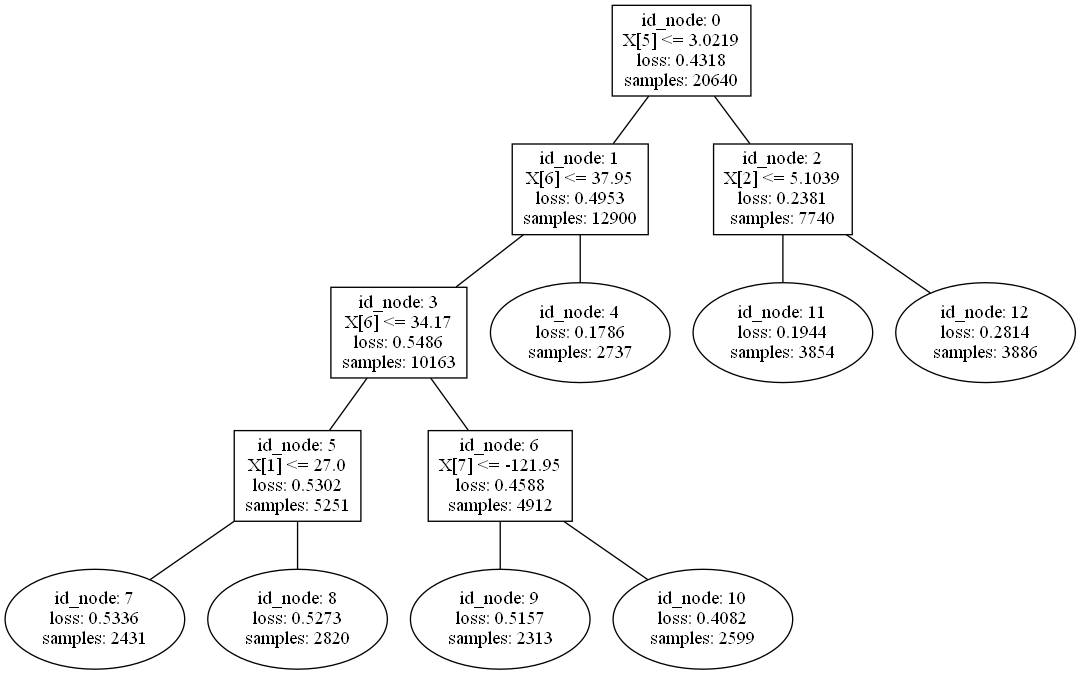
plot tree

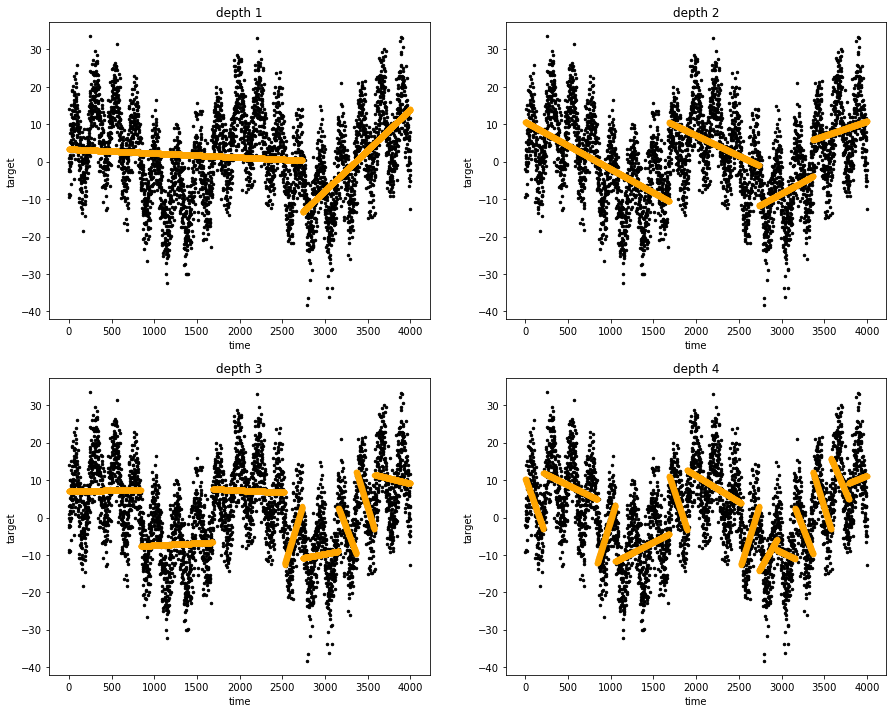
Linear Tree Regressor at work:

linear tree regressor

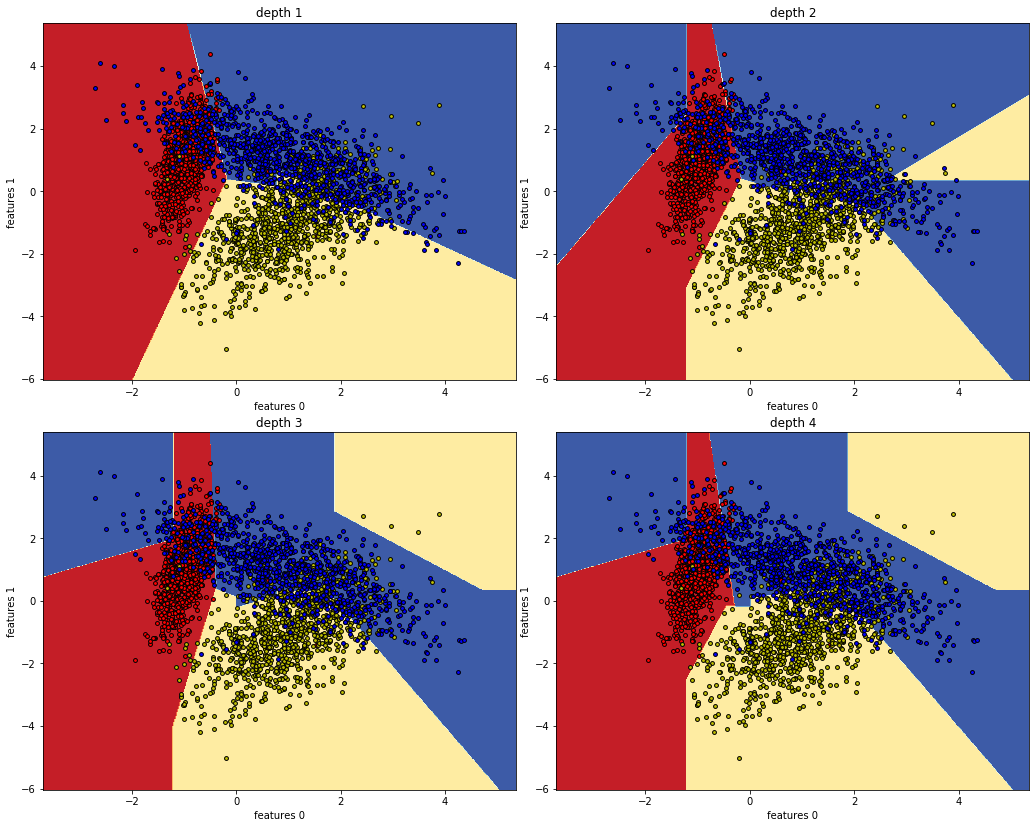
Linear Tree Classifier at work:

linear tree classifier

Extract and examine coefficients at the leaves:
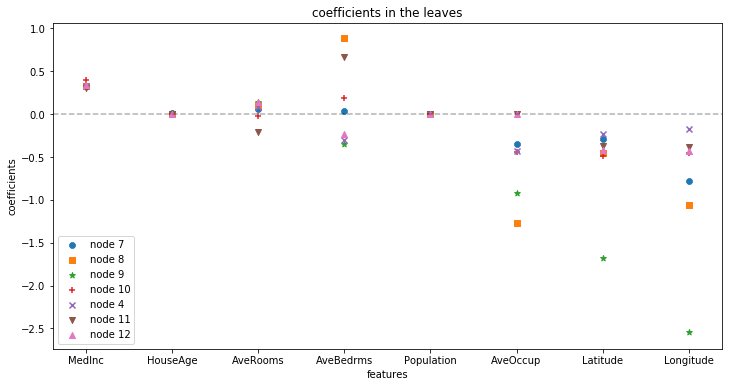
leaf coefficients

Comments
  • finding breakpoint

    finding breakpoint

    Hello,

    thank you for your nice tool. I am using the function LinearTreeRegressor to draw a continuous piecewise linear. It works well, I am wondering, is it possible to show the location (the coordinates) of the breakpoints?

    thank you

    opened by ZhengLiu1119 5
  • Allow the hyperparameter

    Allow the hyperparameter "max_depth = 0".

    Thanks for the good library.

    When using LinearTreeRegressor, I think that max_depth is often optimized by cross-validation.

    This library allows max_depth in the range 1-20. However, depending on the dataset, simple linear regression may be suitable. Even in such a dataset, max_depth is forced to be 1 or more, so Simple Linear Regression cannot be applied properly with LinearTreeRegressor.

    • Of course, it is appropriate to use sklearn.linear_model.LinearRegression for such datasets.

    My suggestion is to change to a program that uses base_estimator to perform regression when "max_depth = 0". With this change, LinearTreeRegressor can flexibly respond to both segmented regression and simple regression by changing hyperparameters.

    opened by jckkvs 4
  • Error when running with multiple jobs: unexpected keyword argument 'target_offload'

    Error when running with multiple jobs: unexpected keyword argument 'target_offload'

    I have been using your library for quite a while and am super happy with it. So first, thanks a lot!

    Lately, I used my framework (which also uses your library) on modern many core server with many jobs. Worked fine. Now I have updated everything via pip and with 8 jobs on my MacBook, I got the following error.

    This error does not occur when using only a single job (I pass the number of jobs to n_jobs).

    I cannot nail the down the actual problem, but since it occurred right after the upgrade, I assume this might be the reason?

    Am I doing something wrong here?

    """
    Traceback (most recent call last):
      File "/Users/martin/opt/anaconda3/lib/python3.7/site-packages/joblib/externals/loky/process_executor.py", line 436, in _process_worker
        r = call_item()
      File "/Users/martin/opt/anaconda3/lib/python3.7/site-packages/joblib/externals/loky/process_executor.py", line 288, in __call__
        return self.fn(*self.args, **self.kwargs)
      File "/Users/martin/opt/anaconda3/lib/python3.7/site-packages/joblib/_parallel_backends.py", line 595, in __call__
        return self.func(*args, **kwargs)
      File "/Users/martin/opt/anaconda3/lib/python3.7/site-packages/joblib/parallel.py", line 263, in __call__
        for func, args, kwargs in self.items]
      File "/Users/martin/opt/anaconda3/lib/python3.7/site-packages/joblib/parallel.py", line 263, in <listcomp>
        for func, args, kwargs in self.items]
      File "/Users/martin/opt/anaconda3/lib/python3.7/site-packages/lineartree/_classes.py", line 56, in __call__
        with config_context(**self.config):
      File "/Users/martin/opt/anaconda3/lib/python3.7/contextlib.py", line 239, in helper
        return _GeneratorContextManager(func, args, kwds)
      File "/Users/martin/opt/anaconda3/lib/python3.7/contextlib.py", line 82, in __init__
        self.gen = func(*args, **kwds)
    TypeError: config_context() got an unexpected keyword argument 'target_offload'
    """
    
    The above exception was the direct cause of the following exception:
    
    Traceback (most recent call last):
      File "compression_selection_pipeline.py", line 41, in <module>
        model_pipeline.learn_runtime_models(calibration_result_dir)
      File "/Users/martin/Programming/compression_selection_v3/hyrise_calibration/model_pipeline.py", line 670, in learn_runtime_models
        non_splitting_models("table_scan", table_scans)
      File "/Users/martin/Programming/compression_selection_v3/hyrise_calibration/model_pipeline.py", line 590, in non_splitting_models
        fitted_model = model_dict["model"].fit(X_train, y_train)
      File "/Users/martin/Programming/compression_selection_v3/hyrise_calibration/model_pipeline.py", line 209, in fit
        return self.regression.fit(X, y)
      File "/Users/martin/opt/anaconda3/lib/python3.7/site-packages/lineartree/lineartree.py", line 187, in fit
        self._fit(X, y, sample_weight)
      File "/Users/martin/opt/anaconda3/lib/python3.7/site-packages/lineartree/_classes.py", line 576, in _fit
        self._grow(X, y, sample_weight)
      File "/Users/martin/opt/anaconda3/lib/python3.7/site-packages/lineartree/_classes.py", line 387, in _grow
        loss=loss)
      File "/Users/martin/opt/anaconda3/lib/python3.7/site-packages/lineartree/_classes.py", line 285, in _split
        for feat in split_feat)
      File "/Users/martin/opt/anaconda3/lib/python3.7/site-packages/joblib/parallel.py", line 1056, in __call__
        self.retrieve()
      File "/Users/martin/opt/anaconda3/lib/python3.7/site-packages/joblib/parallel.py", line 935, in retrieve
        self._output.extend(job.get(timeout=self.timeout))
      File "/Users/martin/opt/anaconda3/lib/python3.7/site-packages/joblib/_parallel_backends.py", line 542, in wrap_future_result
        return future.result(timeout=timeout)
      File "/Users/martin/opt/anaconda3/lib/python3.7/concurrent/futures/_base.py", line 435, in result
        return self.__get_result()
      File "/Users/martin/opt/anaconda3/lib/python3.7/concurrent/futures/_base.py", line 384, in __get_result
        raise self._exception
    TypeError: config_context() got an unexpected keyword argument 'target_offload'
    

    PS: I have already left a star. :D

    opened by Bouncner 3
  • Option to specify features to use for splitting and for leaf models

    Option to specify features to use for splitting and for leaf models

    Added two additional parameters:

    • split_features: Indices of features that can be used for splitting. Default all.
    • linear_features: Indices of features that are used by the linear models in the leaves. Default all except for categorical features

    This implements a feature requested in https://github.com/cerlymarco/linear-tree/issues/2

    Potential performance improvement: Currently the code still computes bins for all features and not only for those used for splitting.

    opened by JonasRauch 3
  • Rationale for rounding during _parallel_binning_fit and _grow

    Rationale for rounding during _parallel_binning_fit and _grow

    I noticed that the implementations of _parallel_binning_fit and _grow internally round loss values to 5 decimal places. This makes the regression results dependent on the scale of the labels, as data with a lower natural loss value will result in many different splits of the data having the same loss when rounded to 5 decimal places. Is there a reason why this is the case?

    This behavior can be observed by fitting a LinearTreeRegressor using the default loss function and multiplying the scale of the labels by a small number (like 1e-9). This will result in the regressor no longer learning any splits.

    opened by session-id 2
  • ValueError: Invalid parameter linearforestregression for estimator Pipeline

    ValueError: Invalid parameter linearforestregression for estimator Pipeline

    Great work! I'm new to ML and stuck with this. I'm trying to combine pipeline and GridSearch to search for best possible hyperparameters for a model.

    image

    I got the following error:

    image

    Kindly help : )

    opened by NousMei 2
  • Performance and possibility to split only on subset of features

    Performance and possibility to split only on subset of features

    Hey, I have been playing around a lot with your linear trees. Like them very much. Thanks!

    Nevertheless, I am somewhat disappointed by the runtime performance. Compared to XGBoost Regressors (I know it's not a fair comparison) or linear regressions (also not fair), the linear tree is reeeeeaally slow. 50k observations, 80 features: 2s for linear regression, 27s for XGBoost, and 300s for the linear tree. Have you seen similar runtimes or might I be using it wrong?

    Another aspects that's interesting to me is the question whether is possibe to limit the features which are used for splits. I haven't found it in the code. Any change to see it in the future?

    opened by Bouncner 2
  • export to graphviz  -AttributeError: 'LinearTreeRegressor' object has no attribute 'n_features_'

    export to graphviz -AttributeError: 'LinearTreeRegressor' object has no attribute 'n_features_'

    Hi

    thanks for writing this great package!

    I was trying to display the decision tree with graphviz I get this error

    AttributeError: 'LinearTreeRegressor' object has no attribute 'n_features_'

    from lineartree import LinearTreeRegressor from sklearn.linear_model import LinearRegression

    reg = LinearTreeRegressor(base_estimator=LinearRegression()) reg.fit(train[x_cols], train["y"])

    from graphviz import Source from sklearn import tree

    graph = Source( tree.export_graphviz(reg, out_file=None,feature_names=train.columns))

    opened by ricmarchao 2
  • numpy deprecation warning

    numpy deprecation warning

    /lineartree/_classes.py:338: DeprecationWarning:

    the interpolation= argument to quantile was renamed to method=, which has additional options. Users of the modes 'nearest', 'lower', 'higher', or 'midpoint' are encouraged to review the method they. (Deprecated NumPy 1.22)

    Seems like a quick update here would get this warning to stop showing up, right? I can always ignore it, but figured I would mention it in case it is actually an error on my side.

    Also, sorry, I don't actually what the best open source etiquette is. If I'm supposed to create a pull request with a proposed fix instead of just mentioning it then feel free to correct me.

    opened by paul-brenner 1
  • How to gridsearch tree and regression parameters?

    How to gridsearch tree and regression parameters?

    Hi, I am wondering how to perform a GridsearchCV to find best parameters for the tree and regression model? For now I am able to tune the tree component of my model:

    `

     param_grid={
        'n_estimators': [50, 100, 500, 700],
        'max_depth': [10, 20, 30, 50],
        'min_samples_split' : [2, 4, 8, 16, 32],
        'max_features' : ['sqrt', 'log2', None]
    }
    cv = RepeatedKFold(n_repeats=3,
                       n_splits=3,
                       random_state=1)
    
    model = GridSearchCV(
        LinearForestRegressor(ElasticNet(random_state = 0), random_state=42),
        param_grid=param_grid,
        n_jobs=-1,
        cv=cv,
        scoring='neg_root_mean_squared_error'
        )
    

    `

    opened by zuzannakarwowska 1
  • Potential bug in LinearForestClassifier 'predict_proba'

    Potential bug in LinearForestClassifier 'predict_proba'

    Hello! Thank you for useful package!

    I think I might have found a potential bug in LinearForestClassifier.

    I expected 'predict_proba' to use 'self.decision_function', similarly to 'predict' - to include predictions from both estimators (base + forest). Is that a potential bug or am I in wrong here?

    https://github.com/cerlymarco/linear-tree/blob/8d5beca8d492cb8c57e6618e3fb770860f28b550/lineartree/lineartree.py#L1560

    opened by PiotrKaszuba 1
Releases(0.3.5)
Owner
Marco Cerliani
Statistician Hacker & Data Scientist
Marco Cerliani
Python library to receive live stream events like comments and gifts in realtime from TikTok LIVE.

TikTokLive A python library to connect to and read events from TikTok's LIVE service A python library to receive and decode livestream events such as

Isaac Kogan 277 Dec 23, 2022
A Lightweight Face Recognition and Facial Attribute Analysis (Age, Gender, Emotion and Race) Library for Python

deepface Deepface is a lightweight face recognition and facial attribute analysis (age, gender, emotion and race) framework for python. It is a hybrid

Sefik Ilkin Serengil 5.2k Jan 02, 2023
Image augmentation library in Python for machine learning.

Augmentor is an image augmentation library in Python for machine learning. It aims to be a standalone library that is platform and framework independe

Marcus D. Bloice 4.8k Jan 07, 2023
Optimized primitives for collective multi-GPU communication

NCCL Optimized primitives for inter-GPU communication. Introduction NCCL (pronounced "Nickel") is a stand-alone library of standard communication rout

NVIDIA Corporation 2k Jan 09, 2023
Unofficial keras(tensorflow) implementation of MAE model from Masked Autoencoders Are Scalable Vision Learners

MAE-keras Unofficial keras(tensorflow) implementation of MAE model described in 'Masked Autoencoders Are Scalable Vision Learners'. This work has been

Yewon 11 Jun 12, 2022
Lightweight, Portable, Flexible Distributed/Mobile Deep Learning with Dynamic, Mutation-aware Dataflow Dep Scheduler; for Python, R, Julia, Scala, Go, Javascript and more

Apache MXNet (incubating) for Deep Learning Apache MXNet is a deep learning framework designed for both efficiency and flexibility. It allows you to m

The Apache Software Foundation 20.2k Jan 08, 2023
Tensorflow-Project-Template - A best practice for tensorflow project template architecture.

Tensorflow Project Template A simple and well designed structure is essential for any Deep Learning project, so after a lot of practice and contributi

Mahmoud G. Salem 3.6k Dec 22, 2022
Prml - Repository of notes, code and notebooks in Python for the book Pattern Recognition and Machine Learning by Christopher Bishop

Pattern Recognition and Machine Learning (PRML) This project contains Jupyter notebooks of many the algorithms presented in Christopher Bishop's Patte

Gerardo Durán-Martín 1k Jan 07, 2023
This repo contains the official code and pre-trained models for the Dynamic Vision Transformer (DVT).

Dynamic-Vision-Transformer (Pytorch) This repo contains the official code and pre-trained models for the Dynamic Vision Transformer (DVT). Not All Ima

210 Dec 18, 2022
Exploring Versatile Prior for Human Motion via Motion Frequency Guidance (3DV2021)

Exploring Versatile Prior for Human Motion via Motion Frequency Guidance This is the codebase for video-based human motion reconstruction in human-mot

Jiachen Xu 5 Jul 14, 2022
Deep Illuminator is a data augmentation tool designed for image relighting. It can be used to easily and efficiently generate a wide range of illumination variants of a single image.

Deep Illuminator Deep Illuminator is a data augmentation tool designed for image relighting. It can be used to easily and efficiently generate a wide

George Chogovadze 52 Nov 29, 2022
C3d-pytorch - Pytorch porting of C3D network, with Sports1M weights

C3D for pytorch This is a pytorch porting of the network presented in the paper Learning Spatiotemporal Features with 3D Convolutional Networks How to

Davide Abati 311 Jan 06, 2023
Freecodecamp Scientific Computing with Python Certification; Solution for Challenge 2: Time Calculator

Assignment Write a function named add_time that takes in two required parameters and one optional parameter: a start time in the 12-hour clock format

Hellen Namulinda 0 Feb 26, 2022
Official PyTorch implementation of Learning Intra-Batch Connections for Deep Metric Learning (ICML 2021) published at International Conference on Machine Learning

About This repository the official PyTorch implementation of Learning Intra-Batch Connections for Deep Metric Learning. The config files contain the s

Dynamic Vision and Learning Group 41 Dec 10, 2022
[CVPR'21 Oral] Seeing Out of tHe bOx: End-to-End Pre-training for Vision-Language Representation Learning

Seeing Out of tHe bOx: End-to-End Pre-training for Vision-Language Representation Learning [CVPR'21, Oral] By Zhicheng Huang*, Zhaoyang Zeng*, Yupan H

Multimedia Research 196 Dec 13, 2022
TriMap: Large-scale Dimensionality Reduction Using Triplets

TriMap TriMap is a dimensionality reduction method that uses triplet constraints to form a low-dimensional embedding of a set of points. The triplet c

Ehsan Amid 235 Dec 24, 2022
This is Unofficial Repo. Lips Don't Lie: A Generalisable and Robust Approach to Face Forgery Detection (CVPR 2021)

Lips Don't Lie: A Generalisable and Robust Approach to Face Forgery Detection This is a PyTorch implementation of the LipForensics paper. This is an U

Minha Kim 2 May 11, 2022
Pytorch implementation of Rosca, Mihaela, et al. "Variational Approaches for Auto-Encoding Generative Adversarial Networks."

alpha-GAN Unofficial pytorch implementation of Rosca, Mihaela, et al. "Variational Approaches for Auto-Encoding Generative Adversarial Networks." arXi

Victor Shepardson 78 Dec 08, 2022
Official repository of PanoAVQA: Grounded Audio-Visual Question Answering in 360° Videos (ICCV 2021)

Pano-AVQA Official repository of PanoAVQA: Grounded Audio-Visual Question Answering in 360° Videos (ICCV 2021) [Paper] [Poster] [Video] Getting Starte

Heeseung Yun 9 Dec 23, 2022
“Robust Lightweight Facial Expression Recognition Network with Label Distribution Training”, AAAI 2021.

EfficientFace Zengqun Zhao, Qingshan Liu, Feng Zhou. "Robust Lightweight Facial Expression Recognition Network with Label Distribution Training". AAAI

Zengqun Zhao 119 Jan 08, 2023