A python library for time-series smoothing and outlier detection in a vectorized way.

Overview

tsmoothie

A python library for time-series smoothing and outlier detection in a vectorized way.

Overview

tsmoothie computes, in a fast and efficient way, the smoothing of single or multiple time-series.

The smoothing techniques available are:

  • Exponential Smoothing
  • Convolutional Smoothing with various window types (constant, hanning, hamming, bartlett, blackman)
  • Spectral Smoothing with Fourier Transform
  • Polynomial Smoothing
  • Spline Smoothing of various kind (linear, cubic, natural cubic)
  • Gaussian Smoothing
  • Binner Smoothing
  • LOWESS
  • Seasonal Decompose Smoothing of various kind (convolution, lowess, natural cubic spline)
  • Kalman Smoothing with customizable components (level, trend, seasonality, long seasonality)

tsmoothie provides the calculation of intervals as result of the smoothing process. This can be useful to identify outliers and anomalies in time-series.

In relation to the smoothing method used, the interval types available are:

  • sigma intervals
  • confidence intervals
  • predictions intervals
  • kalman intervals

tsmoothie can carry out a sliding smoothing approach to simulate an online usage. This is possible splitting the time-series into equal sized pieces and smoothing them independently. As always, this functionality is implemented in a vectorized way through the WindowWrapper class.

tsmoothie can operate time-series bootstrap through the BootstrappingWrapper class.

The supported bootstrap algorithms are:

  • none overlapping block bootstrap
  • moving block bootstrap
  • circular block bootstrap
  • stationary bootstrap

Media

Blog Posts:

Installation

pip install --upgrade tsmoothie

The module depends only on NumPy, SciPy and simdkalman. Python 3.6 or above is supported.

Usage: smoothing

Below a couple of examples of how tsmoothie works. Full examples are available in the notebooks folder.

# import libraries
import numpy as np
import matplotlib.pyplot as plt
from tsmoothie.utils_func import sim_randomwalk
from tsmoothie.smoother import LowessSmoother

# generate 3 randomwalks of lenght 200
np.random.seed(123)
data = sim_randomwalk(n_series=3, timesteps=200, 
                      process_noise=10, measure_noise=30)

# operate smoothing
smoother = LowessSmoother(smooth_fraction=0.1, iterations=1)
smoother.smooth(data)

# generate intervals
low, up = smoother.get_intervals('prediction_interval')

# plot the smoothed timeseries with intervals
plt.figure(figsize=(18,5))

for i in range(3):
    
    plt.subplot(1,3,i+1)
    plt.plot(smoother.smooth_data[i], linewidth=3, color='blue')
    plt.plot(smoother.data[i], '.k')
    plt.title(f"timeseries {i+1}"); plt.xlabel('time')

    plt.fill_between(range(len(smoother.data[i])), low[i], up[i], alpha=0.3)
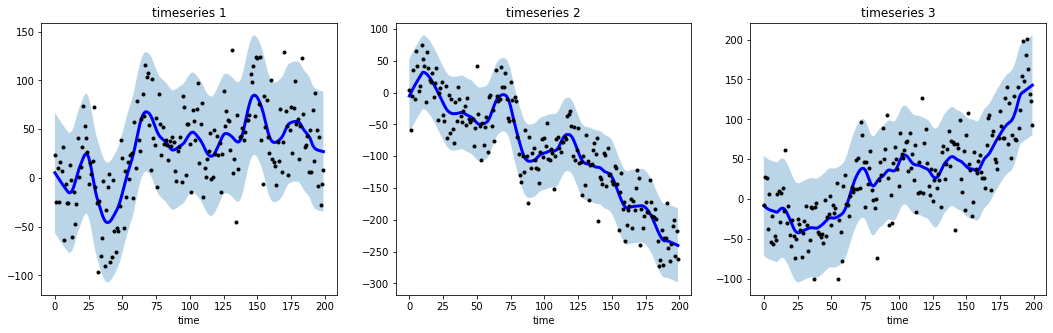
Randomwalk Smoothing

# import libraries
import numpy as np
import matplotlib.pyplot as plt
from tsmoothie.utils_func import sim_seasonal_data
from tsmoothie.smoother import DecomposeSmoother

# generate 3 periodic timeseries of lenght 300
np.random.seed(123)
data = sim_seasonal_data(n_series=3, timesteps=300, 
                         freq=24, measure_noise=30)

# operate smoothing
smoother = DecomposeSmoother(smooth_type='lowess', periods=24,
                             smooth_fraction=0.3)
smoother.smooth(data)

# generate intervals
low, up = smoother.get_intervals('sigma_interval')

# plot the smoothed timeseries with intervals
plt.figure(figsize=(18,5))

for i in range(3):
    
    plt.subplot(1,3,i+1)
    plt.plot(smoother.smooth_data[i], linewidth=3, color='blue')
    plt.plot(smoother.data[i], '.k')
    plt.title(f"timeseries {i+1}"); plt.xlabel('time')

    plt.fill_between(range(len(smoother.data[i])), low[i], up[i], alpha=0.3)
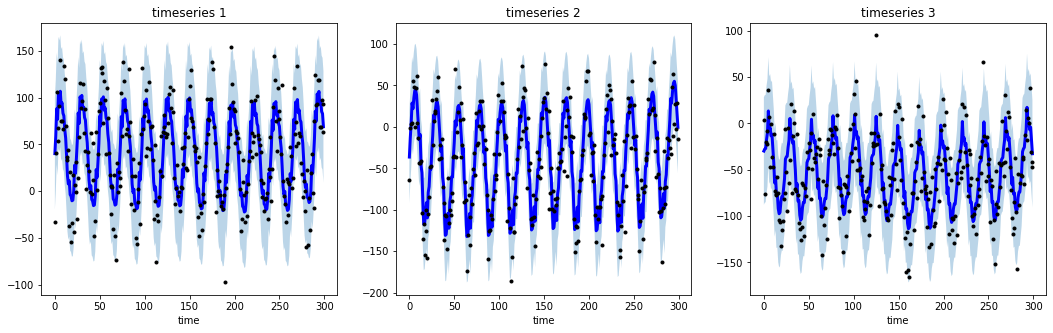
Sinusoidal Smoothing

All the available smoothers are fully integrable with sklearn (see here).

Usage: bootstrap

# import libraries
import numpy as np
import matplotlib.pyplot as plt
from tsmoothie.utils_func import sim_seasonal_data
from tsmoothie.smoother import ConvolutionSmoother
from tsmoothie.bootstrap import BootstrappingWrapper

# generate a periodic timeseries of lenght 300
np.random.seed(123)
data = sim_seasonal_data(n_series=1, timesteps=300, 
                         freq=24, measure_noise=15)

# operate bootstrap
bts = BootstrappingWrapper(ConvolutionSmoother(window_len=8, window_type='ones'), 
                           bootstrap_type='mbb', block_length=24)
bts_samples = bts.sample(data, n_samples=100)

# plot the bootstrapped timeseries
plt.figure(figsize=(13,5))
plt.plot(bts_samples.T, alpha=0.3, c='orange')
plt.plot(data[0], c='blue', linewidth=2)
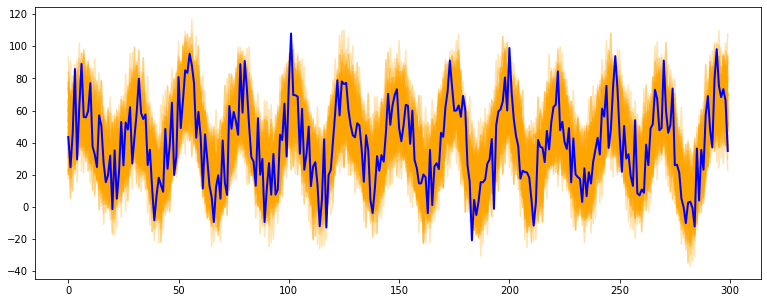
Sinusoidal Bootstrap

References

  • Polynomial, Spline, Gaussian and Binner smoothing are carried out building a regression on custom basis expansions. These implementations are based on the amazing intuitions of Matthew Drury available here
  • Time Series Modelling with Unobserved Components, Matteo M. Pelagatti
  • Bootstrap Methods in Time Series Analysis, Fanny Bergström, Stockholms universitet
Comments
  • Question on KalmanSmoother usage

    Question on KalmanSmoother usage

    Hi, I have a time-series that has seasonality at certain time windows (lets call it sw) and no seasonality at other windows (lets call it nsw). I plan to pass random windows of this time-series into the smoother.

    I am trying to use KalmanSmoother and is considering between:

    smoother1 = ts.smoother.KalmanSmoother(component='level_trend_season', 
                                           component_noise={'level':0.1, 'trend':0.1, 'season':0.1})
    
    vs
    
    smoother2 = ts.smoother.KalmanSmoother(component='level_trend', 
                                           component_noise={'level':0.1, 'trend':0.1})
    

    If the random window slice is sw, the smoother1 should work just fine, and at nsw cases, smoother2 should work better. However I can only use one smoother.

    My question is if I pass nsw into smoother1, will it degrade performance as compared to if pass nsw to smoother2? Is the smoother1 smart enough to "ignore" the fact that nsw has no seasonality in its time-series?

    opened by turmeric-blend 5
  • enhance for tsmoothie to be applicable for inputs with multiple dimensions

    enhance for tsmoothie to be applicable for inputs with multiple dimensions

    Hi, thanks for this library.

    Is it possible to vectorize across multiple dimensions? So a generic N dimensions (..., ..., ..., ..., , timesteps), currently it is limited to (series, timesteps). This would be useful to apply to multivariate time-series problems as well as deep learning applications where there is a batch_size. This should be fairly straight forward using PyTorch (actually even doable with numpy). Would there be a computation limitation?

    opened by turmeric-blend 4
  • question

    question

    Hi Marco

    First thank you for your python package !

    Among all the smoother of the package which one is casual ? or are they all no casual ?

    Regards Ludo

    opened by LinuxpowerLudo 4
  • Numpy rounding issue causes NaN array on Lowess prediction results

    Numpy rounding issue causes NaN array on Lowess prediction results

    Marco, thanks for the excellent project! You've made a great effort combining all the smoothing theories in one single, easy-to-use library! I couldn't thank you enough!

    I stumbled upon a rounding math problem today on the "prediction_interval" function. This problem is actually not on your code, but instead on how Numpy chooses to round floating numbers on the numpy.sum method:

    For floating point numbers the numerical precision of sum (and np.add.reduce) is in general limited by directly adding each number individually to the result causing rounding errors in every step. However, often numpy will use a numerically better approach (partial pairwise summation) leading to improved precision in many use-cases. This improved precision is always provided when no axis is given. When axis is given, it will depend on which axis is summed. Technically, to provide the best speed possible, the improved precision is only used when the summation is along the fast axis in memory. Note that the exact precision may vary depending on other parameters. In contrast to NumPy, Python’s math.fsum function uses a slower but more precise approach to summation. Especially when summing a large number of lower precision floating point numbers, such as float32, numerical errors can become significant. In such cases it can be advisable to use dtype=”float64” to use a higher precision for the output.

    This only occurred with a very particular set of numbers while using the LowessSmoother, which ended up with a negative value that caused an excepetion on the square root later on:

    mse = (np.square(resid).sum(axis=1, keepdims=True) / (N - d_free)).T .... predstd = np.sqrt(predvar).T

    tsmoothie\utils_func.py:306: RuntimeWarning: invalid value encountered in sqrt

    Quick solution first:

    mse = (np.square(resid).sum(axis=1, dtype="float64", keepdims=True) / (N - d_free)).T

    Adding the dtype parameter solved the problem. This causes numpy to increase rounding precision (as stated above) which ended up giving me the correct result.

    Quick observation: As yet, I'm not quite sure on how adding dtype might affect speed and performance on all the other smoother methods, but I will have to check on this eventually.

    Explanation and info:

    While calling Lowess Smother method, setting the iterations parameter to any value greater than 1 caused the rounding numpy problem on the following set of data:

    data[6318, 36871, 39933, 22753, 9680, 6503, 4032, 2733, 2807, 2185, 1866, 1800, 1907, 1537, 1357, 1221, 1354, 1514, 2021, 11110, 17656, 17397, 24385, 22361, 18709, 20201, 20245, 25767, 21345, 18928, 20958, 20425, 23066, 20221, 18756, 17403, 17843, 21201, 25867, 17342, 16815, 5700, 25897, 20891, 20022, 22291, 24334, 21304, 25328, 22201, 20308, 21539, 29637, 22740, 19510, 18959, 21160, 23520, 20574, 16519, 18779]

    Problem occurs at data[-3]. The problem doesn't occur when I cut the rest out:

    data[0:len(data)-3]

    At that point, the total sum causes numpy's rounding to go berserk, I imagine.

    This ends up calling the square root exception above, which in turn causes your "prediction_interval" function to return an array of NaN results:

    [[nan nan nan nan nan nan nan nan nan nan nan nan nan nan nan nan nan nan nan nan nan nan nan nan nan nan nan nan nan nan nan nan nan nan nan nan nan nan nan nan nan nan nan nan nan nan nan nan nan nan nan nan nan nan nan nan nan nan nan nan nan]] [[nan nan nan nan nan nan nan nan nan nan nan nan nan nan nan nan nan nan nan nan nan nan nan nan nan nan nan nan nan nan nan nan nan nan nan nan nan nan nan nan nan nan nan nan nan nan nan nan nan nan nan nan nan nan nan nan nan nan nan nan nan]]

    Variable "mse" without dtype outputs: [[-35780673.18644068]]

    And after including dtype: [[35780673.18644068]]

    Other important parameters I used to help you check this were: Prediction: prediction_interval Confidence: 0.05 Smooth Fraction: 0.3 Batch Size: None Didn't use a WindowWrapper

    For this project I'm stuck with iterations between 5 and 6 and no Batch Size, I need to smooth the entire data together.

    By the way, I think there something going on with the batch_size parameter also, but I haven't got time to look at it yet.

    Thanks again for the great project!! Keep up the good work!!

    opened by brunom63 3
  • sklearn api

    sklearn api

    Would you consider the possibility of making it compatible with sklearn using fit and transform instead of smooth? Is there a specific reason why you save the transformed data as an instance attribute? (this would be against the sklearn API)

    I am thinking of doing it myself for a project I am working on but I wanted to ask you first if I missed anything obvious that would make this difficult or not possible.

    Many thanks

    opened by gioxc88 3
  • Interoperability with sktime

    Interoperability with sktime

    Hi,

    Rather a discussion point than issue: I just saw your post on https://github.com/MaxBenChrist/awesome_time_series_in_python/issues/31 and I'd love to make sktime easily inter-operable with tsmoothie. Would you be interested in working on that?

    opened by mloning 3
  • About component_noise in Kalman filter

    About component_noise in Kalman filter

    Hi Marco I am new to Tsmootie and also Kalman filters. In a process to understand. Have a doubt about component_noise. I have time series where daily seasonality is prominent. So mostly component noise: season= 0.1 works well (low sigma value as I am confident about daily seasonality). But I have tried values like 0.01 and 1 also for the same. I want to know is there any valid limits/ range for the sigma values of component_noise? i.e. 0 to 1 (0 to 100%) etc.

    opened by tawdes 2
  • Is there a way to extend the model past the data?

    Is there a way to extend the model past the data?

    This is a great library, thanks a lot! I have a question, is there a way to extend the smooth/CI past the data domain? See the below plot, aesthetically I would like the smooth regions to go to the edges of the graph region....

    image
    opened by parksj10 2
  • Which smoother is the best to detect and remove outliers?

    Which smoother is the best to detect and remove outliers?

    Hi Marco! Thank you for an awesome package!

    I have a quick question for you. Since you're obviously well-rehearsed in time-series smoothing, which particular smoother will you recommend as a default option?

    In particular, I have a training series y_train (which is potentially very short, <50 observations), and I use some univariate forecasting model to forecast H-periods ahead, resulting in an H-dim vector y_hat. Since my training vector is not always very long, some flexible methods give me crazy results for y_hat, which I want to reset to some sensible value.

    I could do, for instance,

    # Instantiate smoother
    smoother = ConvolutionSmoother(window_len=0.1*len(y_train), window_type='ones')
    smoother.smooth(pd.concat([y_train, y_hat], axis=0)
            
    # Get threshold
    threshold_lower, threshold_upper = smoother.get_intervals('sigma_interval', n_sigma=2)
            
    # Subset to match length
    threshold_lower = threshold_lower[0,-len(y_hat):]
    threshold_upper = threshold_upper[0,-len(y_hat):]
    

    and then use these thresholds. Do you have any recommendations in this setup?

    opened by muhlbach 2
  • Anomaly inference from smoothed data

    Anomaly inference from smoothed data

    Thanks for developing this library. This is a pretty interesting one. I have a question when using tsmoothie as follows.

    Currently I am using an (unsupervised) clustering method to create a model once on a large amount of data (that, assigns inlier and outlier labels) and then query the model repeatedly with small amounts of new data to predict the label (to infer anomaly).

    I am planning to use tsmoothie for filtering the noise in the large input data which will be subject to clustering to assign inlier and outlier labels . Later when I use new data points for predicting the normal or anomaly label, I should smooth that also before prediction. Is that correct?

    opened by nsankar 2
  • WindowWrapper behavior with ExponentialSmoother

    WindowWrapper behavior with ExponentialSmoother

    When I use the WindowWrapper in combination with LowessSmoother, like in the notebook example, I obtain the desired output (NxM numpy array, where N=samples and M=window size). However, when I use WindowWrapper with ExponentialSmoother i get a Nx1 numpy array.

    Is this because ExponentialSmoother is an online-ready algorithm?

    code: https://ibb.co/GdBtWJv

    opened by meneghet 2
Releases(v1.0.4)
Owner
Marco Cerliani
Statistician Hacker & Data Scientist
Marco Cerliani
Catbird is an open source paraphrase generation toolkit based on PyTorch.

Catbird is an open source paraphrase generation toolkit based on PyTorch. Quick Start Requirements and Installation The project is based on PyTorch 1.

Afonso Salgado de Sousa 5 Dec 15, 2022
Keras documentation, hosted live at keras.io

Keras.io documentation generator This repository hosts the code used to generate the keras.io website. Generating a local copy of the website pip inst

Keras 2k Jan 08, 2023
[ICML 2021] A fast algorithm for fitting robust decision trees.

GROOT: Growing Robust Trees Growing Robust Trees (GROOT) is an algorithm that fits binary classification decision trees such that they are robust agai

Cyber Analytics Lab 17 Nov 21, 2022
"SinNeRF: Training Neural Radiance Fields on Complex Scenes from a Single Image", Dejia Xu, Yifan Jiang, Peihao Wang, Zhiwen Fan, Humphrey Shi, Zhangyang Wang

SinNeRF: Training Neural Radiance Fields on Complex Scenes from a Single Image [Paper] [Website] Pipeline Code Environment pip install -r requirements

VITA 250 Jan 05, 2023
Final term project for Bayesian Machine Learning Lecture (XAI-623)

Mixquality_AL Final Term Project For Bayesian Machine Learning Lecture (XAI-623) Youtube Link The presentation is given in YoutubeLink Problem Formula

JeongEun Park 3 Jan 18, 2022
Enigma-Plus - Python based Enigma machine simulator with some extra features

Enigma-Plus Python based Enigma machine simulator with some extra features Examp

1 Jan 05, 2022
Mixed Transformer UNet for Medical Image Segmentation

MT-UNet Update 2022/01/05 By another round of training based on previous weights, our model also achieved a better performance on ACDC (91.61% DSC). W

dotman 92 Dec 25, 2022
Codeflare - Scale complex AI/ML pipelines anywhere

Scale complex AI/ML pipelines anywhere CodeFlare is a framework to simplify the integration, scaling and acceleration of complex multi-step analytics

CodeFlare 169 Nov 29, 2022
The datasets and code of ACL 2021 paper "Aspect-Category-Opinion-Sentiment Quadruple Extraction with Implicit Aspects and Opinions".

Aspect-Category-Opinion-Sentiment (ACOS) Quadruple Extraction This repo contains the data sets and source code of our paper: Aspect-Category-Opinion-S

NUSTM 144 Jan 02, 2023
Official Python implementation of the FuzionCoin protocol

PyFuzc Official Python implementation of the FuzionCoin protocol WARNING: Under construction. Use at your own risk. Some functions may not work. Setup

FuzionCoin 3 Jul 07, 2022
Pytorch implementation of CoCon: A Self-Supervised Approach for Controlled Text Generation

COCON_ICLR2021 This is our Pytorch implementation of COCON. CoCon: A Self-Supervised Approach for Controlled Text Generation (ICLR 2021) Alvin Chan, Y

alvinchangw 79 Dec 18, 2022
A simple command line tool for text to image generation, using OpenAI's CLIP and a BigGAN.

Ryan Murdock has done it again, combining OpenAI's CLIP and the generator from a BigGAN! This repository wraps up his work so it is easily accessible to anyone who owns a GPU.

Phil Wang 2.3k Jan 09, 2023
Overview of architecture and implementation of TEDS-Net, as described in MICCAI 2021: "TEDS-Net: Enforcing Diffeomorphisms in Spatial Transformers to Guarantee TopologyPreservation in Segmentations"

TEDS-Net Overview of architecture and implementation of TEDS-Net, as described in MICCAI 2021: "TEDS-Net: Enforcing Diffeomorphisms in Spatial Transfo

Madeleine K Wyburd 14 Jan 04, 2023
Multi-Scale Geometric Consistency Guided Multi-View Stereo

ACMM [News] The code for ACMH is released!!! [News] The code for ACMP is released!!! About ACMM is a multi-scale geometric consistency guided multi-vi

Qingshan Xu 118 Jan 04, 2023
Imbalanced Gradients: A Subtle Cause of Overestimated Adversarial Robustness

Imbalanced Gradients: A Subtle Cause of Overestimated Adversarial Robustness Code for Paper "Imbalanced Gradients: A Subtle Cause of Overestimated Adv

Hanxun Huang 11 Nov 30, 2022
Image Segmentation with U-Net Algorithm on Carvana Dataset using AWS Sagemaker

Image Segmentation with U-Net Algorithm on Carvana Dataset using AWS Sagemaker This is a full project of image segmentation using the model built with

Htin Aung Lu 1 Jan 04, 2022
This package contains a PyTorch Implementation of IB-GAN of the submitted paper in AAAI 2021

The PyTorch implementation of IB-GAN model of AAAI 2021 This package contains a PyTorch implementation of IB-GAN presented in the submitted paper (IB-

Insu Jeon 9 Mar 30, 2022
MonoScene: Monocular 3D Semantic Scene Completion

MonoScene: Monocular 3D Semantic Scene Completion MonoScene: Monocular 3D Semantic Scene Completion] [arXiv + supp] | [Project page] Anh-Quan Cao, Rao

298 Jan 08, 2023
Code for EmBERT, a transformer model for embodied, language-guided visual task completion.

Code for EmBERT, a transformer model for embodied, language-guided visual task completion.

41 Jan 03, 2023
Game Agent Framework. Helping you create AIs / Bots that learn to play any game you own!

Serpent.AI - Game Agent Framework (Python) Update: Revival (May 2020) Development work has resumed on the framework with the aim of bringing it into 2

Serpent.AI 6.4k Jan 05, 2023