Using / reproducing ACD from the paper "Hierarchical interpretations for neural network predictions" 🧠 (ICLR 2019)

Overview

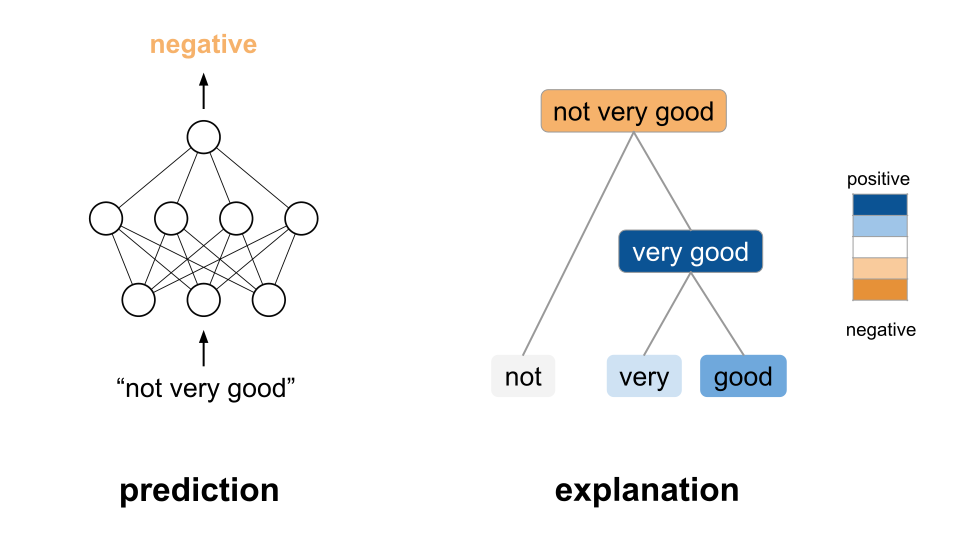
Hierarchical neural-net interpretations (ACD) 🧠

Produces hierarchical interpretations for a single prediction made by a pytorch neural network. Official code for Hierarchical interpretations for neural network predictions (ICLR 2019 pdf).


DocumentationDemo notebooks

Note: this repo is actively maintained. For any questions please file an issue.
examples/documentation

  • installation: pip install acd (or clone and run python setup.py install)
  • examples: the reproduce_figs folder has notebooks with many demos
  • src: the acd folder contains the source for the method implementation
  • allows for different types of interpretations by changing hyperparameters (explained in examples)
  • all required data/models/code for reproducing are included in the dsets folder
Inspecting NLP sentiment models Detecting adversarial examples Analyzing imagenet models

notes on using ACD on your own data

  • the current CD implementation often works out-of-the box, especially for networks built on common layers, such as alexnet/vgg/resnet. However, if you have custom layers or layers not accessible in net.modules(), you may need to write a custom function to iterate through some layers of your network (for examples see cd.py).
  • to use baselines such build-up and occlusion, replace the pred_ims function by a function, which gets predictions from your model given a batch of examples.

related work

  • CDEP (ICML 2020 pdf, github) - penalizes CD / ACD scores during training to make models generalize better
  • TRIM (ICLR 2020 workshop pdf, github) - using simple reparameterizations, allows for calculating disentangled importances to transformations of the input (e.g. assigning importances to different frequencies)
  • PDR framework (PNAS 2019 pdf) - an overarching framewwork for guiding and framing interpretable machine learning
  • DAC (arXiv 2019 pdf, github) - finds disentangled interpretations for random forests
  • Baseline interpretability methods - the file scores/score_funcs.py also contains simple pytorch implementations of integrated gradients and the simple interpration technique gradient * input

reference

  • feel free to use/share this code openly
  • if you find this code useful for your research, please cite the following:
@inproceedings{
   singh2019hierarchical,
   title={Hierarchical interpretations for neural network predictions},
   author={Chandan Singh and W. James Murdoch and Bin Yu},
   booktitle={International Conference on Learning Representations},
   year={2019},
   url={https://openreview.net/forum?id=SkEqro0ctQ},
}
Owner
Chandan Singh
Working on interpretable machine learning across domains 🧠⚕️🦠 Let's do good with models.
Chandan Singh
Interpretability and explainability of data and machine learning models

AI Explainability 360 (v0.2.1) The AI Explainability 360 toolkit is an open-source library that supports interpretability and explainability of datase

1.2k Dec 29, 2022
treeinterpreter - Interpreting scikit-learn's decision tree and random forest predictions.

TreeInterpreter Package for interpreting scikit-learn's decision tree and random forest predictions. Allows decomposing each prediction into bias and

Ando Saabas 720 Dec 22, 2022
⬛ Python Individual Conditional Expectation Plot Toolbox

⬛ PyCEbox Python Individual Conditional Expectation Plot Toolbox A Python implementation of individual conditional expecation plots inspired by R's IC

Austin Rochford 140 Dec 30, 2022
Pytorch implementation of convolutional neural network visualization techniques

Convolutional Neural Network Visualizations This repository contains a number of convolutional neural network visualization techniques implemented in

Utku Ozbulak 7k Jan 03, 2023
tensorboard for pytorch (and chainer, mxnet, numpy, ...)

tensorboardX Write TensorBoard events with simple function call. The current release (v2.1) is tested on anaconda3, with PyTorch 1.5.1 / torchvision 0

Tzu-Wei Huang 7.5k Jan 07, 2023
Lime: Explaining the predictions of any machine learning classifier

lime This project is about explaining what machine learning classifiers (or models) are doing. At the moment, we support explaining individual predict

Marco Tulio Correia Ribeiro 10.3k Jan 01, 2023
PyTorch implementation of DeepDream algorithm

neural-dream This is a PyTorch implementation of DeepDream. The code is based on neural-style-pt. Here we DeepDream a photograph of the Golden Gate Br

121 Nov 05, 2022
Summary Explorer is a tool to visually explore the state-of-the-art in text summarization.

Summary Explorer is a tool to visually explore the state-of-the-art in text summarization.

Webis 42 Aug 14, 2022
Quickly and easily create / train a custom DeepDream model

Dream-Creator This project aims to simplify the process of creating a custom DeepDream model by using pretrained GoogleNet models and custom image dat

56 Jan 03, 2023
Visualization Toolbox for Long Short Term Memory networks (LSTMs)

Visualization Toolbox for Long Short Term Memory networks (LSTMs)

Hendrik Strobelt 1.1k Jan 04, 2023
Algorithms for monitoring and explaining machine learning models

Alibi is an open source Python library aimed at machine learning model inspection and interpretation. The focus of the library is to provide high-qual

Seldon 1.9k Dec 30, 2022
Code for visualizing the loss landscape of neural nets

Visualizing the Loss Landscape of Neural Nets This repository contains the PyTorch code for the paper Hao Li, Zheng Xu, Gavin Taylor, Christoph Studer

Tom Goldstein 2.2k Dec 30, 2022
Convolutional neural network visualization techniques implemented in PyTorch.

This repository contains a number of convolutional neural network visualization techniques implemented in PyTorch.

1 Nov 06, 2021
Making decision trees competitive with neural networks on CIFAR10, CIFAR100, TinyImagenet200, Imagenet

Neural-Backed Decision Trees · Site · Paper · Blog · Video Alvin Wan, *Lisa Dunlap, *Daniel Ho, Jihan Yin, Scott Lee, Henry Jin, Suzanne Petryk, Sarah

Alvin Wan 556 Dec 20, 2022
A ultra-lightweight 3D renderer of the Tensorflow/Keras neural network architectures

A ultra-lightweight 3D renderer of the Tensorflow/Keras neural network architectures

Souvik Pratiher 16 Nov 17, 2021
ModelChimp is an experiment tracker for Deep Learning and Machine Learning experiments.

ModelChimp What is ModelChimp? ModelChimp is an experiment tracker for Deep Learning and Machine Learning experiments. ModelChimp provides the followi

ModelChimp 124 Dec 21, 2022
A collection of infrastructure and tools for research in neural network interpretability.

Lucid Lucid is a collection of infrastructure and tools for research in neural network interpretability. We're not currently supporting tensorflow 2!

4.5k Jan 07, 2023
Visual analysis and diagnostic tools to facilitate machine learning model selection.

Yellowbrick Visual analysis and diagnostic tools to facilitate machine learning model selection. What is Yellowbrick? Yellowbrick is a suite of visual

District Data Labs 3.9k Dec 30, 2022
Visualize a molecule and its conformations in Jupyter notebooks/lab using py3dmol

Mol Viewer This is a simple package wrapping py3dmol for a single command visualization of a RDKit molecule and its conformations (embed as Conformer

Benoît BAILLIF 1 Feb 11, 2022
Implementation of linear CorEx and temporal CorEx.

Correlation Explanation Methods Official implementation of linear correlation explanation (linear CorEx) and temporal correlation explanation (T-CorEx

Hrayr Harutyunyan 34 Nov 15, 2022

