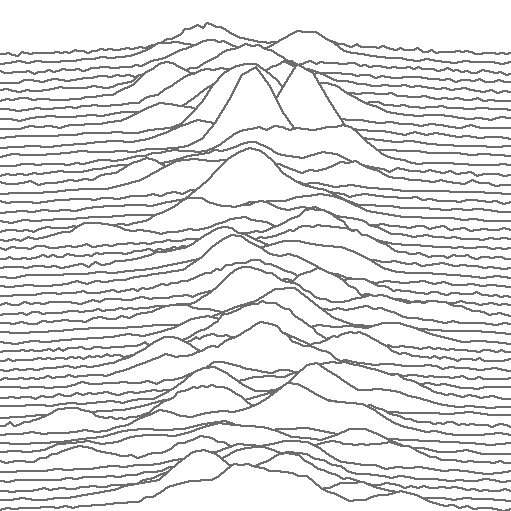
A Python library for unevenly-spaced time series analysis

Related tags

Deep Learningtraces
Overview

traces

Version PyVersions CircleCI Documentation Status Coverage Status

A Python library for unevenly-spaced time series analysis.

Why?

Taking measurements at irregular intervals is common, but most tools are primarily designed for evenly-spaced measurements. Also, in the real world, time series have missing observations or you may have multiple series with different frequencies: it can be useful to model these as unevenly-spaced.

Traces was designed by the team at Datascope based on several practical applications in different domains, because it turns out unevenly-spaced data is actually pretty great, particularly for sensor data analysis.

Installation

To install traces, run this command in your terminal:

$ pip install traces

Quickstart: using traces

To see a basic use of traces, let's look at these data from a light switch, also known as Big Data from the Internet of Things.

The main object in traces is a TimeSeries, which you create just like a dictionary, adding the five measurements at 6:00am, 7:45:56am, etc.

>>> time_series = traces.TimeSeries()
>>> time_series[datetime(2042, 2, 1,  6,  0,  0)] = 0 #  6:00:00am
>>> time_series[datetime(2042, 2, 1,  7, 45, 56)] = 1 #  7:45:56am
>>> time_series[datetime(2042, 2, 1,  8, 51, 42)] = 0 #  8:51:42am
>>> time_series[datetime(2042, 2, 1, 12,  3, 56)] = 1 # 12:03:56am
>>> time_series[datetime(2042, 2, 1, 12,  7, 13)] = 0 # 12:07:13am

What if you want to know if the light was on at 11am? Unlike a python dictionary, you can look up the value at any time even if it's not one of the measurement times.

>>> time_series[datetime(2042, 2, 1, 11,  0, 0)] # 11:00am
0

The distribution function gives you the fraction of time that the TimeSeries is in each state.

>>> time_series.distribution(
>>>   start=datetime(2042, 2, 1,  6,  0,  0), # 6:00am
>>>   end=datetime(2042, 2, 1,  13,  0,  0)   # 1:00pm
>>> )
Histogram({0: 0.8355952380952381, 1: 0.16440476190476191})

The light was on about 16% of the time between 6am and 1pm.

Adding more data...

Now let's get a little more complicated and look at the sensor readings from forty lights in a house.

How many lights are on throughout the day? The merge function takes the forty individual TimeSeries and efficiently merges them into one TimeSeries where the each value is a list of all lights.

>>> trace_list = [... list of forty traces.TimeSeries ...]
>>> count = traces.TimeSeries.merge(trace_list, operation=sum)

We also applied a sum operation to the list of states to get the TimeSeries of the number of lights that are on.

How many lights are on in the building on average during business hours, from 8am to 6pm?

>>> histogram = count.distribution(
>>>   start=datetime(2042, 2, 1,  8,  0,  0),   # 8:00am
>>>   end=datetime(2042, 2, 1,  12 + 6,  0,  0) # 6:00pm
>>> )
>>> histogram.median()
17

The distribution function returns a Histogram that can be used to get summary metrics such as the mean or quantiles.

It's flexible

The measurements points (keys) in a TimeSeries can be in any units as long as they can be ordered. The values can be anything.

For example, you can use a TimeSeries to keep track the contents of a grocery basket by the number of minutes within a shopping trip.

>>> time_series = traces.TimeSeries()
>>> time_series[1.2] = {'broccoli'}
>>> time_series[1.7] = {'broccoli', 'apple'}
>>> time_series[2.2] = {'apple'}          # puts broccoli back
>>> time_series[3.5] = {'apple', 'beets'} # mmm, beets

To learn more, check the examples and the detailed reference.

More info

Contributing

Contributions are welcome and greatly appreciated! Please visit our guidelines for more info.

Comments
  • Trying to calculate the mean of an empty Histogram fails

    Trying to calculate the mean of an empty Histogram fails

    Running .mean() on an empty Histogram object (Histogram(None, 1000, {0: 0.0})) fails with a divide by zero error:

      File "/src/traces/traces/histogram.py", line 30, in mean
        return weighted_sum / float(self.total())
    ZeroDivisionError: float division by zero
    
    Bug Report 
    opened by vlsd 6
  • How are the plots in the documentation created?

    How are the plots in the documentation created?

    Not a bug, but just curious about how you've plotted the charts in the documentation and what the recommended approach for plotting TimeSeries objects is? I couldn't find a trace of this information in the repo. Thanks in advance!

    opened by Ogaday 5
  • Dev

    Dev

    This covers an initial implementation of the EventSeries features described in #229

    I ended up leaving out the histogram plotting feature as creating reasonable and responsive log binned histograms of time units felt a little outside the scope of this project, though something I may yet tackle.

    Would love a review for readability, test coverage, or feature suggestions!

    opened by nsteins 4
  • add possibility to write ts[start:end] = v to change value on an interval

    add possibility to write ts[start:end] = v to change value on an interval

    I have a use case where I need to change the value of a timeseries on an interval without changing the value outside of the interval, ie do something like ts[start:end] = value. Just setting

    ts[end] = ts[end]   # freezing/anchoring the current value of ts as of [end, ...)
    ts[start] = value      # changing the value as of [start, ...)
    

    may fail as intermediate points in [start,end) may exist ==> we need to remove all intermediate points (which is easy as ts.iterperiods(start,end) provides them nicely).

    I think the function below does it properly (but it would be better integrated in the item to use the slice notation)

    def set_slice(ts, start, end, value):
        """
       ts[start:end] = value ==> call set_slice(ts, start, end, value)
        Set the value of the ts so that
        - on the interval [start, end) we have the new value
        - on [end, ...) we haven't change the value
        - on (..., start) we haven't change the value neither
        We replace the value of the ts on an interval.
    
        :param ts: 
        :param start: 
        :param end: 
        :param value: 
        :return: 
        """
        # for each interval to render
        for i, (s, e, v) in enumerate(list(ts.iterperiods(start, end))):
            # look at all intervals included in the current interval
            # (always at least 1)
            if i == 0:
                # if the first, set initial value to new value of range
                ts[s] = value
            else:
                # otherwise, remove intermediate key
                del ts[s]
        # finish by setting the end of the interval to the previous value
        ts[end] = v


    opened by sdementen 4
  • Values in TimeSeries.distribution() are sentence-cased regardless of how vales were added to the TimeSeries

    Values in TimeSeries.distribution() are sentence-cased regardless of how vales were added to the TimeSeries

    If you are using strings as values in a TimeSeries:

    ts = traces.TimeSeries()
    ts[1] = JUNK
    ts[3] = JANK
    ts[5] = WHAT
    

    If you call something like ts.distrubution(min, max), you would see something like this:

    Histogram(None, 1000, {'Jank': 0.16008504570112725, 'Junk': 0.04229136076598496, 'What': 0.797577092766277})
    

    It looks like somewhere along the line, the string-values are getting sentence-cased. Not sure exactly where yet, but this could be confusing or cause silly bugs if looking-up these objects with the wrong value.

    opened by michaelmoliterno 4
  • Fix conversion of window_size to float breaking timedelta compatiblity

    Fix conversion of window_size to float breaking timedelta compatiblity

    With commit 05a14608d06b06dfc589ae9c247d300b89f956b5, using a timedelta as sampling_period in moving_average throws an exception when converting window_size to a float. Multiplying by 1. (as previously done) serves the same purpose and still allows timedelta to be used.

    opened by cesarrodrig 2
  • Feature Request: linear interpolation for mean

    Feature Request: linear interpolation for mean

    So I recently discovered this nice library and decided to try it since I got unevenly spaced data, however I found out today that the .mean() wasn't doing linear interpolation as I thought it would be:

    >>> from traces import TimeSeries
    >>> t = TimeSeries()
    >>> t[0] = 0
    >>> t[1] = 0
    >>> t[3] = 20
    >>> t.mean(0, 2)
    0.0
    

    With linear interpolation between 2 points we would find that t[2] = 10 and doing the average from 0 to 2 would give us 3.333 in this example. A simple optional argument in mean() to choose the interpolation method would be fantastic, and I really think that it would be useful to many users who are not using traces exclusively for binary data (where linear interpolation would make no sense). I know that we can re-sample the TimeSeries but I think a shortcut like this would be really neat since this library is designed with ease of use in mind.

    Thanks for reading and have a nice day 👋

    opened by Inspirateur 2
  • [Question] How to recreate traces chart?

    [Question] How to recreate traces chart?

    I wonder, how could one plot traces' Signature plot? signature plot ?

    I was wondering if the library has anything to do with the charts (as per the docs that is not the case) but seeing a couple of charts like that in the docs made me think that maybe producing that kind of charts is within the scope of the projects.

    opened by manugarri 2
  • Can't pickle TimeSeries objects

    Can't pickle TimeSeries objects

    [UPDATE] This only seems to happen on python 2.7

    Trying to pickle a TimeSeries object:

    import traces
    ofile = open('test.pkl', 'wb')
    import pickle
    ts = traces.TimeSeries()
    ts[23]="blah"
    ts[2]="foo"
    pickle.dump(ts, ofile)
    

    I get the following error:

    In [9]: pickle.dump(ts, ofile)
    ---------------------------------------------------------------------------
    TypeError                                 Traceback (most recent call last)
    <ipython-input-9-f1eed5bd8d83> in <module>()
    ----> 1 pickle.dump(ts, ofile)
    
    /Users/vlad/.pyenv/versions/2.7.13/lib/python2.7/pickle.pyc in dump(obj, file, protocol)
       1374
       1375 def dump(obj, file, protocol=None):
    -> 1376     Pickler(file, protocol).dump(obj)
       1377
       1378 def dumps(obj, protocol=None):
    
    /Users/vlad/.pyenv/versions/2.7.13/lib/python2.7/pickle.pyc in dump(self, obj)
        222         if self.proto >= 2:
        223             self.write(PROTO + chr(self.proto))
    --> 224         self.save(obj)
        225         self.write(STOP)
        226
    
    /Users/vlad/.pyenv/versions/2.7.13/lib/python2.7/pickle.pyc in save(self, obj)
        329
        330         # Save the reduce() output and finally memoize the object
    --> 331         self.save_reduce(obj=obj, *rv)
        332
        333     def persistent_id(self, obj):
    
    /Users/vlad/.pyenv/versions/2.7.13/lib/python2.7/pickle.pyc in save_reduce(self, func, args, state, listitems, dictitems, obj)
        423
        424         if state is not None:
    --> 425             save(state)
        426             write(BUILD)
        427
    
    /Users/vlad/.pyenv/versions/2.7.13/lib/python2.7/pickle.pyc in save(self, obj)
        284         f = self.dispatch.get(t)
        285         if f:
    --> 286             f(self, obj) # Call unbound method with explicit self
        287             return
        288
    
    /Users/vlad/.pyenv/versions/2.7.13/lib/python2.7/pickle.pyc in save_dict(self, obj)
        653
        654         self.memoize(obj)
    --> 655         self._batch_setitems(obj.iteritems())
        656
        657     dispatch[DictionaryType] = save_dict
    
    /Users/vlad/.pyenv/versions/2.7.13/lib/python2.7/pickle.pyc in _batch_setitems(self, items)
        667             for k, v in items:
        668                 save(k)
    --> 669                 save(v)
        670                 write(SETITEM)
        671             return
    
    /Users/vlad/.pyenv/versions/2.7.13/lib/python2.7/pickle.pyc in save(self, obj)
        284         f = self.dispatch.get(t)
        285         if f:
    --> 286             f(self, obj) # Call unbound method with explicit self
        287             return
        288
    
    /Users/vlad/.pyenv/versions/2.7.13/lib/python2.7/pickle.pyc in save_dict(self, obj)
        653
        654         self.memoize(obj)
    --> 655         self._batch_setitems(obj.iteritems())
        656
        657     dispatch[DictionaryType] = save_dict
    
    /Users/vlad/.pyenv/versions/2.7.13/lib/python2.7/pickle.pyc in _batch_setitems(self, items)
        667             for k, v in items:
        668                 save(k)
    --> 669                 save(v)
        670                 write(SETITEM)
        671             return
    
    /Users/vlad/.pyenv/versions/2.7.13/lib/python2.7/pickle.pyc in save(self, obj)
        304             reduce = getattr(obj, "__reduce_ex__", None)
        305             if reduce:
    --> 306                 rv = reduce(self.proto)
        307             else:
        308                 reduce = getattr(obj, "__reduce__", None)
    
    /Users/vlad/.pyenv/versions/2.7.13/envs/prelude_monitor/lib/python2.7/copy_reg.pyc in _reduce_ex(self, proto)
         68     else:
         69         if base is self.__class__:
    ---> 70             raise TypeError, "can't pickle %s objects" % base.__name__
         71         state = base(self)
         72     args = (self.__class__, base, state)
    
    TypeError: can't pickle instancemethod objects```
    opened by vlsd 2
  • When using a mask with TimeSeries.distribution(), mask.start() is called in `timeseries.py` but `start()` doesn't exist

    When using a mask with TimeSeries.distribution(), mask.start() is called in `timeseries.py` but `start()` doesn't exist

    I think this will be fixed with the next bump; looked for an issue related to this but didn't find one. Feel free to close this out if it was as simple as defining start() for TimeSeries.

    Traceback (most recent call last):
      File "run_plots.py", line 25, in <module>
        make_plots()
      File "/Users/mjfm/projects/modustri/analysis/plots/see_cart_trips.py", line 55, in make_plots
        mask = front_ts,
      File "/Users/mjfm/Virtualenvs/modustri/lib/python2.7/site-packages/traces/timeseries.py", line 622, in distribution
        new_ts = self.slice(mask.start(), mask.end())
    AttributeError: 'TimeSeries' object has no attribute 'start'
    
    opened by michaelmoliterno 2
  • Add `compact` option to `iterperiods()`

    Add `compact` option to `iterperiods()`

    This would merge adjacent periods that have the same value and return them as only one period. Ideally this would be done efficiently, although I'm unclear what that means (store a compact version of the timeseries along with the non-compact one?)

    Enhancement Request 
    opened by vlsd 2
  • `max` for distribution with `start` and `end` gives wrong result

    `max` for distribution with `start` and `end` gives wrong result

    Hello, there seems to be a bug with the Histogram initialization when a start and end are passed.

    versions:

    • python: 3.10.5
    • traces: 0.6.0

    Given the following TimeSeries:

    from traces import TimeSeries
    from pandas import Timestamp
    
    
    ts = TimeSeries(
        {
            Timestamp('2022-10-09 08:48:47'): 5.5,
            Timestamp('2022-10-09 10:36:47'): 51.4,
            Timestamp('2022-10-09 10:38:47'): 15.2,
            Timestamp('2022-10-09 10:38:56'): 0.1,
            Timestamp('2022-10-09 10:41:25'): 4.5
        }
    )
    

    Computing the maximum value with

    ts.distribution().max()
    

    gives 51.4 (as expected)

    However

    ts.distribution(
        start=Timestamp('2022-10-09 07:55:10'),
        end=Timestamp('2022-10-09 10:56:32'),
    ).max()
    

    gives 5.5

    Thank you.

    opened by RuiLoureiro 1
  • No longer maintained?

    No longer maintained?

    This repo looks like it's no longer maintained, with the last PR merged over two years ago. Are you looking for active maintainers? What's the plan for this repo?

    opened by nielsuit227 0
  • Incorrect handling of Numpy array passed as times of measurements

    Incorrect handling of Numpy array passed as times of measurements

    In the following example, although ts1 and ts2 are equal, ts2.distribution() fails with a TypeError as if Numpy arrays weren't recognized properly.
    Somewhat similar to issue #145

    import numpy as np  # Numpy version 1.22.3
    import traces  # traces version 0.6.0
    
    ts1 = traces.TimeSeries(zip(range(4), range(4)), default=0)
    ts2 = traces.TimeSeries(zip(np.arange(4), range(4)), default=0)
    
    ts1 == ts2  # True
    ts1.distribution()  # Histogram({0: 0.3333333333333333, 1: 0.3333333333333333, 2: 0.3333333333333333})
    ts2.distribution()  # TypeError: duration is an unknown type (1)
    
    opened by yportier 0
  • [... list of forty traces.TimeSeries ...] is not functioning.

    [... list of forty traces.TimeSeries ...] is not functioning.

    Hi, Thanks for creating traces. I am trying to learn it. But while I run the following command,

    [... list of forty traces.TimeSeries ...]
    

    I get an error which is mentioned below,

     File "/tmp/ipykernel_51/3316415681.py", line 3
        trace_list = [... list of forty traces.TimeSeries ...]
                             ^
    SyntaxError: invalid syntax
    

    Could anybody please help? Thanks a lot.

    opened by bhavinmoriya 2
  • Allow more flexible type checks on duration

    Allow more flexible type checks on duration

    The current way of checking int and float cannot handle numpy's data types, such as np.int64 and np.float64, which requires extra effort to convert a numpy element into int or float to pass the check.

    Using numeric ABCs solves the problem and allows more flexible "implementations" of integers and real numbers. (Better than the approach in #224, no extra dependencies needed)

    === Updated === Tests can be passed locally. CI seems to complain something about repo_token and marked them as failed.

    opened by zzrcxb 0
Releases(v0.5.1)
网络协议2天集训

网络协议2天集训 抓包工具安装 Wireshark wireshark下载地址 Tcpdump CentOS yum install tcpdump -y Ubuntu apt-get install tcpdump -y k8s抓包测试环境 查看虚拟网卡veth pair 查看

120 Dec 12, 2022
Instance Semantic Segmentation List

Instance Semantic Segmentation List This repository contains lists of state-or-art instance semantic segmentation works. Papers and resources are list

bighead 87 Mar 06, 2022
This repository contains the code for "SBEVNet: End-to-End Deep Stereo Layout Estimation" paper by Divam Gupta, Wei Pu, Trenton Tabor, Jeff Schneider

SBEVNet: End-to-End Deep Stereo Layout Estimation This repository contains the code for "SBEVNet: End-to-End Deep Stereo Layout Estimation" paper by D

Divam Gupta 19 Dec 17, 2022
This repository contains the code for "Self-Diagnosis and Self-Debiasing: A Proposal for Reducing Corpus-Based Bias in NLP".

Self-Diagnosis and Self-Debiasing This repository contains the source code for Self-Diagnosis and Self-Debiasing: A Proposal for Reducing Corpus-Based

Timo Schick 62 Dec 12, 2022
[CVPR 2021] Pytorch implementation of Hijack-GAN: Unintended-Use of Pretrained, Black-Box GANs

Hijack-GAN: Unintended-Use of Pretrained, Black-Box GANs In this work, we propose a framework HijackGAN, which enables non-linear latent space travers

Hui-Po Wang 46 Sep 05, 2022
Curved Projection Reformation

Description Assuming that we already know the image of the centerline, we want the lumen to be displayed on a plane, which requires curved projection

夜听残荷 5 Sep 11, 2022
pytorch implementation of ABC : Auxiliary Balanced Classifier for Class-imbalanced Semi-supervised Learning

ABC:Auxiliary Balanced Classifier for Class-imbalanced Semi-supervised Learning, NeurIPS 2021 pytorch implementation of ABC : Auxiliary Balanced Class

Hyuck Lee 25 Dec 22, 2022
Export CenterPoint PonintPillars ONNX Model For TensorRT

CenterPoint-PonintPillars Pytroch model convert to ONNX and TensorRT Welcome to CenterPoint! This project is fork from tianweiy/CenterPoint. I impleme

CarkusL 149 Dec 13, 2022
Multi-query Video Retreival

Multi-query Video Retreival

Princeton Visual AI Lab 17 Nov 22, 2022
Blender scripts for computing geodesic distance

GeoDoodle Geodesic distance computation for Blender meshes Table of Contents Overivew Usage Implementation Overview This addon provides an operator fo

20 Jun 08, 2022
Experimental solutions to selected exercises from the book [Advances in Financial Machine Learning by Marcos Lopez De Prado]

Advances in Financial Machine Learning Exercises Experimental solutions to selected exercises from the book Advances in Financial Machine Learning by

Brian 1.4k Jan 04, 2023
Learning to Reconstruct 3D Non-Cuboid Room Layout from a Single RGB Image

NonCuboidRoom Paper Learning to Reconstruct 3D Non-Cuboid Room Layout from a Single RGB Image Cheng Yang*, Jia Zheng*, Xili Dai, Rui Tang, Yi Ma, Xiao

67 Dec 15, 2022
BossNAS: Exploring Hybrid CNN-transformers with Block-wisely Self-supervised Neural Architecture Search

BossNAS This repository contains PyTorch evaluation code, retraining code and pretrained models of our paper: BossNAS: Exploring Hybrid CNN-transforme

Changlin Li 127 Dec 26, 2022
Header-only library for using Keras models in C++.

frugally-deep Use Keras models in C++ with ease Table of contents Introduction Usage Performance Requirements and Installation FAQ Introduction Would

Tobias Hermann 927 Jan 05, 2023
Mortgage-loan-prediction - Show how to perform advanced Analytics and Machine Learning in Python using a full complement of PyData utilities

Mortgage-loan-prediction - Show how to perform advanced Analytics and Machine Learning in Python using a full complement of PyData utilities

Deepak Nandwani 1 Dec 31, 2021
Deep-learning X-Ray Micro-CT image enhancement, pore-network modelling and continuum modelling

EDSR modelling A Github repository for deep-learning image enhancement, pore-network and continuum modelling from X-Ray Micro-CT images. The repositor

Samuel Jackson 7 Nov 03, 2022
PyTorch Implementation of Region Similarity Representation Learning (ReSim)

ReSim This repository provides the PyTorch implementation of Region Similarity Representation Learning (ReSim) described in this paper: @Article{xiao2

Tete Xiao 74 Jan 03, 2023
Faune proche - Retrieval of Faune-France data near a google maps location

faune_proche Récupération des données de Faune-France près d'un lieu google maps

4 Feb 15, 2022
DynaTune: Dynamic Tensor Program Optimization in Deep Neural Network Compilation

DynaTune: Dynamic Tensor Program Optimization in Deep Neural Network Compilation This repository is the implementation of DynaTune paper. This folder

4 Nov 02, 2022
Discriminative Condition-Aware PLDA

DCA-PLDA This repository implements the Discriminative Condition-Aware Backend described in the paper: L. Ferrer, M. McLaren, and N. Brümmer, "A Speak

Luciana Ferrer 31 Aug 05, 2022