DivNoising is an unsupervised denoising method to generate diverse denoised samples for any noisy input image. This repository contains the code to reproduce the results reported in the paper https://openreview.net/pdf?id=agHLCOBM5jP

Overview

DivNoising: Diversity Denoising with Fully Convolutional Variational Autoencoders

Mangal Prakash1, Alexander Krull1,2, Florian Jug2
1Authors contributed equally, 2Shared last authors.
Max Planck Institute of Molecular Cell Biology and Genetics (MPI-CBG)
Center for Systems Biology (CSBD) in Dresden, Germany .

teaserFigure

Deep Learning based methods have emerged as the indisputable leaders for virtually all image restoration tasks. Especially in the domain of microscopy images, various content-aware image restoration (CARE) approaches are now used to improve the interpretability of acquired data. But there are limitations to what can be restored in corrupted images, and any given method needs to make a sensible compromise between many possible clean signals when predicting a restored image. Here, we propose DivNoising - a denoising approach based on fully-convolutional variational autoencoders, overcoming this problem by predicting a whole distribution of denoised images. Our method is unsupervised, requiring only noisy images and a description of the imaging noise, which can be measured or bootstrapped from noisy data. If desired, consensus predictions can be inferred from a set of DivNoising predictions, leading to competitive results with other unsupervised methods and, on occasion, even with the supervised state-of-the-art. DivNoising samples from the posterior enable a plethora of useful applications. We are (i) discussing how optical character recognition (OCR) applications could benefit from diverse predictions on ambiguous data, and (ii) show in detail how instance cell segmentation gains performance when using diverse DivNoising predictions.

Information

This repository hosts the the code for the publication Fully Unsupervised Diversity Denoising with Convolutional Variational Autoencoders.

Citation

If you find our work useful in your research, please consider citing:

@inproceedings{
prakash2021fully,
title={Fully Unsupervised Diversity Denoising with Convolutional Variational Autoencoders},
author={Mangal Prakash and Alexander Krull and Florian Jug},
booktitle={International Conference on Learning Representations},
year={2021},
url={https://openreview.net/forum?id=agHLCOBM5jP}
}

Dependencies and Setup

We have tested this implementation using pytorch version 1.1.0 and cudatoolkit version 9.0.

Follow the steps below to setup DivNoising.
(i) Move to the command prompt and enter git clone https://github.com/juglab/DivNoising/.
(ii) Move to the folder where the repository was cloned by cd DivNoising.
(iii) Create a new conda environment by the command conda env create -f DivNoising.yml.
(iv) Activate the conda environemnt conda activate DivNoising.
(v) Install tensorboard with the command conda install -c conda-forge tensorboard.
(vi) Install jupyter with the command pip install -U jupyter protobuf.
(vii) Finally, execute the command pip install ipykernel followed by the command python -m ipykernel install --user --name DivNoising --display-name 'DivNoising'.

You are all set to run DivNoising now.

Getting Started

Look in the examples directory and try out the notebooks. Inside this directory, there are folders corresponding to different datasets.

If your data is real microscopy data with intrinsic noise (Convallaria and Mouse skull nuclei datasets in our case), then you will need a noise model which can be generated by first running the notebook: (i) 0-CreateNoiseModel.ipynb. This will create a suitable noise model. Next run (ii) 1-Training.ipynb. This starts network training. Following this, run (iii) 2-Prediction.ipynb which starts prediction part.

In case, your noisy data is generated by synthetic corruption with Gaussian noise, then you can start with the training step directly by running 1-Training.ipynb followed by 2-Prediction.ipynb.

Remeber to select the kernel DivNoising whenever you run any of the jupyter notebooks.

Minor note

This is the PyTorch Lightning version of DivNoising and gives equivalent results compared to the PyTorch version used for paper. The PyTorch version can still be accessed from the release v0.1 in this repository.
You might also like...
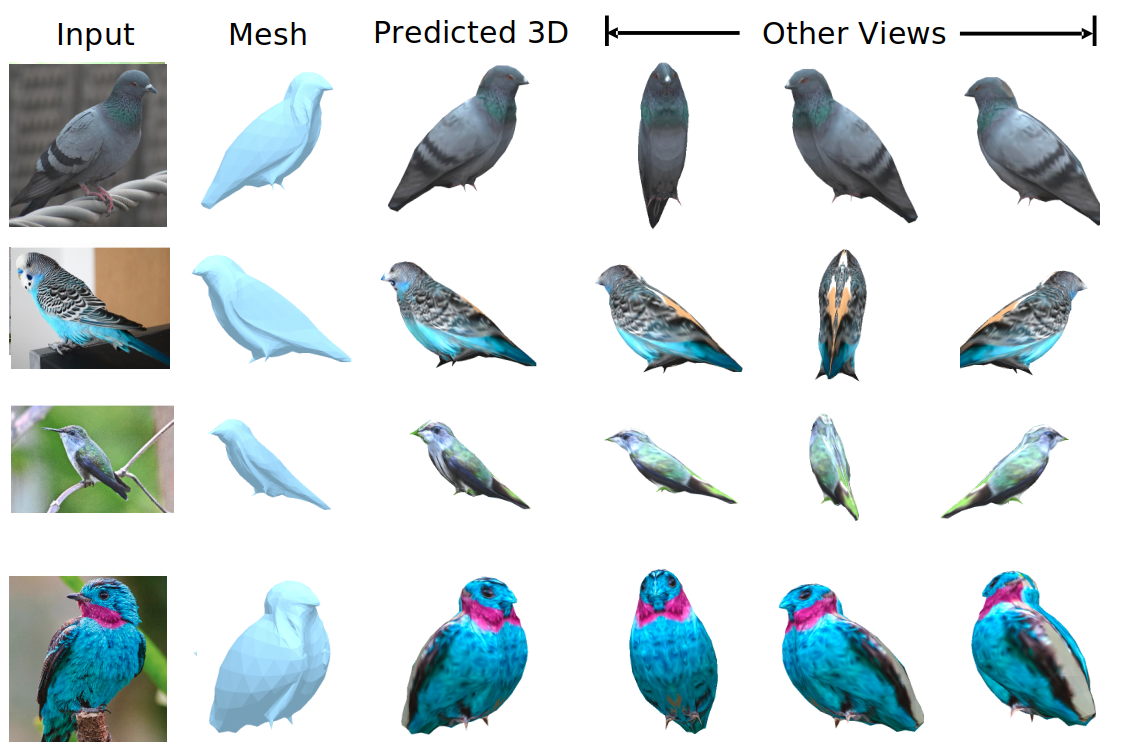
We evaluate our method on different datasets (including ShapeNet, CUB-200-2011, and Pascal3D+) and achieve state-of-the-art results, outperforming all the other supervised and unsupervised methods and 3D representations, all in terms of performance, accuracy, and training time.
Code to reproduce the results for Compositional Attention: Disentangling Search and Retrieval.

Compositional-Attention This repository contains the official implementation for the paper Compositional Attention: Disentangling Search and Retrieval

Code to reproduce the results for Statistically Robust Neural Network Classification, published in UAI 2021

Code to reproduce the results for Statistically Robust Neural Network Classification, published in UAI 2021

This repository contains the source code and data for reproducing results of Deep Continuous Clustering paper

Deep Continuous Clustering Introduction This is a Pytorch implementation of the DCC algorithms presented in the following paper (paper): Sohil Atul Sh

This repository contains the code and models necessary to replicate the results of paper:  How to Robustify Black-Box ML Models? A Zeroth-Order Optimization Perspective
This repository contains the code and models necessary to replicate the results of paper: How to Robustify Black-Box ML Models? A Zeroth-Order Optimization Perspective

Black-Box-Defense This repository contains the code and models necessary to replicate the results of our recent paper: How to Robustify Black-Box ML M

This repository contains the code and models necessary to replicate the results of paper:  How to Robustify Black-Box ML Models? A Zeroth-Order Optimization Perspective
This repository contains the code and models necessary to replicate the results of paper: How to Robustify Black-Box ML Models? A Zeroth-Order Optimization Perspective

Black-Box-Defense This repository contains the code and models necessary to replicate the results of our recent paper: How to Robustify Black-Box ML M

Fast image augmentation library and easy to use wrapper around other libraries. Documentation:  https://albumentations.ai/docs/ Paper about library: https://www.mdpi.com/2078-2489/11/2/125
Fast image augmentation library and easy to use wrapper around other libraries. Documentation: https://albumentations.ai/docs/ Paper about library: https://www.mdpi.com/2078-2489/11/2/125

Albumentations Albumentations is a Python library for image augmentation. Image augmentation is used in deep learning and computer vision tasks to inc

Point Cloud Denoising input segmentation output raw point-cloud valid/clear fog rain de-noised Abstract Lidar sensors are frequently used in environme

Point Cloud Denoising input segmentation output raw point-cloud valid/clear fog rain de-noised Abstract Lidar sensors are frequently used in environme

In this repo we reproduce and extend results of Learning in High Dimension Always Amounts to Extrapolation by Balestriero et al. 2021

In this repo we reproduce and extend results of Learning in High Dimension Always Amounts to Extrapolation by Balestriero et al. 2021. Balestriero et

Releases(v0.2)
Owner
JugLab
GitHub for the JugLab
JugLab
Easily pull telemetry data and create beautiful visualizations for analysis.

This repository is a work in progress. Anything and everything is subject to change. Porpo Table of Contents Porpo Table of Contents General Informati

Ryan Dawes 33 Nov 30, 2022
PyTorch implementation for Score-Based Generative Modeling through Stochastic Differential Equations (ICLR 2021, Oral)

Score-Based Generative Modeling through Stochastic Differential Equations This repo contains a PyTorch implementation for the paper Score-Based Genera

Yang Song 757 Jan 04, 2023
Code for weakly supervised segmentation of a single class

SingleClassRL Implementation of weak single object segmentation from paper "Regularized Loss for Weakly Supervised Single Class Semantic Segmentation"

16 Nov 14, 2022
Original code for "Zero-Shot Domain Adaptation with a Physics Prior"

Zero-Shot Domain Adaptation with a Physics Prior [arXiv] [sup. material] - ICCV 2021 Oral paper, by Attila Lengyel, Sourav Garg, Michael Milford and J

Attila Lengyel 40 Dec 21, 2022
Instance-level Image Retrieval using Reranking Transformers

Instance-level Image Retrieval using Reranking Transformers Fuwen Tan, Jiangbo Yuan, Vicente Ordonez, ICCV 2021. Abstract Instance-level image retriev

UVA Computer Vision 87 Jan 03, 2023
Demonstrational Session git repo for H SAF User Workshop (28/1)

5th H SAF User Workshop The 5th H SAF User Workshop supported by EUMeTrain will be held in online in January 24-28 2022. This repository contains inst

H SAF 4 Aug 04, 2022
ImVoxelNet: Image to Voxels Projection for Monocular and Multi-View General-Purpose 3D Object Detection

ImVoxelNet: Image to Voxels Projection for Monocular and Multi-View General-Purpose 3D Object Detection This repository contains implementation of the

Visual Understanding Lab @ Samsung AI Center Moscow 190 Dec 30, 2022
NUANCED is a user-centric conversational recommendation dataset that contains 5.1k annotated dialogues and 26k high-quality user turns.

NUANCED: Natural Utterance Annotation for Nuanced Conversation with Estimated Distributions Overview NUANCED is a user-centric conversational recommen

Facebook Research 18 Dec 28, 2021
HyperaPy: An automatic hyperparameter optimization framework ⚡🚀

hyperpy HyperPy: An automatic hyperparameter optimization framework Description HyperPy: Library for automatic hyperparameter optimization. Build on t

Sergio Mora 7 Sep 06, 2022
Code for a real-time distributed cooperative slam(RDC-SLAM) system for ROS compatible platforms.

RDC-SLAM This repository contains code for a real-time distributed cooperative slam(RDC-SLAM) system for ROS compatible platforms. The system takes in

40 Nov 19, 2022
(AAAI2022) Style Mixing and Patchwise Prototypical Matching for One-Shot Unsupervised Domain Adaptive Semantic Segmentation

SM-PPM This is a Pytorch implementation of our paper "Style Mixing and Patchwise Prototypical Matching for One-Shot Unsupervised Domain Adaptive Seman

W-zx-Y 10 Dec 07, 2022
PyTorch implementation of Spiking Neural Networks trained on surrogate gradient & BPTT using snntorch.

snn-localization repo PyTorch implementation of Spiking Neural Networks trained on surrogate gradient & BPTT using snntorch. Install Dependencies Orig

Sami BARCHID 1 Jan 06, 2022
TransReID: Transformer-based Object Re-Identification

TransReID: Transformer-based Object Re-Identification [arxiv] The official repository for TransReID: Transformer-based Object Re-Identification achiev

569 Dec 30, 2022
The Face Mask recognition system uses AI technology to detect the person with or without a mask.

Face Mask Detection Face Mask Detection system built with OpenCV, Keras/TensorFlow using Deep Learning and Computer Vision concepts in order to detect

Rohan Kasabe 4 Apr 05, 2022
ObjectDrawer-ToolBox: a graphical image annotation tool to generate ground plane masks for a 3D object reconstruction system

ObjectDrawer-ToolBox is a graphical image annotation tool to generate ground plane masks for a 3D object reconstruction system, Object Drawer.

77 Jan 05, 2023
Like ThreeJS but for Python and based on wgpu

pygfx A render engine, inspired by ThreeJS, but for Python and targeting Vulkan/Metal/DX12 (via wgpu). Introduction This is a Python render engine bui

139 Jan 07, 2023
Dataset Condensation with Contrastive Signals

Dataset Condensation with Contrastive Signals This repository is the official implementation of Dataset Condensation with Contrastive Signals (DCC). T

3 May 19, 2022
Official implementation of the paper 'Details or Artifacts: A Locally Discriminative Learning Approach to Realistic Image Super-Resolution' in CVPR 2022

LDL Paper | Supplementary Material Details or Artifacts: A Locally Discriminative Learning Approach to Realistic Image Super-Resolution Jie Liang*, Hu

150 Dec 26, 2022
This repository is the official implementation of Unleashing the Power of Contrastive Self-Supervised Visual Models via Contrast-Regularized Fine-Tuning (NeurIPS21).

Core-tuning This repository is the official implementation of ``Unleashing the Power of Contrastive Self-Supervised Visual Models via Contrast-Regular

vanint 18 Dec 17, 2022
Polynomial-time Meta-Interpretive Learning

Louise - polynomial-time Program Learning Getting help with Louise Louise's author can be reached by email at Stassa Patsantzis 64 Dec 26, 2022