Application of the L2HMC algorithm to simulations in lattice QCD.

Overview

l2hmc-qcd CodeFactor

πŸ“Š Slides

πŸ“’ Example Notebook


Overview

The L2HMC algorithm aims to improve upon HMC by optimizing a carefully chosen loss function which is designed to minimize autocorrelations within the Markov Chain, thereby improving the efficiency of the sampler.

This work is based on the original implementation: brain-research/l2hmc/.

A detailed description of the L2HMC algorithm can be found in the paper:

Generalizing Hamiltonian Monte Carlo with Neural Network

by Daniel Levy, Matt D. Hoffman and Jascha Sohl-Dickstein.

Broadly, given an analytically described target distribution, Ο€(x), L2HMC provides a statistically exact sampler that:

  • Quickly converges to the target distribution (fast burn-in).
  • Quickly produces uncorrelated samples (fast mixing).
  • Is able to efficiently mix between energy levels.
  • Is capable of traversing low-density zones to mix between modes (often difficult for generic HMC).

L2HMC for LatticeQCD

Goal: Use L2HMC to efficiently generate gauge configurations for calculating observables in lattice QCD.

A detailed description of the (ongoing) work to apply this algorithm to simulations in lattice QCD (specifically, a 2D U(1) lattice gauge theory model) can be found in doc/main.pdf.

l2hmc-qcd poster

Organization

Dynamics / Network

The base class for the augmented L2HMC leapfrog integrator is implemented in the BaseDynamics (a tf.keras.Model object).

The GaugeDynamics is a subclass of BaseDynamics containing modifications for the 2D U(1) pure gauge theory.

The network is defined in l2hmc-qcd/network/functional_net.py.

Network Architecture

An illustration of the leapfrog layer updating (x, v) --> (x', v') can be seen below.

leapfrog layer

Lattice

Lattice code can be found in lattice.py, specifically the GaugeLattice object that provides the base structure on which our target distribution exists.

Additionally, the GaugeLattice object implements a variety of methods for calculating physical observables such as the average plaquette, ΙΈβ‚š, and the topological charge Q,

Training

The training loop is implemented in l2hmc-qcd/utils/training_utils.py .

To train the sampler on a 2D U(1) gauge model using the parameters specified in bin/train_configs.json:

$ python3 /path/to/l2hmc-qcd/l2hmc-qcd/train.py --json_file=/path/to/l2hmc-qcd/bin/train_configs.json

Or via the bin/train.sh script provided in bin/.

Features

  • Distributed training (via horovod): If horovod is installed, the model can be trained across multiple GPUs (or CPUs) by:

    #!/bin/bash
    
    TRAINER=/path/to/l2hmc-qcd/l2hmc-qcd/train.py
    JSON_FILE=/path/to/l2hmc-qcd/bin/train_configs.json
    
    horovodrun -np ${PROCS} python3 ${TRAINER} --json_file=${JSON_FILE}

Contact


Code author: Sam Foreman

Pull requests and issues should be directed to: saforem2

Citation

If you use this code or found this work interesting, please cite our work along with the original paper:

@misc{foreman2021deep,
      title={Deep Learning Hamiltonian Monte Carlo}, 
      author={Sam Foreman and Xiao-Yong Jin and James C. Osborn},
      year={2021},
      eprint={2105.03418},
      archivePrefix={arXiv},
      primaryClass={hep-lat}
}
@article{levy2017generalizing,
  title={Generalizing Hamiltonian Monte Carlo with Neural Networks},
  author={Levy, Daniel and Hoffman, Matthew D. and Sohl-Dickstein, Jascha},
  journal={arXiv preprint arXiv:1711.09268},
  year={2017}
}

Acknowledgement

This research used resources of the Argonne Leadership Computing Facility, which is a DOE Office of Science User Facility supported under contract DE_AC02-06CH11357. This work describes objective technical results and analysis. Any subjective views or opinions that might be expressed in the work do not necessarily represent the views of the U.S. DOE or the United States Government. Declaration of Interests - None.

Hits

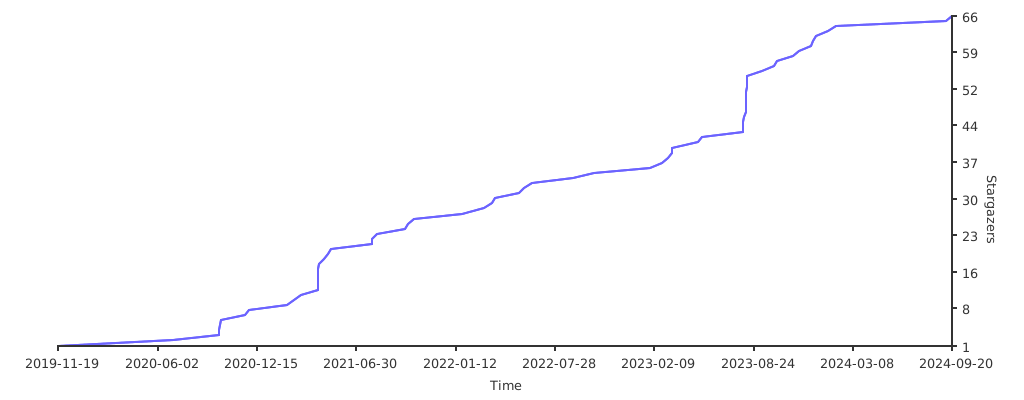
Stargazers over time

Comments
  • Remove upper bound on python_requires

    Remove upper bound on python_requires

    (I'm moving between meetings so can iterate on this more later, so excuse the very brief Issue for now).

    At the moment the project has an upper bound on python_requires

    https://github.com/saforem2/l2hmc-qcd/blob/2eb6ee63cc0c53b187e6d716f4c12f418c8b8515/setup.py#L165

    Assuming that you're intending l2hmc to be a library and not an application, then I would highly recommend removing this for the reasons summarized in Henry's detailed blog post on the subject.

    Congrats on getting l2hmc up on PyPI though! :snake: :rocket:

    opened by matthewfeickert 2
  • Alpha

    Alpha

    Pull upstream alpha branch into main

    Major changes

    • new src/ hierarchical module organization
    • Contains skeleton implementation of 4D SU(3) lattice gauge model
    • Framework independent configuration
      • Unified configuration system simplifies logic, same configs used for both tensorflow and pytorch experiments
      • Plan to be able to specify which backend to use through config option
    • Unified (and framework independent) configurations between tensorflow and pytorch implementations

    Note: This is still very much a WIP. Many existing features still need to be re-implemented / updated into new code in src/.

    Todo

    • [ ] Write unit tests
    • [ ] Use simple configs for end-to-end workflow test + integrate into CI
    • [ ] dynamic learning rate scheduling
    • [ ] Test 4D SU(3) numpy code
    • [ ] Write tensorflow and pytorch implementations of LatticeSU3 objects
    • [ ] Improved / simplified ( / trainable?) annealing schedule
    • [ ] Distributed training support
      • [ ] horovod
      • [ ] DDP for pytorch implementation
      • [ ] DeepSpeed from Microsoft??
    • [ ] Testing / inference logic
    • [ ] Automatic checkpointing
    • [ ] Metric logging
      • [ ] Tensorboard?
      • [ ] Sacred?
      • [ ] build custom dashboard? plot.ly?
    • [ ] Setup packaging / distribution through pip
    • [ ] Resolve issue
    opened by saforem2 1
  • Alpha

    Alpha

    opened by saforem2 1
  • Rich

    Rich

    General improvements, rewrote logging methods to use Rich for better formatting.

    • Adds dynamic (trainable) step size eps for each separate x and v updates, seems to generally increase the total energy towards the middle of the trajectory but it remains unclear if this corresponds to an improvement in the tunneling rate
    • Adds methods for calculating autocorrelations of the topological charge, as well as notebooks for generating the plots
    • Updates to the writeup in doc/main.pdf
    • Will likely be last changes to writeup before public release of official draft
    opened by saforem2 1
  • Dev

    Dev

    • Updates to README

    • Ability to load network with new training instance

    • Updates to doc/, removes old sections related to debugging the bias in the plaquette

    opened by saforem2 1
  • Saveable model

    Saveable model

    Complete rewrite of dynamics.xnet and dynamics.vnet models to use tf.keras.functional Models.

    Additional changes include:

    • Non-Compact Projection update for gauge fields
    • Ability to specify convolution structure to be prepended at beginning of gauge network
    opened by saforem2 1
  • Dev

    Dev

    Removes models/gauge_model.py entirely.

    Instead, a base dynamics class is implemented in dynamics/dynamics.py, and an example subclass is provided in dynamics/gauge_dynamics.py.

    opened by saforem2 1
  • Split networks

    Split networks

    Major rewrite of existing codebase.

    This pull request updates everything to be compatible with tensorflow >= 2.2 and removes a bunch of redundant legacy code.

    opened by saforem2 1
  • Dev

    Dev

    • Dynamics object is now compatible with tf >= 2.0
    • Running inference on trained model with tensorflow now creates identical graphs and summary files to numpy inference code
    • Inference with numpy now uses object oriented structure
    • Adds LaTeX + PDF documentation in doc/
    opened by saforem2 1
  • Cooley dev

    Cooley dev

    Adds new GaugeNetwork architecture as the default for training GaugeModel

    Additionally, replaces pickle with joblib for saving data as .z compressed files (as opposed to .pkl files).

    opened by saforem2 1
  • Testing

    Testing

    Implemented nnehmc_loss calculation for an alternative loss function using the approach suggested in https://infoscience.epfl.ch/record/264887/files/robust_parameter_estimation.pdf.

    This modified loss function can be chosen (instead of the standard loss described in the original paper) by passing --use_nnehmc_loss as a command line argument.

    opened by saforem2 1
  • Packaging and PyPI distribution?

    Packaging and PyPI distribution?

    As you've made a library and are using it as such:

    # snippet from toy_distributions.ipynb
    
    # append parent directory to `sys.path`
    # to load from modules in `../l2hmc-qcd/`
    module_path = os.path.join('..')
    if module_path not in sys.path:
        sys.path.append(module_path)
    
    # Local imports
    from utils.attr_dict import AttrDict
    from utils.training_utils import train_dynamics
    from dynamics.config import DynamicsConfig
    from dynamics.base_dynamics import BaseDynamics
    from dynamics.generic_dynamics import GenericDynamics
    from network.config import LearningRateConfig
    from config import (State, NetWeights, MonteCarloStates,
                        BASE_DIR, BIN_DIR, TF_FLOAT)
    
    from utils.distributions import (plot_samples2D, contour_potential,
                                     two_moons_potential, sin_potential,
                                     sin_potential1, sin_potential2)
    

    do you have any plans and/or interest in packaging it as a Python library so it can either be pip installed from GitHub or be distributed on PyPI?

    opened by matthewfeickert 5
Releases(0.12.0)
Owner
Sam Foreman
Computational science Postdoc at Argonne National Laboratory working on applying machine learning to simulations in lattice QCD.
Sam Foreman
Source code of the paper Meta-learning with an Adaptive Task Scheduler.

ATS About Source code of the paper Meta-learning with an Adaptive Task Scheduler. If you find this repository useful in your research, please cite the

Huaxiu Yao 16 Dec 26, 2022
El-Gamal on Elliptic Curve (Python)

El-Gamal-on-EC El-Gamal on Elliptic Curve (Python) References: https://docsdrive.com/pdfs/ansinet/itj/2005/299-306.pdf https://arxiv.org/ftp/arxiv/pap

3 May 04, 2022
This is the code for ACL2021 paper A Unified Generative Framework for Aspect-Based Sentiment Analysis

This is the code for ACL2021 paper A Unified Generative Framework for Aspect-Based Sentiment Analysis Install the package in the requirements.txt, the

108 Dec 23, 2022
Quantized tflite models for ailia TFLite Runtime

ailia-models-tflite Quantized tflite models for ailia TFLite Runtime About ailia TFLite Runtime ailia TF Lite Runtime is a TensorFlow Lite compatible

ax Inc. 13 Dec 23, 2022
[CVPR2021 Oral] FFB6D: A Full Flow Bidirectional Fusion Network for 6D Pose Estimation.

FFB6D This is the official source code for the CVPR2021 Oral work, FFB6D: A Full Flow Biderectional Fusion Network for 6D Pose Estimation. (Arxiv) Tab

Yisheng (Ethan) He 201 Dec 28, 2022
AISTATS 2019: Confidence-based Graph Convolutional Networks for Semi-Supervised Learning

Confidence-based Graph Convolutional Networks for Semi-Supervised Learning Source code for AISTATS 2019 paper: Confidence-based Graph Convolutional Ne

MALL Lab (IISc) 56 Dec 03, 2022
Robbing the FED: Directly Obtaining Private Data in Federated Learning with Modified Models

Robbing the FED: Directly Obtaining Private Data in Federated Learning with Modified Models This repo contains a barebones implementation for the atta

16 Dec 04, 2022
ProjectOxford-ClientSDK - This repo has moved :house: Visit our website for the latest SDKs & Samples

This project has moved 🏠 We heard your feedback! This repo has been deprecated and each project has moved to a new home in a repo scoped by API and p

Microsoft 970 Nov 28, 2022
Context-Sensitive Misspelling Correction of Clinical Text via Conditional Independence, CHIL 2022

cim-misspelling Pytorch implementation of Context-Sensitive Spelling Correction of Clinical Text via Conditional Independence, CHIL 2022. This model (

Juyong Kim 11 Dec 19, 2022
Implementation of Multistream Transformers in Pytorch

Multistream Transformers Implementation of Multistream Transformers in Pytorch. This repository deviates slightly from the paper, where instead of usi

Phil Wang 47 Jul 26, 2022
Face Mask Detector by live camera using tensorflow-keras, openCV and Python

Face Mask Detector 😷 by Live Camera Detecting masked or unmasked faces by live camera with percentange of mask occupation About Project: This an Arti

Karan Shingde 2 Apr 04, 2022
Repository for publicly available deep learning models developed in Rosetta community

trRosetta2 This package contains deep learning models and related scripts used by Baker group in CASP14. Installation Linux/Mac clone the package git

81 Dec 29, 2022
A universal framework for learning timestamp-level representations of time series

TS2Vec This repository contains the official implementation for the paper Learning Timestamp-Level Representations for Time Series with Hierarchical C

Zhihan Yue 284 Dec 30, 2022
CUda Matrix Multiply library.

cumm CUda Matrix Multiply library. cumm is developed during learning of CUTLASS, which use too much c++ template and make code unmaintainable. So I de

49 Dec 27, 2022
Code for Universal Semi-Supervised Semantic Segmentation models paper accepted in ICCV 2019

USSS_ICCV19 Code for Universal Semi Supervised Semantic Segmentation accepted to ICCV 2019. Full Paper available at https://arxiv.org/abs/1811.10323.

Tarun K 68 Nov 24, 2022
Monitor your ML jobs on mobile devicesπŸ“±, especially for Google Colab / Kaggle

TF Watcher TF Watcher is a simple to use Python package and web app which allows you to monitor πŸ‘€ your Machine Learning training or testing process o

Rishit Dagli 54 Nov 01, 2022
toroidal - a lightweight transformer library for PyTorch

toroidal - a lightweight transformer library for PyTorch Toroidal transformers are of smaller size and lower weight than the more common E-I types. Th

MathInf GmbH 64 Jan 07, 2023
Training a deep learning model on the noisy CIFAR dataset

Training-a-deep-learning-model-on-the-noisy-CIFAR-dataset This repository contai

1 Jun 14, 2022
N-HiTS: Neural Hierarchical Interpolation for Time Series Forecasting

N-HiTS: Neural Hierarchical Interpolation for Time Series Forecasting Recent progress in neural forecasting instigated significant improvements in the

Cristian Challu 82 Jan 04, 2023
Tweesent-back - Tweesent backend uses fastAPI as the web framework

TweeSent Backend Tweesent backend. This repo uses fastAPI as the web framework.

0 Mar 26, 2022