Implementation of "Fast and Flexible Temporal Point Processes with Triangular Maps" (Oral @ NeurIPS 2020)

Overview

Fast and Flexible Temporal Point Processes with Triangular Maps
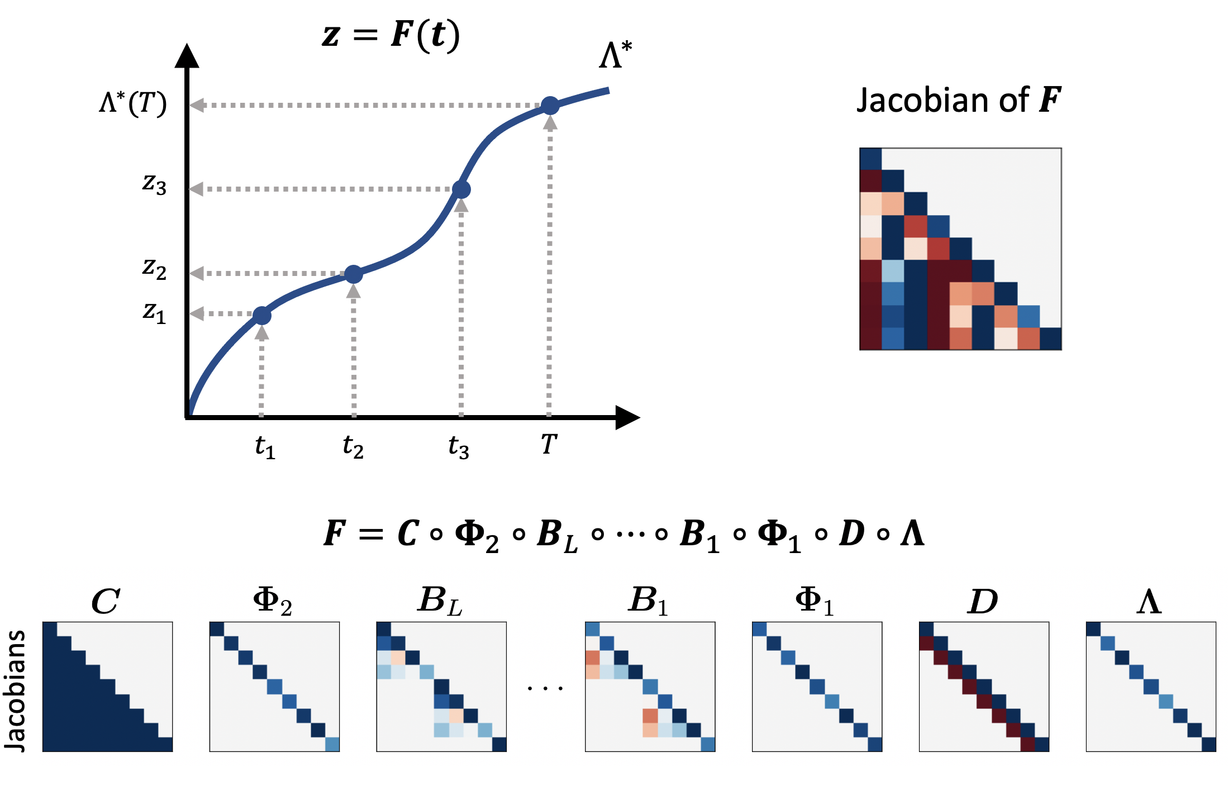
This repository includes a reference implementation of the algorithms described in "Fast and Flexible Temporal Point Processes with Triangular Maps" by Oleksandr Shchur, Nicholas Gao, Marin Biloš and Stephan Günnemann (Oral, NeurIPS 2020).

Temporal point processes (TPPs) allow us to define probability distributions over variable-length event sequences in some time interval [0, t_max]. In our paper, we show how to define TPPs using invertible transformations, similar to normalizing flows. The code includes new parametrizations for several existing TPPs as well as a new, more flexible model. Our parametrizations allow to both draw samples & compute likelihood in parallel, which leads to signficant speedups compared to traditional RNN-based models.

The following models are available in ttpp.models:

  • Inhomogeneous Poisson Process
  • Renewal Process
  • Modulated Renewal Process
  • TriTPP
  • Autoregressive (RNN-based TPP with slow sampling)

Requirements

The code is written in Python version 3.7 and was tested on Ubuntu 18.04. The code requires PyTorch version 1.5 with CUDA enabled. Other requirements are listed in requirements.txt.

To install the library run

pip install -e .

The datasets used in the paper can be found in data/.

Usage

Jupyter notebooks reproducing the experimental results can be found in the notebooks/ folder:

You can also train the model using command line. For example, to train the TriTPP model on the taxi dataset run

python scripts/experiment.py taxi TriTPP

To see the command line arguments, use

python scripts/experiment.py --help

Cite

Please cite our paper if you use this code or data in your own work:

@inproceedings{shchur2020fast,
  title = {Fast and Flexible Temporal Point Processes with Triangular Maps},
  author = {Shchur, Oleksandr and Gao, Nicholas and Bilo\v{s}, Marin and G{\"u}nnemann, Stephan},
  booktitle={Advances in Neural Information Processing Systems (NeurIPS)},
  year = {2020} 
}
Owner
Oleksandr Shchur
PhD student in Machine Learning at Technical University of Munich
Oleksandr Shchur
Action Recognition for Self-Driving Cars

Action Recognition for Self-Driving Cars This repo contains the codes for the 2021 Fall semester project "Action Recognition for Self-Driving Cars" at

VITA lab at EPFL 3 Apr 07, 2022
Resources for our AAAI 2022 paper: "LOREN: Logic-Regularized Reasoning for Interpretable Fact Verification".

LOREN Resources for our AAAI 2022 paper (pre-print): "LOREN: Logic-Regularized Reasoning for Interpretable Fact Verification". DEMO System Check out o

Jiangjie Chen 37 Dec 27, 2022
PyTorch implementation of EGVSR: Efficcient & Generic Video Super-Resolution (VSR)

This is a PyTorch implementation of EGVSR: Efficcient & Generic Video Super-Resolution (VSR), using subpixel convolution to optimize the inference speed of TecoGAN VSR model. Please refer to the offi

789 Jan 04, 2023
ICLR2021 (Under Review)

Self-Supervised Time Series Representation Learning by Inter-Intra Relational Reasoning This repository contains the official PyTorch implementation o

Haoyi Fan 58 Dec 30, 2022
RefineGNN - Iterative refinement graph neural network for antibody sequence-structure co-design (RefineGNN)

Iterative refinement graph neural network for antibody sequence-structure co-des

Wengong Jin 83 Dec 31, 2022
Evidential Softmax for Sparse Multimodal Distributions in Deep Generative Models

Evidential Softmax for Sparse Multimodal Distributions in Deep Generative Models Abstract Many applications of generative models rely on the marginali

Stanford Intelligent Systems Laboratory 9 Jun 06, 2022
Extracting and filtering paraphrases by bridging natural language inference and paraphrasing

nli2paraphrases Source code repository accompanying the preprint Extracting and filtering paraphrases by bridging natural language inference and parap

Matej Klemen 1 Mar 09, 2022
BYOL for Audio: Self-Supervised Learning for General-Purpose Audio Representation

BYOL for Audio: Self-Supervised Learning for General-Purpose Audio Representation This is a demo implementation of BYOL for Audio (BYOL-A), a self-sup

NTT Communication Science Laboratories 160 Jan 04, 2023
Pytorch implementation of Implicit Behavior Cloning.

Implicit Behavior Cloning - PyTorch (wip) Pytorch implementation of Implicit Behavior Cloning. Install conda create -n ibc python=3.8 pip install -r r

Kevin Zakka 49 Dec 25, 2022
[CVPR'21] Projecting Your View Attentively: Monocular Road Scene Layout Estimation via Cross-view Transformation

Projecting Your View Attentively: Monocular Road Scene Layout Estimation via Cross-view Transformation Weixiang Yang, Qi Li, Wenxi Liu, Yuanlong Yu, Y

118 Dec 26, 2022
Tensorflow implementation of "Learning Deep Features for Discriminative Localization"

Weakly_detector Tensorflow implementation of "Learning Deep Features for Discriminative Localization" B. Zhou, A. Khosla, A. Lapedriza, A. Oliva, and

Taeksoo Kim 363 Jun 29, 2022
MM1 and MMC Queue Simulation using python - Results and parameters in excel and csv files

implementation of MM1 and MMC Queue on randomly generated data and evaluate simulation results then compare with analytical results and draw a plot curve for them, simulate some integrals and compare

Mohamadreza Rezaei 1 Jan 19, 2022
[CVPR 2021] Modular Interactive Video Object Segmentation: Interaction-to-Mask, Propagation and Difference-Aware Fusion

[CVPR 2021] Modular Interactive Video Object Segmentation: Interaction-to-Mask, Propagation and Difference-Aware Fusion

Rex Cheng 364 Jan 03, 2023
Analyses of the individual electric field magnitudes with Roast.

Aloi Davide - PhD Student (UoB) Analysis of electric field magnitudes (wp2a dataset only at the moment) and correlation analysis with Dynamic Causal M

Davide Aloi 7 Dec 15, 2022
Relative Positional Encoding for Transformers with Linear Complexity

Stochastic Positional Encoding (SPE) This is the source code repository for the ICML 2021 paper Relative Positional Encoding for Transformers with Lin

Antoine Liutkus 48 Nov 16, 2022
Segmentation in Style: Unsupervised Semantic Image Segmentation with Stylegan and CLIP

Segmentation in Style: Unsupervised Semantic Image Segmentation with Stylegan and CLIP Abstract: We introduce a method that allows to automatically se

Daniil Pakhomov 134 Dec 19, 2022
Dialect classification

Dialect-Classification This repository presents the data that was used in a talk at ICKL-5 (5th International Conference on Kurdish Linguistics) at th

Kurdish-BLARK 0 Nov 12, 2021
LUKE -- Language Understanding with Knowledge-based Embeddings

LUKE (Language Understanding with Knowledge-based Embeddings) is a new pre-trained contextualized representation of words and entities based on transf

Studio Ousia 587 Dec 30, 2022
WRENCH: Weak supeRvision bENCHmark

🔧 What is it? Wrench is a benchmark platform containing diverse weak supervision tasks. It also provides a common and easy framework for development

Jieyu Zhang 176 Dec 28, 2022
Small utility to demangle Nim symbols in callgrind files

nim_callgrind A small utility to demangle Nim symbols from callgrind files. Usage Run your (Nim) program with something like this: valgrind --tool=cal

kraptor 3 Feb 15, 2022