Graph Attention Networks

Overview

GAT

Graph Attention Networks (Veličković et al., ICLR 2018): https://arxiv.org/abs/1710.10903

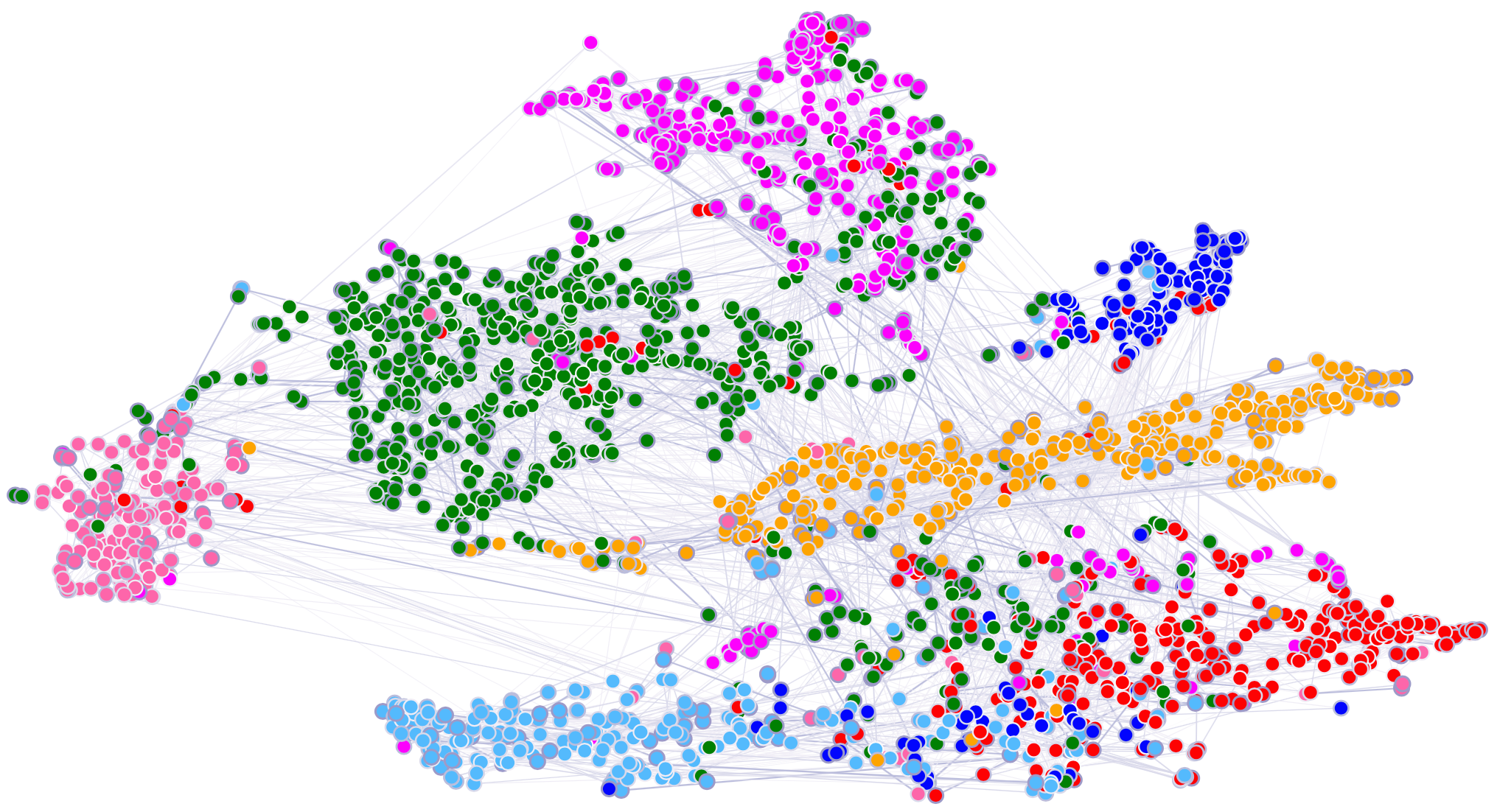
GAT layer t-SNE + Attention coefficients on Cora

Overview

Here we provide the implementation of a Graph Attention Network (GAT) layer in TensorFlow, along with a minimal execution example (on the Cora dataset). The repository is organised as follows:

  • data/ contains the necessary dataset files for Cora;
  • models/ contains the implementation of the GAT network (gat.py);
  • pre_trained/ contains a pre-trained Cora model (achieving 84.4% accuracy on the test set);
  • utils/ contains:
    • an implementation of an attention head, along with an experimental sparse version (layers.py);
    • preprocessing subroutines (process.py);
    • preprocessing utilities for the PPI benchmark (process_ppi.py).

Finally, execute_cora.py puts all of the above together and may be used to execute a full training run on Cora.

Sparse version

An experimental sparse version is also available, working only when the batch size is equal to 1. The sparse model may be found at models/sp_gat.py.

You may execute a full training run of the sparse model on Cora through execute_cora_sparse.py.

Dependencies

The script has been tested running under Python 3.5.2, with the following packages installed (along with their dependencies):

  • numpy==1.14.1
  • scipy==1.0.0
  • networkx==2.1
  • tensorflow-gpu==1.6.0

In addition, CUDA 9.0 and cuDNN 7 have been used.

Reference

If you make advantage of the GAT model in your research, please cite the following in your manuscript:

@article{
  velickovic2018graph,
  title="{Graph Attention Networks}",
  author={Veli{\v{c}}kovi{\'{c}}, Petar and Cucurull, Guillem and Casanova, Arantxa and Romero, Adriana and Li{\`{o}}, Pietro and Bengio, Yoshua},
  journal={International Conference on Learning Representations},
  year={2018},
  url={https://openreview.net/forum?id=rJXMpikCZ},
  note={accepted as poster},
}

For getting started with GATs, as well as graph representation learning in general, we highly recommend the pytorch-GAT repository by Aleksa Gordić. It ships with an inductive (PPI) example as well.

GAT is a popular method for graph representation learning, with optimised implementations within virtually all standard GRL libraries:

We recommend using either one of those (depending on your favoured framework), as their implementations have been more readily battle-tested.

Early on post-release, two unofficial ports of the GAT model to various frameworks quickly surfaced. To honour the effort of their developers as early adopters of the GAT layer, we leave pointers to them here.

License

MIT

Owner
Petar Veličković
Senior Research Scientist
Petar Veličković
Implementation of the Remixer Block from the Remixer paper, in Pytorch

Remixer - Pytorch Implementation of the Remixer Block from the Remixer paper, in Pytorch. It claims that substituting the feedforwards in transformers

Phil Wang 35 Aug 23, 2022
PyTorch implementation of Algorithm 1 of "On the Anatomy of MCMC-Based Maximum Likelihood Learning of Energy-Based Models"

Code for On the Anatomy of MCMC-Based Maximum Likelihood Learning of Energy-Based Models This repository will reproduce the main results from our pape

Mitch Hill 32 Nov 25, 2022
CVPR 2021 Challenge on Super-Resolution Space

Learning the Super-Resolution Space Challenge NTIRE 2021 at CVPR Learning the Super-Resolution Space challenge is held as a part of the 6th edition of

andreas 104 Oct 26, 2022
PyTorch-centric library for evaluating and enhancing the robustness of AI technologies

Responsible AI Toolbox A library that provides high-quality, PyTorch-centric tools for evaluating and enhancing both the robustness and the explainabi

24 Dec 22, 2022
Jiminy Cricket Environment (NeurIPS 2021)

Jiminy Cricket This is the repository for "What Would Jiminy Cricket Do? Towards Agents That Behave Morally" by Dan Hendrycks*, Mantas Mazeika*, Andy

Dan Hendrycks 15 Aug 29, 2022
IOT: Instance-wise Layer Reordering for Transformer Structures

Introduction This repository contains the code for Instance-wise Ordered Transformer (IOT), which is introduced in the ICLR2021 paper IOT: Instance-wi

IOT 19 Nov 15, 2022
Competitive Programming Club, Clinify's Official repository for CP problems hosting by club members.

Clinify-CPC_Programs This repository holds the record of the competitive programming club where the competitive coding aspirants are thriving hard and

Clinify Open Sauce 4 Aug 22, 2022
Orbivator AI - To Determine which features of data (measurements) are most important for diagnosing breast cancer and find out if breast cancer occurs or not.

Orbivator_AI Breast Cancer Wisconsin (Diagnostic) GOAL To Determine which features of data (measurements) are most important for diagnosing breast can

anurag kumar singh 1 Jan 02, 2022
ViSER: Video-Specific Surface Embeddings for Articulated 3D Shape Reconstruction

ViSER: Video-Specific Surface Embeddings for Articulated 3D Shape Reconstruction. NeurIPS 2021.

Gengshan Yang 59 Nov 25, 2022
Toolbox to analyze temporal context invariance of deep neural networks

PyTCI A toolbox that estimates the integration window of a sensory response using the "Temporal Context Invariance" paradigm (TCI). The TCI method Int

4 Oct 23, 2022
[AI6101] Introduction to AI & AI Ethics is a core course of MSAI, SCSE, NTU, Singapore

[AI6101] Introduction to AI & AI Ethics is a core course of MSAI, SCSE, NTU, Singapore. The repository corresponds to the AI6101 of Semester 1, AY2021-2022, starting from 08/2021. The instructors of

AccSrd 1 Sep 22, 2022
Code for the paper "Adversarial Generator-Encoder Networks"

This repository contains code for the paper "Adversarial Generator-Encoder Networks" (AAAI'18) by Dmitry Ulyanov, Andrea Vedaldi, Victor Lempitsky. Pr

Dmitry Ulyanov 279 Jun 26, 2022
official code for dynamic convolution decomposition

Revisiting Dynamic Convolution via Matrix Decomposition (ICLR 2021) A pytorch implementation of DCD. If you use this code in your research please cons

Yunsheng Li 110 Nov 23, 2022
Python lib to talk to pylontech lithium batteries (US2000, US3000, ...) using RS485

python-pylontech Python lib to talk to pylontech lithium batteries (US2000, US3000, ...) using RS485 What is this lib ? This lib is meant to talk to P

Frank 26 Dec 28, 2022
CenterNet:Objects as Points目标检测模型在Pytorch当中的实现

CenterNet:Objects as Points目标检测模型在Pytorch当中的实现

Bubbliiiing 267 Dec 29, 2022
Pytorch code for our paper "Feedback Network for Image Super-Resolution" (CVPR2019)

Feedback Network for Image Super-Resolution [arXiv] [CVF] [Poster] Update: Our proposed Gated Multiple Feedback Network (GMFN) will appear in BMVC2019

Zhen Li 539 Jan 06, 2023
PyTorch implementation for "Sharpness-aware Quantization for Deep Neural Networks".

Sharpness-aware Quantization for Deep Neural Networks Recent Update 2021.11.23: We release the source code of SAQ. Setup the environments Clone the re

Zhuang AI Group 30 Dec 19, 2022
[CVPR2022] Representation Compensation Networks for Continual Semantic Segmentation

RCIL [CVPR2022] Representation Compensation Networks for Continual Semantic Segmentation Chang-Bin Zhang1, Jia-Wen Xiao1, Xialei Liu1, Ying-Cong Chen2

Chang-Bin Zhang 71 Dec 28, 2022
Learn about quantum computing and algorithm on quantum computing

quantum_computing this repo contains everything i learn about quantum computing and algorithm on quantum computing what is aquantum computing quantum

arfy slowy 8 Dec 25, 2022
Framework to build and train RL algorithms

RayLink RayLink is a RL framework used to build and train RL algorithms. RayLink was used to build a RL framework, and tested in a large-scale multi-a

Bytedance Inc. 32 Oct 07, 2022