Beginner-friendly repository for Hacktober Fest 2021. Start your contribution to open source through baby steps. 💜

Overview

Hacktober Fest 2021

🎉 Open source is changing the world – one contribution at a time! 🎉


This repository is made for beginners who are unfamiliar with open source and GitHub. So what is holding you back?! Make your first contribution to the open source and take home swags. 👕 📦

What is Hacktober Fest?

Hacktoberfest is a month-long open source contribution program hosted by DigitalOcean in the month of October for supporting open source development. Hacktoberfest encourages participation in the open source community, which grows bigger every year. Whether you are a pro in programming or a newbie, Hacktoberfest welcomes each one of the contributors for providing their valuable contribution to the open source community. Completing the challenge earns you a limited edition swags and other exiciting goodies.

How to receive swags?

  • Register yourself at the Hacktober Fest Website
  • Create 4 pull-requests from repositories participating in the challenge (repositories having hacktoberfest topic)
  • Successfully merged PRs will be validated further for 14 days.
  • After that, the PR is accepted
  • Remember! All PRs must be done between October 1 to October 31 to be eligible for swags.
  • This year the first 55,000 participants will be eligible for the prize.

How to contribute?

Read RULES.md before creating a pull request

PRs violating the rules will be closed and reported Spam!

If you're not comfortable with command line, here are tutorials using GUI tools. If you don't have git on your machine, install it.

1. Fork the repository.
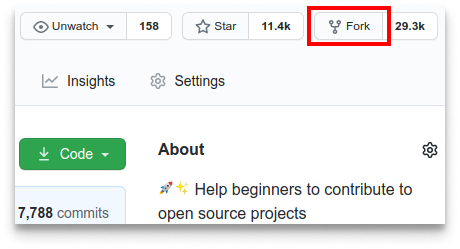
fork this repository

2. Clone your forked copy of the project.

git clone  https://github.com/abhilashmnair/HacktoberFest2021.git

3. Navigate to the project directory 📁 .

cd HacktoberFest2021

4. Add a reference(remote) to the original repository.

git remote add upstream https://github.com/abhilashmnair/HacktoberFest2021.git

5. Check the remotes for this repository.

git remote -v

6. Always take a pull from the upstream repository to your master branch to keep it at par with the main project(updated repository).

git pull upstream main

7. Create a new branch.

git checkout -b <your_branch_name>

8. Perform your desired changes to the code base.

9. Track your changes ✔️ .

git add *

10. Commit your changes .

git commit -m "Message"

11. Push the committed changes in your feature branch to your remote repo.

git push -u origin <your_branch_name>

12. To create a pull request, click on compare and pull requests. Please ensure you compare your feature branch to the desired branch of the repository you are supposed to make a PR to.

Not a developer or programmer? Don't worry! Add useful documentation and fix grammatical errors in the README file. Every single contribution of yours will benefit your open source venture.

License

This repository and the contained files are licensed under MIT License. See LICENSE for full text.


💜 Thank You for your participation! 💜

Owner
Abhilash M Nair
Abhilash M Nair
A Review of Deep Learning Techniques for Markerless Human Motion on Synthetic Datasets

HOW TO USE THIS PROJECT A Review of Deep Learning Techniques for Markerless Human Motion on Synthetic Datasets Based on DeepLabCut toolbox, we run wit

1 Jan 10, 2022
Semi-SDP Semi-supervised parser for semantic dependency parsing.

Semi-SDP Semi-supervised parser for semantic dependency parsing. This repo contains the code used for the semi-supervised semantic dependency parser i

12 Sep 17, 2021
GradAttack is a Python library for easy evaluation of privacy risks in public gradients in Federated Learning

GradAttack is a Python library for easy evaluation of privacy risks in public gradients in Federated Learning, as well as corresponding mitigation strategies.

129 Dec 30, 2022
CityLearn Challenge Multi-Agent Reinforcement Learning for Intelligent Energy Management, 2020, PikaPika team

Citylearn Challenge This is the PyTorch implementation for PikaPika team, CityLearn Challenge Multi-Agent Reinforcement Learning for Intelligent Energ

bigAIdream projects 10 Oct 10, 2022
Iris prediction model is used to classify iris species created julia's DecisionTree, DataFrames, JLD2, PlotlyJS and Statistics packages.

Iris Species Predictor Iris prediction is used to classify iris species using their sepal length, sepal width, petal length and petal width created us

Siva Prakash 2 Jan 06, 2022
Keras Implementation of The One Hundred Layers Tiramisu: Fully Convolutional DenseNets for Semantic Segmentation by (Simon Jégou, Michal Drozdzal, David Vazquez, Adriana Romero, Yoshua Bengio)

The One Hundred Layers Tiramisu: Fully Convolutional DenseNets for Semantic Segmentation: Work In Progress, Results can't be replicated yet with the m

Yad Konrad 196 Aug 30, 2022
RepMLP: Re-parameterizing Convolutions into Fully-connected Layers for Image Recognition

RepMLP: Re-parameterizing Convolutions into Fully-connected Layers for Image Recognition (PyTorch) Paper: https://arxiv.org/abs/2105.01883 Citation: @

260 Jan 03, 2023
IEGAN — Official PyTorch Implementation Independent Encoder for Deep Hierarchical Unsupervised Image-to-Image Translation

IEGAN — Official PyTorch Implementation Independent Encoder for Deep Hierarchical Unsupervised Image-to-Image Translation Independent Encoder for Deep

30 Nov 05, 2022
PyTorch implementation of DeepLab v2 on COCO-Stuff / PASCAL VOC

DeepLab with PyTorch This is an unofficial PyTorch implementation of DeepLab v2 [1] with a ResNet-101 backbone. COCO-Stuff dataset [2] and PASCAL VOC

Kazuto Nakashima 995 Jan 08, 2023
4th place solution to datafactory challenge by Intermarché.

Solution to Datafactory challenge by Intermarché. 4th place solution to datafactory challenge by Intermarché. The objective of the challenge is to pre

Raphael Sourty 11 Mar 19, 2022
A simple, unofficial implementation of MAE using pytorch-lightning

Masked Autoencoders in PyTorch A simple, unofficial implementation of MAE (Masked Autoencoders are Scalable Vision Learners) using pytorch-lightning.

Connor Anderson 20 Dec 03, 2022
Application of the L2HMC algorithm to simulations in lattice QCD.

l2hmc-qcd 📊 Slides Recent talk on Training Topological Samplers for Lattice Gauge Theory from the Machine Learning for High Energy Physics, on and of

Sam Foreman 37 Dec 14, 2022
[ICCV2021] Official Pytorch implementation for SDGZSL (Semantics Disentangling for Generalized Zero-Shot Learning)

Semantics Disentangling for Generalized Zero-shot Learning This is the official implementation for paper Zhi Chen, Yadan Luo, Ruihong Qiu, Zi Huang, J

25 Dec 06, 2022
exponential adaptive pooling for PyTorch

AdaPool: Exponential Adaptive Pooling for Information-Retaining Downsampling Abstract Pooling layers are essential building blocks of Convolutional Ne

Alexandros Stergiou 55 Jan 04, 2023
SMIS - Semantically Multi-modal Image Synthesis(CVPR 2020)

Semantically Multi-modal Image Synthesis Project page / Paper / Demo Semantically Multi-modal Image Synthesis(CVPR2020). Zhen Zhu, Zhiliang Xu, Anshen

316 Dec 01, 2022
The mini-MusicNet dataset

mini-MusicNet A music-domain dataset for multi-label classification Music transcription is sequence-to-sequence prediction problem: given an audio per

John Thickstun 4 Nov 09, 2022
Official Implementation of 'UPDeT: Universal Multi-agent Reinforcement Learning via Policy Decoupling with Transformers' ICLR 2021(spotlight)

UPDeT Official Implementation of UPDeT: Universal Multi-agent Reinforcement Learning via Policy Decoupling with Transformers (ICLR 2021 spotlight) The

hhhusiyi 96 Dec 22, 2022
Text-to-SQL in the Wild: A Naturally-Occurring Dataset Based on Stack Exchange Data

SEDE SEDE (Stack Exchange Data Explorer) is new dataset for Text-to-SQL tasks with more than 12,000 SQL queries and their natural language description

Rupert. 83 Nov 11, 2022
Reproduce partial features of DeePMD-kit using PyTorch.

DeePMD-kit on PyTorch For better understand DeePMD-kit, we implement its partial features using PyTorch and expose interface consuing descriptors. Tec

Shaochen Shi 8 Dec 17, 2022
Revisiting Global Statistics Aggregation for Improving Image Restoration

Revisiting Global Statistics Aggregation for Improving Image Restoration Xiaojie Chu, Liangyu Chen, Chengpeng Chen, Xin Lu Paper: https://arxiv.org/pd

MEGVII Research 128 Dec 24, 2022