A criticism of a recent paper on buggy image downsampling methods in popular image processing and deep learning libraries.

Overview

A Criticism of the Paper On Buggy Resizing Libraries

This repository contains:

  • a Jupyter notebook for reproducing the aliased image downsampling fenomenon, as demonstrated in the On Buggy Resizing Libraries paper, which argues that the image downsampling methods of the OpenCV, Tensorflow and PyTorch libraries are "buggy", with only PIL being correct.
  • simple solutions for antialiasing in every framework, which solves the issue in all cases using the same functions, simply by setting parameters appropriately:

Try it out in a Colab Notebook: Open In Colab

My opinion:

  • neither of the used image downsampling methods is "buggy", not applying antialiasing by default is an understandable design decision for both image and tensor operations.
  • the main figure of the paper is misleading, and it only illustrates the issues of aliasing for image resizing.
  • the aliasing issue with downsampling can be solved in all frameworks by simply setting a few parameters correctly. My criticism is that this is not mentioned in the paper.
  • torchvision.transforms.Resize() is claimed to only be a "a wrapper around the PIL library" in a note in Section 3.2 of the paper. This is true for PIL image inputs, but is incorrect for torch.Tensors, which are resized using torchvision interpolation operations.
  • the remaining parts of the paper provide valuable insights into the effects of interpolation methods, quantization and compression on the FID score of generative models.

Update: Just found out that there is another, very thorough investigation of the same issue. Highly recommend checking the blogpost out. They also implement an OpenCV-compatible Pillow-equivalent resizing that provides proper antialiasing for all interpolations.

Bilinear downsampling results with and without aliasing: resizing with and without aliasing

The main figure (Figure 1) of the paper:
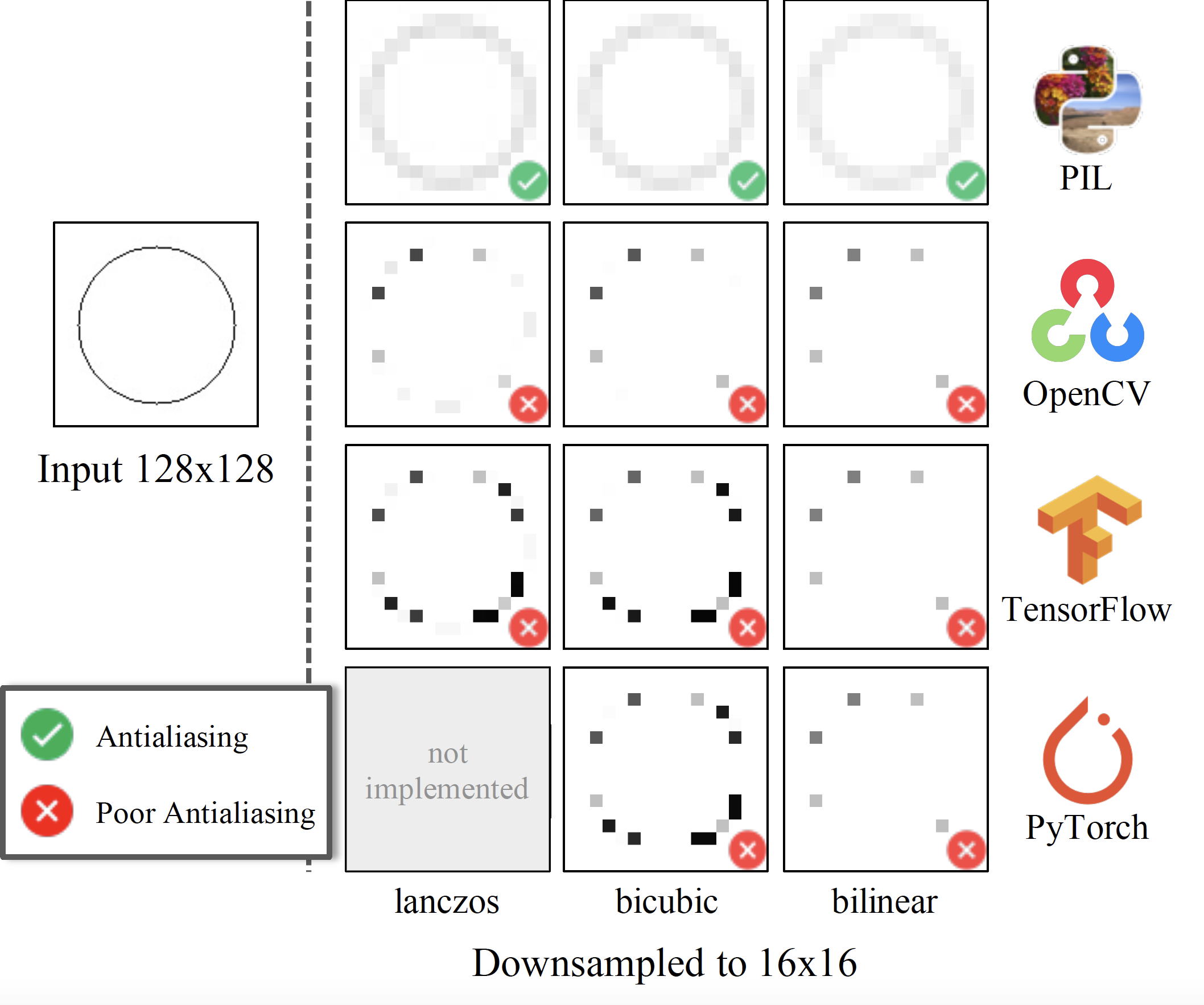
resizing with aliasing

A pytorch-version implementation codes of paper: "BSN++: Complementary Boundary Regressor with Scale-Balanced Relation Modeling for Temporal Action Proposal Generation"

BSN++: Complementary Boundary Regressor with Scale-Balanced Relation Modeling for Temporal Action Proposal Generation A pytorch-version implementation

11 Oct 08, 2022
End-To-End Crowdsourcing

End-To-End Crowdsourcing Comparison of traditional crowdsourcing approaches to a state-of-the-art end-to-end crowdsourcing approach LTNet on sentiment

Andreas Koch 1 Mar 06, 2022
Codes for TIM2021 paper "Anchor-Based Spatio-Temporal Attention 3-D Convolutional Networks for Dynamic 3-D Point Cloud Sequences"

Codes for TIM2021 paper "Anchor-Based Spatio-Temporal Attention 3-D Convolutional Networks for Dynamic 3-D Point Cloud Sequences"

Intelligent Robotics and Machine Vision Lab 4 Jul 19, 2022
An inofficial PyTorch implementation of PREDATOR based on KPConv.

PREDATOR: Registration of 3D Point Clouds with Low Overlap An inofficial PyTorch implementation of PREDATOR based on KPConv. The code has been tested

ZhuLifa 14 Aug 03, 2022
Fast Style Transfer in TensorFlow

Fast Style Transfer in TensorFlow Add styles from famous paintings to any photo in a fraction of a second! You can even style videos! It takes 100ms o

Jefferson 5 Oct 24, 2021
PyTorch code for the ICCV'21 paper: "Always Be Dreaming: A New Approach for Class-Incremental Learning"

Always Be Dreaming: A New Approach for Data-Free Class-Incremental Learning PyTorch code for the ICCV 2021 paper: Always Be Dreaming: A New Approach f

49 Dec 21, 2022
DeconvNet : Learning Deconvolution Network for Semantic Segmentation

DeconvNet: Learning Deconvolution Network for Semantic Segmentation Created by Hyeonwoo Noh, Seunghoon Hong and Bohyung Han at POSTECH Acknowledgement

Hyeonwoo Noh 325 Oct 20, 2022
LightHuBERT: Lightweight and Configurable Speech Representation Learning with Once-for-All Hidden-Unit BERT

LightHuBERT LightHuBERT: Lightweight and Configurable Speech Representation Learning with Once-for-All Hidden-Unit BERT | Github | Huggingface | SUPER

WangRui 46 Dec 29, 2022
Build fully-functioning computer vision models with PyTorch

Detecto is a Python package that allows you to build fully-functioning computer vision and object detection models with just 5 lines of code. Inferenc

Alan Bi 576 Dec 29, 2022
High-quality implementations of standard and SOTA methods on a variety of tasks.

Uncertainty Baselines The goal of Uncertainty Baselines is to provide a template for researchers to build on. The baselines can be a starting point fo

Google 1.1k Dec 30, 2022
The Self-Supervised Learner can be used to train a classifier with fewer labeled examples needed using self-supervised learning.

Published by SpaceML • About SpaceML • Quick Colab Example Self-Supervised Learner The Self-Supervised Learner can be used to train a classifier with

SpaceML 92 Nov 30, 2022
Repository for the Bias Benchmark for QA dataset.

BBQ Repository for the Bias Benchmark for QA dataset. Authors: Alicia Parrish, Angelica Chen, Nikita Nangia, Vishakh Padmakumar, Jason Phang, Jana Tho

ML² AT CILVR 18 Nov 18, 2022
This is the code repository for the paper "Identification of the Generalized Condorcet Winner in Multi-dueling Bandits" (NeurIPS 2021).

Code Repository for the Paper "Identification of the Generalized Condorcet Winner in Multi-dueling Bandits" (To appear in: Proceedings of NeurIPS20

1 Oct 03, 2022
GarmentNets: Category-Level Pose Estimation for Garments via Canonical Space Shape Completion

GarmentNets This repository contains the source code for the paper GarmentNets: Category-Level Pose Estimation for Garments via Canonical Space Shape

Columbia Artificial Intelligence and Robotics Lab 43 Nov 21, 2022
Digan - Official PyTorch implementation of Generating Videos with Dynamics-aware Implicit Generative Adversarial Networks

DIGAN (ICLR 2022) Official PyTorch implementation of "Generating Videos with Dyn

Sihyun Yu 147 Dec 31, 2022
Paddle pit - Rethinking Spatial Dimensions of Vision Transformers

基于Paddle实现PiT ——Rethinking Spatial Dimensions of Vision Transformers,arxiv 官方原版代

Hongtao Wen 4 Jan 15, 2022
Official pytorch implementation of Rainbow Memory (CVPR 2021)

Rainbow Memory: Continual Learning with a Memory of Diverse Samples

Clova AI Research 91 Dec 17, 2022
Code for CVPR 2021 paper TransNAS-Bench-101: Improving Transferrability and Generalizability of Cross-Task Neural Architecture Search.

TransNAS-Bench-101 This repository contains the publishable code for CVPR 2021 paper TransNAS-Bench-101: Improving Transferrability and Generalizabili

Yawen Duan 17 Nov 20, 2022
The official code for PRIMER: Pyramid-based Masked Sentence Pre-training for Multi-document Summarization

PRIMER The official code for PRIMER: Pyramid-based Masked Sentence Pre-training for Multi-document Summarization. PRIMER is a pre-trained model for mu

AI2 114 Jan 06, 2023
A PyTorch implementation of a Factorization Machine module in cython.

fmpytorch A library for factorization machines in pytorch. A factorization machine is like a linear model, except multiplicative interaction terms bet

Jack Hessel 167 Jul 06, 2022