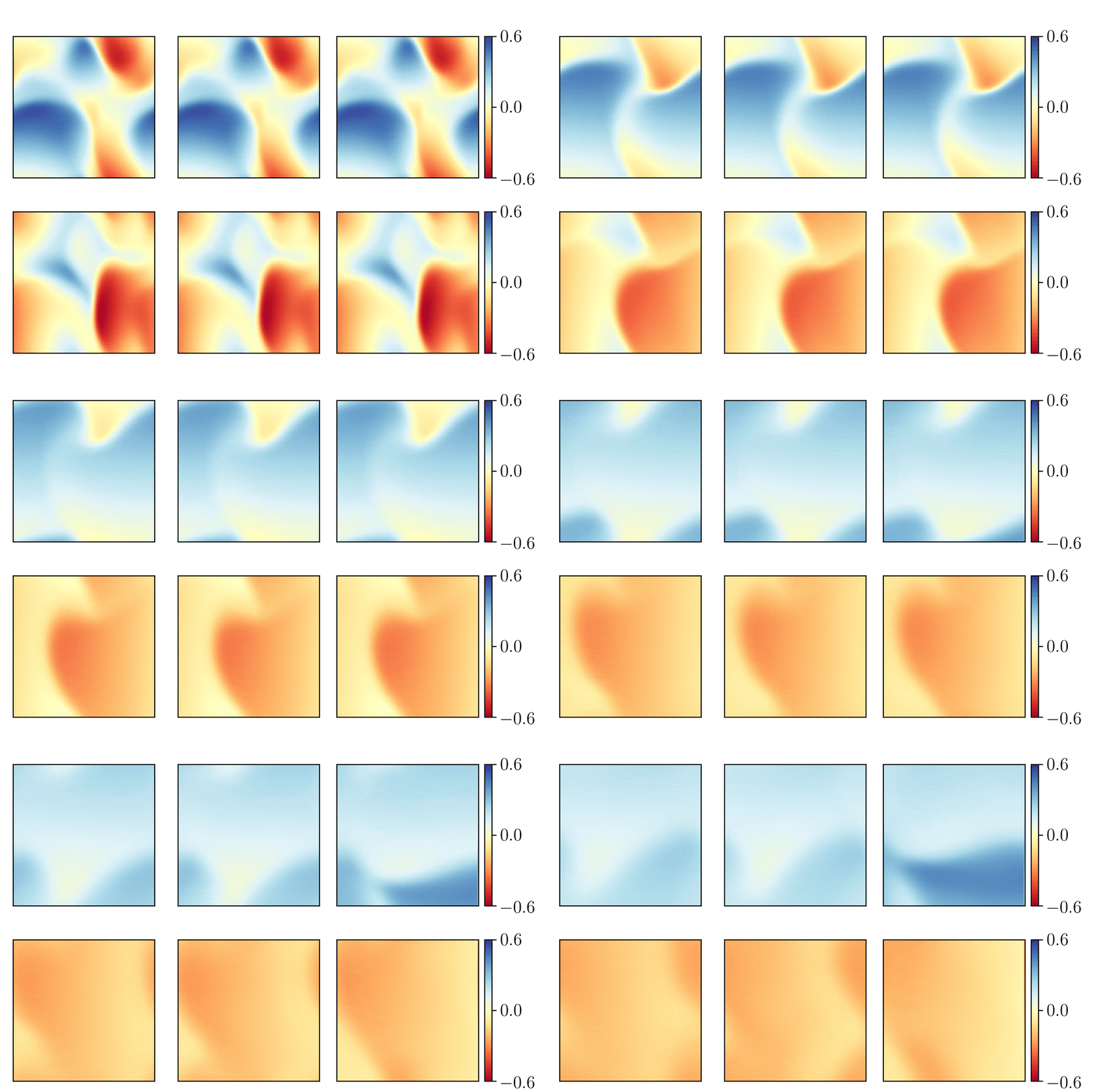
PyTorch code for Composing Partial Differential Equations with Physics-Aware Neural Networks

Related tags

Deep Learningfinn
Overview

FInite volume Neural Network (FINN)

This repository contains the PyTorch code for models, training, and testing, and Python code for data generation to conduct the experiments as reported in the work Composing Partial Differential Equations with Physics-Aware Neural Networks

If you find this repository helpful, please cite our work:

@article{karlbauer2021composing,
	author    = {Karlbauer, Matthias and Praditia, Timothy and Otte, Sebastian and Oladyshkin, Sergey and Nowak, Wolfgang and Butz, Martin V},
	title     = {Composing Partial Differential Equations with Physics-Aware Neural Networks},
	journal   = {arXiv preprint arXiv:2111.11798},
	year      = {2021},
}

Dependencies

We recommend setting up an (e.g. conda) environment with python 3.7 (i.e. conda create -n finn python=3.7). The required packages for data generation and model evaluation are

  • conda install -c anaconda numpy scipy
  • conda install -c pytorch pytorch==1.9.0
  • conda install -c jmcmurray json
  • conda install -c conda-forge matplotlib torchdiffeq jsmin

Models & Experiments

The code of the different pure machine learning models (TCN, ConvLSTM, DISTANA) and physics-aware models (PINN, PhyDNet, FINN) can be found in the models directory.

Each model directory contains a config.json file to specify model parameters, data, etc. Please modify the sections in the respective config.json files as detailed below (further information about data and model architectures is reported in the according data sections of the paper's appendices):

"training": {
	"t_stop": 150  // burger and allen-cahn 150, diff-sorp 400, diff-react 70
},

"validation": {
	"t_start": 150,  // burger and allen-cahn 150, diff-sorp 400, diff-react 70
	"t_stop": 200  // burger and allen-cahn 200, diff-sorp 500, diff-react 100
},

"data": {
	"type": "burger",  // "burger", "diffusion_sorption", "diffusion_reaction", "allen_cahn"
	"name": "data_ext",  // "data_train", "data_ext", "data_test"
}

"model": {
  	"name": "burger"  // "burger", "diff-sorp", "diff-react", "allen-cahn"
	"field_size": [49],  // burger and allen-cahn [49], diff-sorp [26], fhn [49, 49]
	... other settings to be specified according to the model architectures section in the paper's appendix
}

The actual models can be trained and tested by calling the according python train.py or python test.py scripts. Alternatively, python experiment.py can be used to either train or test n models (please consider the settings in the experiment.py script).

Data generation

The Python scripts to generate the burger, diffusion-sorption, diffusion-reaction, and allen-cahn data can be found in the data directory.

In each of the burger, diffusion_sorption, diffusion_reaction, and allen-cahn directories, a data_generation.py and simulator.py script can be found. The former is used to generate train, extrapolation (ext), or test data. For details about the according data generation settings of each dataset, please refer to the corresponding data sections in the paper's appendices.

You might also like...
Official implementation for the paper:
Official implementation for the paper: "Multi-label Classification with Partial Annotations using Class-aware Selective Loss"

Multi-label Classification with Partial Annotations using Class-aware Selective Loss Paper | Pretrained models Official PyTorch Implementation Emanuel

Must-read Papers on Physics-Informed Neural Networks.

PINNpapers Contributed by IDRL lab. Introduction Physics-Informed Neural Network (PINN) has achieved great success in scientific computing since 2017.

Physics-informed convolutional-recurrent neural networks for solving spatiotemporal PDEs

PhyCRNet Physics-informed convolutional-recurrent neural networks for solving spatiotemporal PDEs Paper link: [ArXiv] By: Pu Ren, Chengping Rao, Yang

 Physics-Aware Training (PAT) is a method to train real physical systems with backpropagation.
Physics-Aware Training (PAT) is a method to train real physical systems with backpropagation.

Physics-Aware Training (PAT) is a method to train real physical systems with backpropagation. It was introduced in Wright, Logan G. & Onodera, Tatsuhiro et al. (2021)1 to train Physical Neural Networks (PNNs) - neural networks whose building blocks are physical systems.

Pytorch Implementation of Interaction Networks for Learning about Objects, Relations and Physics

Interaction-Network-Pytorch Pytorch Implementraion of Interaction Networks for Learning about Objects, Relations and Physics. Interaction Network is a

IDRLnet, a Python toolbox for modeling and solving problems through Physics-Informed Neural Network (PINN) systematically.

IDRLnet IDRLnet is a machine learning library on top of PyTorch. Use IDRLnet if you need a machine learning library that solves both forward and inver

PINN(s): Physics-Informed Neural Network(s) for von Karman vortex street

PINN(s): Physics-Informed Neural Network(s) for von Karman vortex street This is

Implementation of "Scaled-YOLOv4: Scaling Cross Stage Partial Network" using PyTorch framwork.

YOLOv4-large This is the implementation of "Scaled-YOLOv4: Scaling Cross Stage Partial Network" using PyTorch framwork. YOLOv4-CSP YOLOv4-tiny YOLOv4-

Unofficial pytorch implementation of 'Image Inpainting for Irregular Holes Using Partial Convolutions'

pytorch-inpainting-with-partial-conv Official implementation is released by the authors. Note that this is an ongoing re-implementation and I cannot f

Releases(v1.0.0)
  • v1.0.0(Oct 28, 2022)

    This release contains the PyTorch code for models, training, and testing, and Python code for data generation to conduct the experiments.

    Source code(tar.gz)
    Source code(zip)
Owner
Cognitive Modeling
The chair of Cognitive Modeling addresses the question: "How does the mind work?", pursuing an integrative, interdisciplinary, computational approach.
Cognitive Modeling
Torch-based tool for quantizing high-dimensional vectors using additive codebooks

Trainable multi-codebook quantization This repository implements a utility for use with PyTorch, and ideally GPUs, for training an efficient quantizer

Daniel Povey 41 Jan 07, 2023
Log4j JNDI inj. vuln scanner

Log-4-JAM - Log 4 Just Another Mess Log4j JNDI inj. vuln scanner Requirements pip3 install requests_toolbelt Usage # make sure target list has http/ht

Ashish Kunwar 66 Nov 09, 2022
Block Sparse movement pruning

Movement Pruning: Adaptive Sparsity by Fine-Tuning Magnitude pruning is a widely used strategy for reducing model size in pure supervised learning; ho

Hugging Face 54 Dec 20, 2022
This is the official implementation for the paper "Heterogeneous Multi-player Multi-armed Bandits: Closing the Gap and Generalization" in NeurIPS 2021.

MPMAB_BEACON This is code used for the paper "Decentralized Multi-player Multi-armed Bandits: Beyond Linear Reward Functions", Neurips 2021. Requireme

Cong Shen Research Group 0 Oct 26, 2021
Code for "NeuralRecon: Real-Time Coherent 3D Reconstruction from Monocular Video", CVPR 2021 oral

NeuralRecon: Real-Time Coherent 3D Reconstruction from Monocular Video Project Page | Paper NeuralRecon: Real-Time Coherent 3D Reconstruction from Mon

ZJU3DV 1.4k Dec 30, 2022
Applicator Kit for Modo allow you to apply Apple ARKit Face Tracking data from your iPhone or iPad to your characters in Modo.

Applicator Kit for Modo Applicator Kit for Modo allow you to apply Apple ARKit Face Tracking data from your iPhone or iPad with a TrueDepth camera to

Andrew Buttigieg 3 Aug 24, 2021
Nicholas Lee 3 Jan 09, 2022
The Deep Learning with Julia book, using Flux.jl.

Deep Learning with Julia DL with Julia is a book about how to do various deep learning tasks using the Julia programming language and specifically the

Logan Kilpatrick 67 Dec 25, 2022
Populating 3D Scenes by Learning Human-Scene Interaction https://posa.is.tue.mpg.de/

Populating 3D Scenes by Learning Human-Scene Interaction [Project Page] [Paper] License Software Copyright License for non-commercial scientific resea

Mohamed Hassan 81 Nov 08, 2022
Code for the paper "Jukebox: A Generative Model for Music"

Status: Archive (code is provided as-is, no updates expected) Jukebox Code for "Jukebox: A Generative Model for Music" Paper Blog Explorer Colab Insta

OpenAI 6k Jan 02, 2023
A library for efficient similarity search and clustering of dense vectors.

Faiss Faiss is a library for efficient similarity search and clustering of dense vectors. It contains algorithms that search in sets of vectors of any

Meta Research 18.8k Jan 08, 2023
Contrastive Language-Image Pretraining

CLIP [Blog] [Paper] [Model Card] [Colab] CLIP (Contrastive Language-Image Pre-Training) is a neural network trained on a variety of (image, text) pair

OpenAI 11.5k Jan 08, 2023
Generic Event Boundary Detection: A Benchmark for Event Segmentation

Generic Event Boundary Detection: A Benchmark for Event Segmentation We release our data annotation & baseline codes for detecting generic event bound

47 Nov 22, 2022
PyTorch source code for Distilling Knowledge by Mimicking Features

LSHFM.detection This is the PyTorch source code for Distilling Knowledge by Mimicking Features. And this project contains code for object detection wi

Guo-Hua Wang 4 Dec 17, 2022
SciFive: a text-text transformer model for biomedical literature

SciFive SciFive provided a Text-Text framework for biomedical language and natural language in NLP. Under the T5's framework and desrbibed in the pape

Long Phan 54 Dec 24, 2022
VarCLR: Variable Semantic Representation Pre-training via Contrastive Learning

    VarCLR: Variable Representation Pre-training via Contrastive Learning New: Paper accepted by ICSE 2022. Preprint at arXiv! This repository contain

squaresLab 32 Oct 24, 2022
Companion code for the paper "An Infinite-Feature Extension for Bayesian ReLU Nets That Fixes Their Asymptotic Overconfidence" (NeurIPS 2021)

ReLU-GP Residual (RGPR) This repository contains code for reproducing the following NeurIPS 2021 paper: @inproceedings{kristiadi2021infinite, title=

Agustinus Kristiadi 4 Dec 26, 2021
This is the official PyTorch implementation of our paper: "Artistic Style Transfer with Internal-external Learning and Contrastive Learning".

Artistic Style Transfer with Internal-external Learning and Contrastive Learning This is the official PyTorch implementation of our paper: "Artistic S

51 Dec 20, 2022
Bringing Computer Vision and Flutter together , to build an awesome app !!

Bringing Computer Vision and Flutter together , to build an awesome app !! Explore the Directories Flutter · Machine Learning Table of Contents About

Padmanabha Banerjee 14 Apr 07, 2022
Python based Advanced AI Assistant

Knick is a virtual artificial intelligence project, fully developed in python. The objective of this project is to develop a virtual assistant that can handle our minor, intermediate as well as heavy

19 Nov 15, 2022