Physics-informed convolutional-recurrent neural networks for solving spatiotemporal PDEs

Overview

PhyCRNet

Physics-informed convolutional-recurrent neural networks for solving spatiotemporal PDEs

Paper link: [ArXiv]

By: Pu Ren, Chengping Rao, Yang Liu, Jian-Xun Wang and Hao Sun

Highlights

  • Present a Physics-informed discrete learning framework for solving spatiotemporal PDEs without any labeled data
  • Proposed an encoder-decoder convolutional-recurrent scheme for low-dimensional feature extraction
  • Employ hard-encoding of initial and boundary conditions
  • Incorporate autoregressive and residual connections to explicitly simulate the time marching

Training and Extrapolation

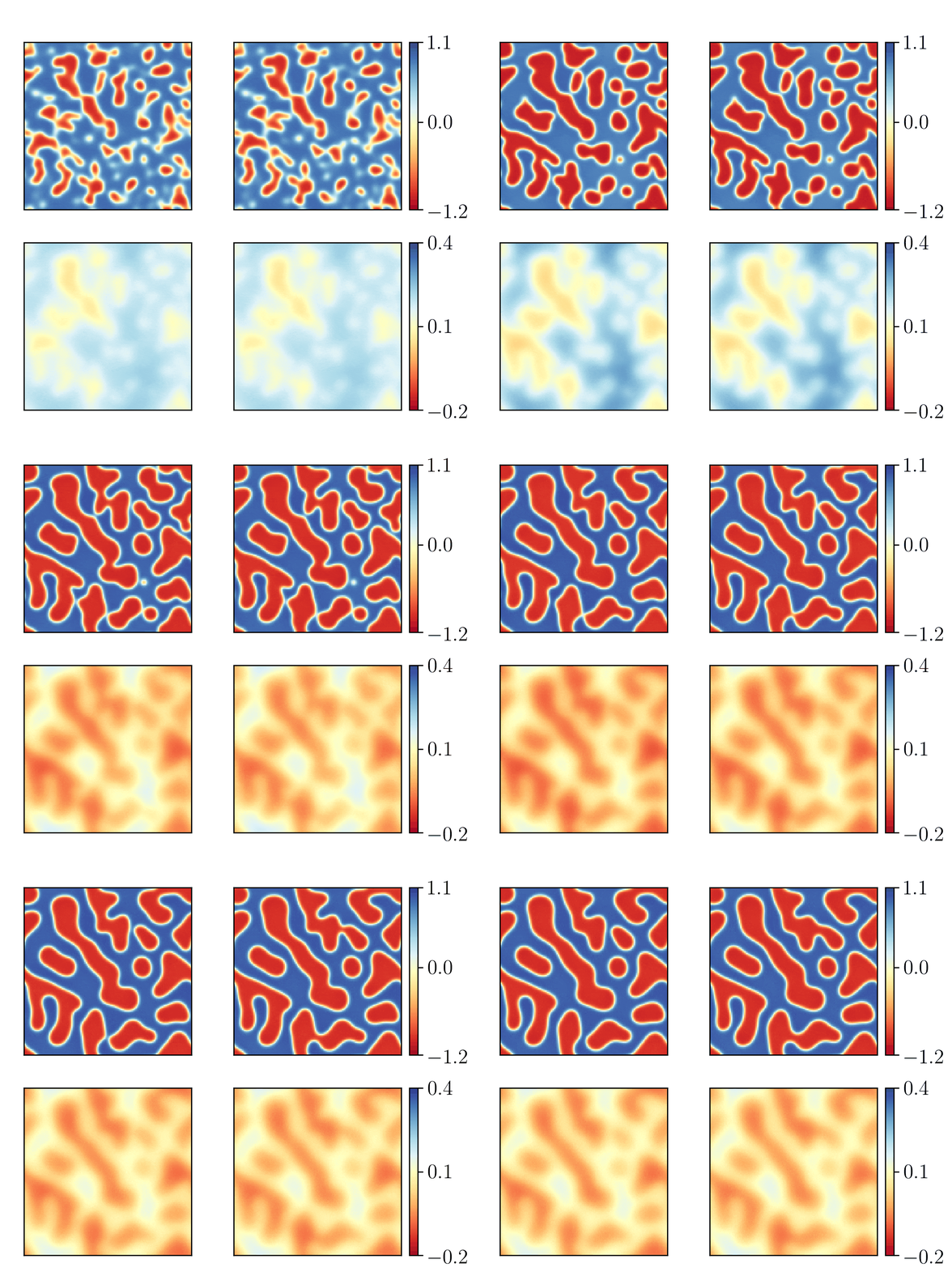
We show the comparison between PhyCRNet and PINN on 2D Burgers' equations below. The left, middle and right figures are the ground truth, the result from our PhyCRNet and the result from PINNs respectively.
Generalization

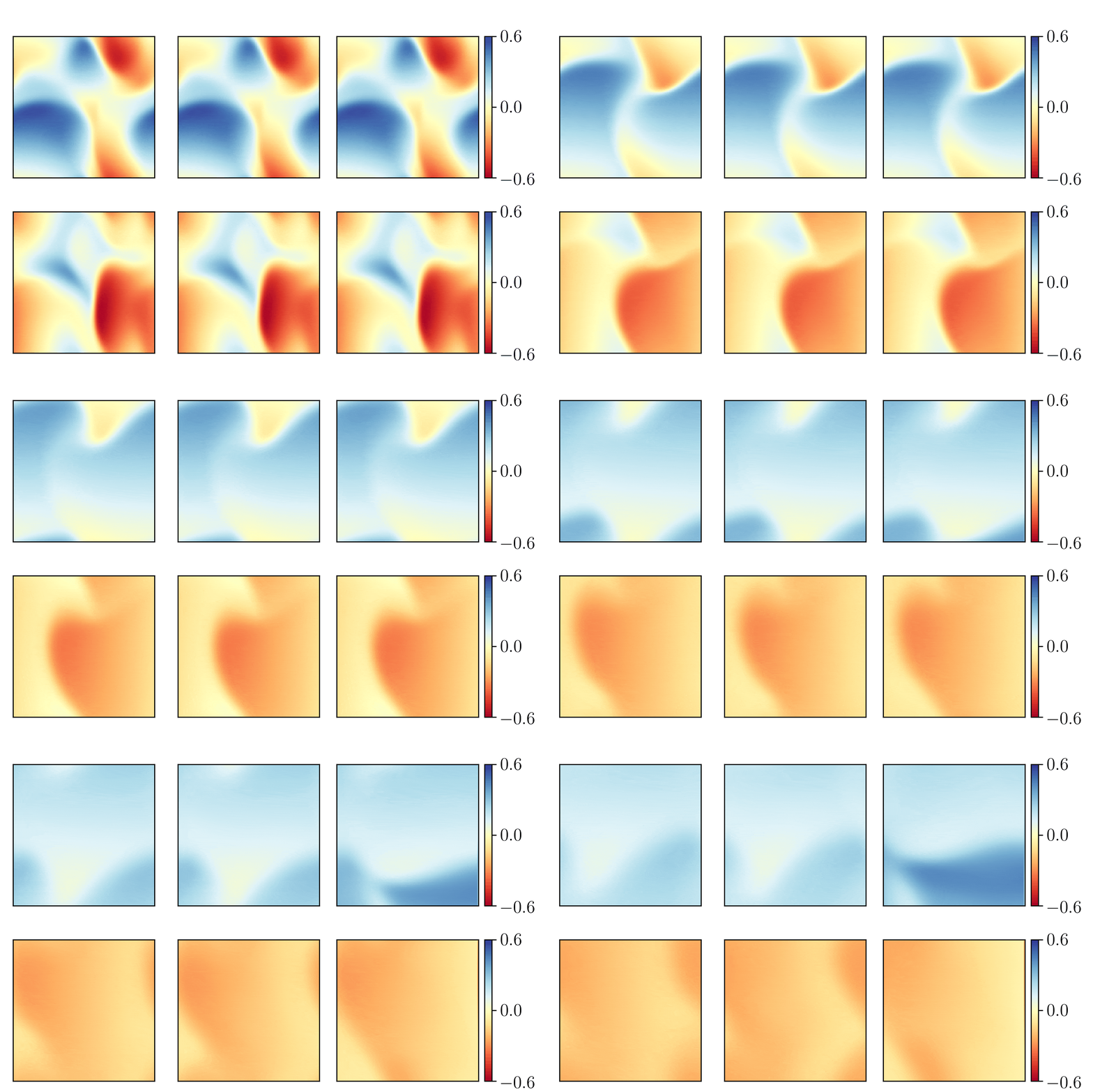
We show the generalization test on FitzHugh-Nagumo reaction-diffusion equations with four different initial conditions. The left and right parts are the ground truth generated with the high-order finite difference method and the results from our PhyCRNet, respectively.

Requirements

  • Python 3.6.13
  • Pytorch 1.6.0
  • Other packages such as Matplotlib, Numpy and Scipy are also used

Datasets

We provide the codes for data generation used in this paper, including 2D Burgers' equations and 2D FitzHugh-Nagumo reaction-diffusion equations. They are coded in the high-order finite difference method. Besides, the code for random field is modified from [Link]. You may find the data solver for λ-ω reaction-diffusion equations in [Link].

The initial conditions tested in this paper are also provided in the folder Datasets.

Codes

The general code of PhyCRNet is provided in the folder Codes, where we use 2D Burgers' equations as a testing example. For other PDE systems, the network setting is similar. You may try modifying the grid sizes and time steps to your own cases.

Citation

If you find our research helpful, please consider citing us with:

@article{ren2021phycrnet,
  title={PhyCRNet: Physics-informed Convolutional-Recurrent Network for Solving Spatiotemporal PDEs},
  author={Ren, Pu and Rao, Chengping and Liu, Yang and Wang, Jianxun and Sun, Hao},
  journal={arXiv preprint arXiv:2106.14103},
  year={2021}
}
Owner
Pu Ren
Pu Ren
Scaling and Benchmarking Self-Supervised Visual Representation Learning

FAIR Self-Supervision Benchmark is deprecated. Please see VISSL, a ground-up rewrite of benchmark in PyTorch. FAIR Self-Supervision Benchmark This cod

Meta Research 584 Dec 31, 2022
Simple Dynamic Batching Inference

Simple Dynamic Batching Inference 解决了什么问题? 众所周知,Batch对于GPU上深度学习模型的运行效率影响很大。。。 是在Inference时。搜索、推荐等场景自带比较大的batch,问题不大。但更多场景面临的往往是稀碎的请求(比如图片服务里一次一张图)。 如果

116 Jan 01, 2023
Registration Loss Learning for Deep Probabilistic Point Set Registration

RLLReg This repository contains a Pytorch implementation of the point set registration method RLLReg. Details about the method can be found in the 3DV

Felix Järemo Lawin 35 Nov 02, 2022
PyTorch implementation of MulMON

MulMON This repository contains a PyTorch implementation of the paper: Learning Object-Centric Representations of Multi-object Scenes from Multiple Vi

NanboLi 16 Nov 03, 2022
[NeurIPS'21 Spotlight] PyTorch code for our paper "Aligned Structured Sparsity Learning for Efficient Image Super-Resolution"

ASSL This repository is for a new network pruning method (Aligned Structured Sparsity Learning, ASSL) for efficient single image super-resolution (SR)

Huan Wang 47 Nov 28, 2022
Let's Git - Versionsverwaltung & Open Source Hausaufgabe

Let's Git - Versionsverwaltung & Open Source Hausaufgabe Herzlich Willkommen zu dieser Hausaufgabe für unseren MOOC: Let's Git! Wir hoffen, dass Du vi

1 Dec 13, 2021
Leaderboard, taxonomy, and curated list of few-shot object detection papers.

Leaderboard, taxonomy, and curated list of few-shot object detection papers.

Gabriel Huang 70 Jan 07, 2023
Automated Evidence Collection for Fake News Detection

Automated Evidence Collection for Fake News Detection This is the code repo for the Automated Evidence Collection for Fake News Detection paper accept

Mrinal Rawat 2 Apr 12, 2022
Reinforcement-learning - Repository of the class assignment questions for the course on reinforcement learning

DSE 314/614: Reinforcement Learning This repository containing reinforcement lea

Manav Mishra 4 Apr 15, 2022
Pytorch implementation of the AAAI 2022 paper "Cross-Domain Empirical Risk Minimization for Unbiased Long-tailed Classification"

[AAAI22] Cross-Domain Empirical Risk Minimization for Unbiased Long-tailed Classification We point out the overlooked unbiasedness in long-tailed clas

PatatiPatata 28 Oct 18, 2022
Monocular Depth Estimation Using Laplacian Pyramid-Based Depth Residuals

LapDepth-release This repository is a Pytorch implementation of the paper "Monocular Depth Estimation Using Laplacian Pyramid-Based Depth Residuals" M

Minsoo Song 205 Dec 30, 2022
3ds-Ghidra-Scripts - Ghidra scripts to help with 3ds reverse engineering

3ds Ghidra Scripts These are ghidra scripts to help with 3ds reverse engineering

Zak 7 May 23, 2022
VOGUE: Try-On by StyleGAN Interpolation Optimization

VOGUE is a StyleGAN interpolation optimization algorithm for photo-realistic try-on. Top: shirt try-on automatically synthesized by our method in two different examples.

Wei ZHANG 66 Dec 09, 2022
The Pytorch code of "Joint Distribution Matters: Deep Brownian Distance Covariance for Few-Shot Classification", CVPR 2022 (Oral).

DeepBDC for few-shot learning        Introduction In this repo, we provide the implementation of the following paper: "Joint Distribution Matters: Dee

FeiLong 116 Dec 19, 2022
Package for extracting emotions from social media text. Tailored for financial data.

EmTract: Extracting Emotions from Social Media Text Tailored for Financial Contexts EmTract is a tool that extracts emotions from social media text. I

13 Nov 17, 2022
NLP made easy

GluonNLP: Your Choice of Deep Learning for NLP GluonNLP is a toolkit that helps you solve NLP problems. It provides easy-to-use tools that helps you l

Distributed (Deep) Machine Learning Community 2.5k Jan 04, 2023
ShinRL: A Library for Evaluating RL Algorithms from Theoretical and Practical Perspectives

Status: Under development (expect bug fixes and huge updates) ShinRL: A Library for Evaluating RL Algorithms from Theoretical and Practical Perspectiv

37 Dec 28, 2022
Contrastive Language-Image Pretraining

CLIP [Blog] [Paper] [Model Card] [Colab] CLIP (Contrastive Language-Image Pre-Training) is a neural network trained on a variety of (image, text) pair

OpenAI 11.5k Jan 08, 2023
Starter kit for getting started in the Music Demixing Challenge.

Music Demixing Challenge - Starter Kit 👉 Challenge page This repository is the Music Demixing Challenge Submission template and Starter kit! Clone th

AIcrowd 106 Dec 20, 2022
This repository contains several jupyter notebooks to help users learn to use neon, our deep learning framework

neon_course This repository contains several jupyter notebooks to help users learn to use neon, our deep learning framework. For more information, see

Nervana 92 Jan 03, 2023