DL & CV-based indicator toolset for the vehicle drivers via live dash-cam footage.

Overview

Vehicle Indicator Toolset

Deep Learning and Computer Vision based indicator toolset for vehicle drivers using live dash-cam footages.

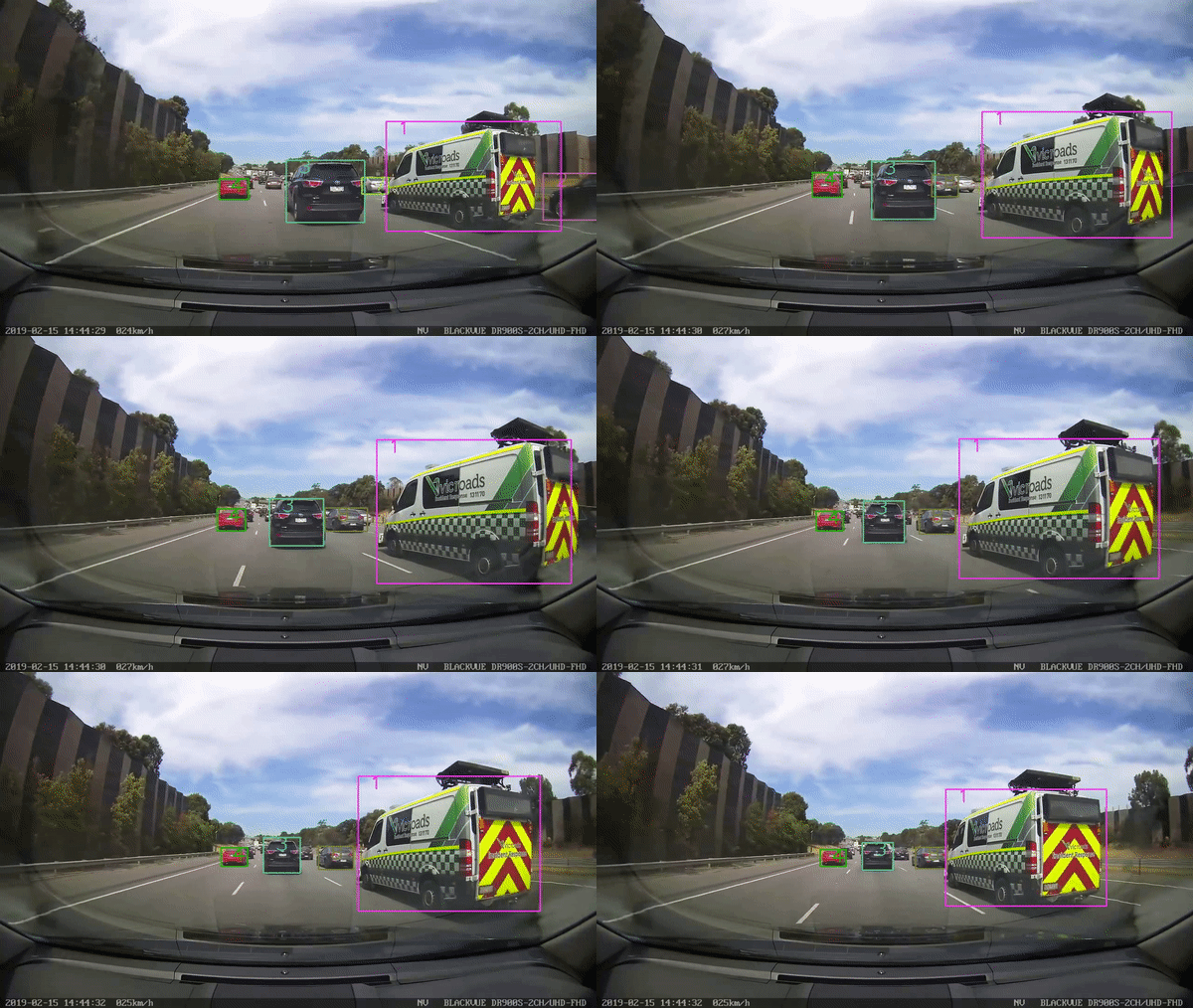
Tracking of vehicles
The tracking of the vehicles with a track ID can be seen below.

|


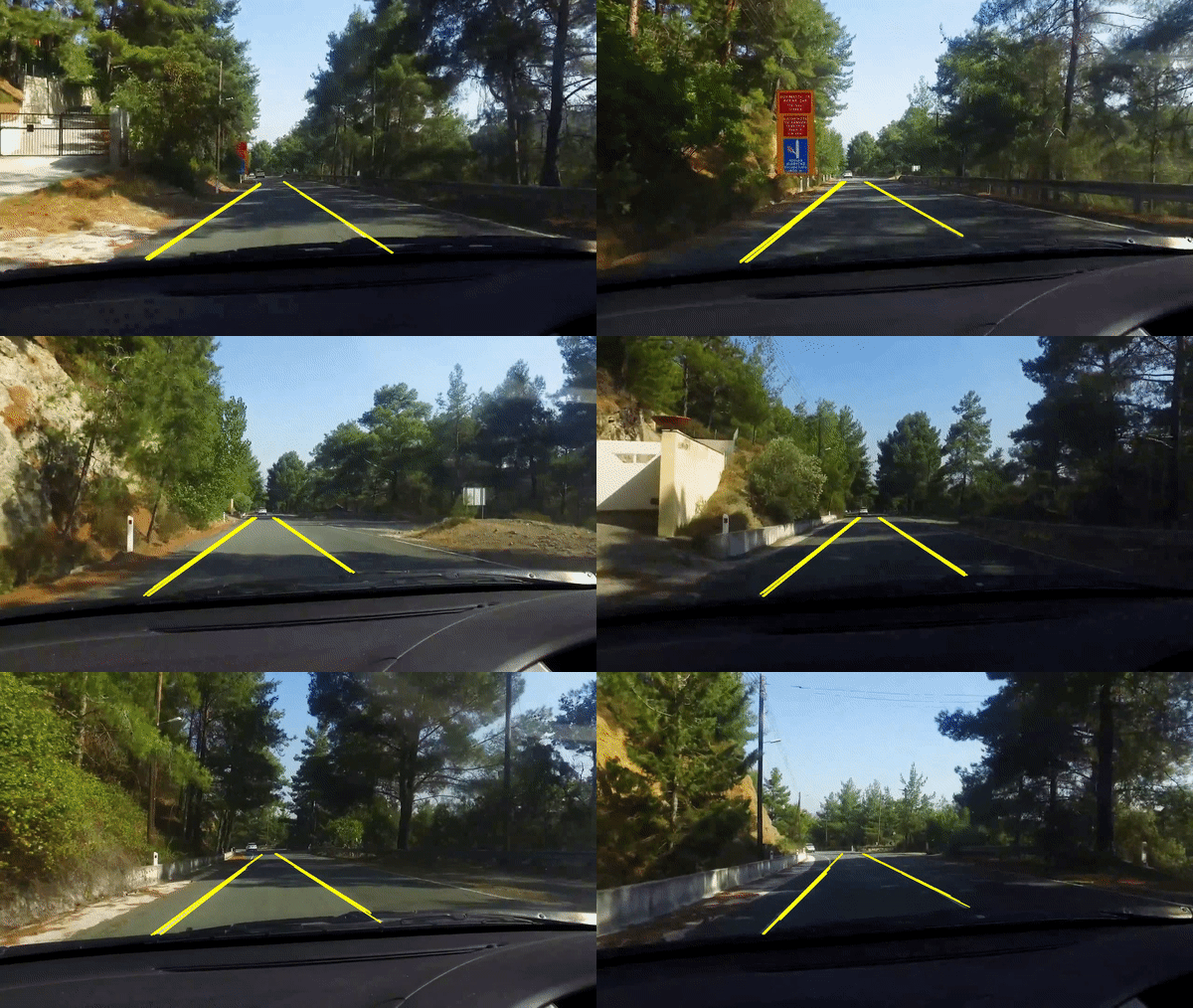
Detection of the lanes.
Whenever the driver gets out of the lane, he will be displayed a warning to stay inside the lane.
|


Tail light detection
Detect all the tail lights of the vehicles applying brakes at night.

|


Traffic signal recognition
Warning is shown when to stop and resume again using traffic lights.

|


Vehicle collision estimation
Incase, a collision is estimated, driver is warned.

|


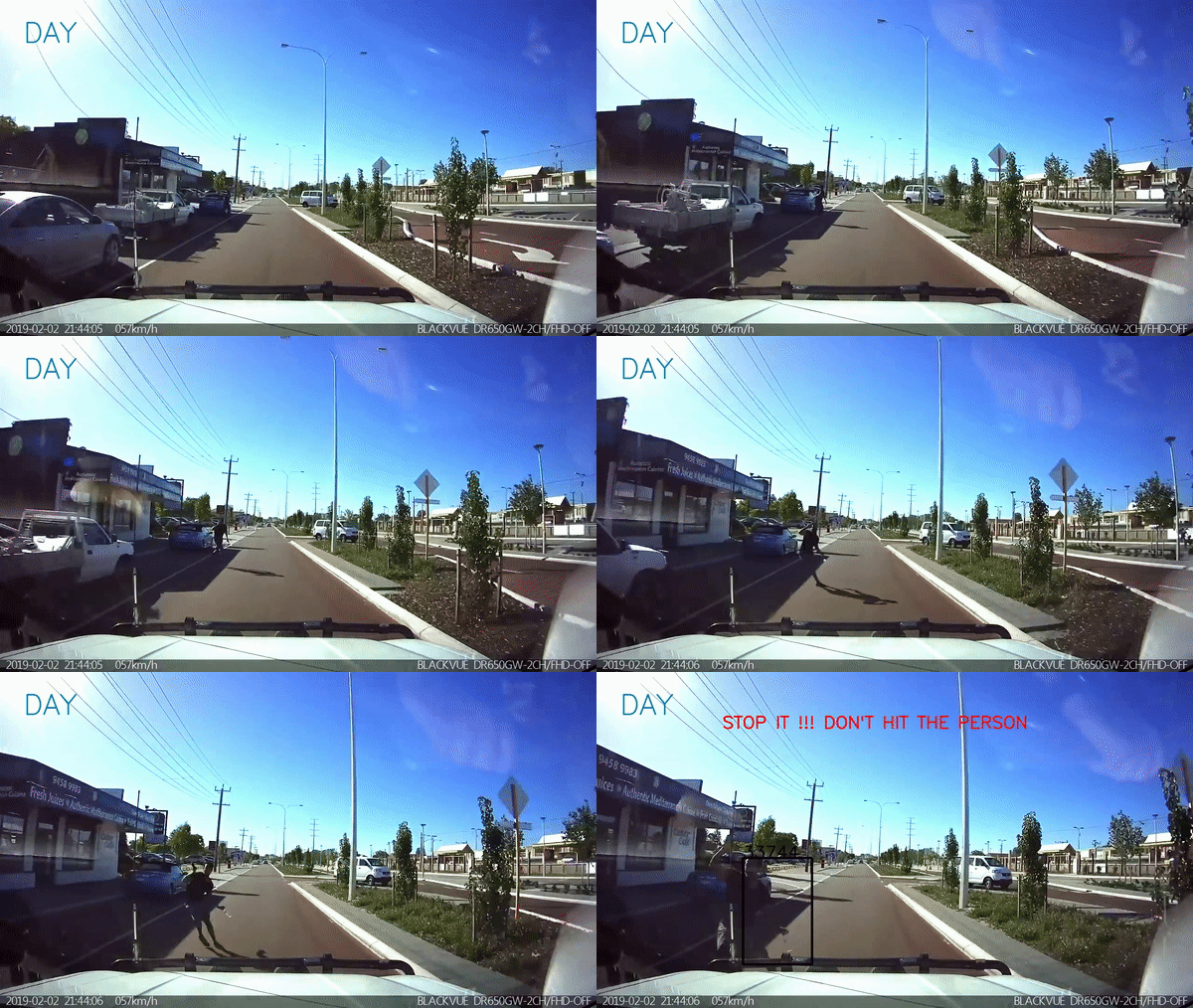
Pedestrian stepping
Whenever, pedestrian comes in our view, a warning is displayed.

|


Dependencies required:

  • Python 3.0
  • TensorFlow 2.0
  • openCV

Project Structure:

  • lanes:This folder contains files related to lane detection only.
  • tf-color: This folder contains files related to traffic light detection and detect the colour and accordingly give instructions to the driver.
  • tracked: This folder contains detection and tracking algorithm for the vehicles.
  • untracked: Detection and visualization only
  • utils: contains various functions that are used continuously again and again for different frames.
  • estimations: Detect pedestrians and vehicles too close to us that may cause collision.
  • cropping: Cropping frames using drag and drop or clicking points.
  • display: All the gifs shown above are stored here.

Requisities:

Download the tensorflow model from here.

  • Provide the path to the labels txt file using variable named PATH_TO_LABELS.
  • Provide the path to the tensorflow model using variable named model_name.
  • Make sure all the files are imported properly from the utils folder. If you get an error, add the location of the utils folder using sys module.
  • Tensorflow version 2.0 is must or else you may come across various error.

Working:

Run python integrate3.py or python intyolo.py after following the above mentioned requisities.
Now select the dash area for the car by clicking on multiple points as shown below. This is done to
remove detection of our own vehicle in some cases which may generate false results.

In the second step, select the area where searching of the lanes should be made. This may differ due to
the placement of dash-cams in the vehicle. The area above the horizon where road ends should not be selected.

Now, you can visualize the working and see the warnings/suggestions displayed to the driver.
All the works that are implemented individually are present in their respective folders, which are integrated together.
Old models may have some bugs now, as many files inside utils are changed.
Visit honors branch of models repository forked from tf/models to see more work on this project,
that I have done in google colab.

Drawbacks:

  • At night, searching for tail light should be made in the dark. If sufficient light is present, false cases can get introduced.
  • Tracking works good for bigger objects, while smaller may loose their track ID at places.
  • Threshold values used in lane detection needs to be altered depending on the roads and the quality of the videos.
  • Object detection needs to work properly for better results throughout. The model with higher accuracy should be downloaded from the link given above.
Owner
Alex Xu
Alex Xu
A PyTorch-Based Framework for Deep Learning in Computer Vision

TorchCV: A PyTorch-Based Framework for Deep Learning in Computer Vision @misc{you2019torchcv, author = {Ansheng You and Xiangtai Li and Zhen Zhu a

Donny You 2.2k Jan 09, 2023
A Self-Supervised Contrastive Learning Framework for Aspect Detection

AspDecSSCL A Self-Supervised Contrastive Learning Framework for Aspect Detection This repository is a pytorch implementation for the following AAAI'21

Tian Shi 30 Dec 28, 2022
SW components and demos for visual kinship recognition. An emphasis is put on the FIW dataset-- data loaders, benchmarks, results in summary.

FIW Data Development Kit Table of Contents Introduction Families In the Wild Database Publications Organization To Do License Getting Involved Introdu

Joseph P. Robinson 12 Jun 04, 2022
Prompt Tuning with Rules

PTR Code and datasets for our paper "PTR: Prompt Tuning with Rules for Text Classification" If you use the code, please cite the following paper: @art

THUNLP 118 Dec 30, 2022
Providing the solutions for high-frequency trading (HFT) strategies using data science approaches (Machine Learning) on Full Orderbook Tick Data.

Modeling High-Frequency Limit Order Book Dynamics Using Machine Learning Framework to capture the dynamics of high-frequency limit order books. Overvi

Chang-Shu Chung 1.3k Jan 07, 2023
🔥🔥High-Performance Face Recognition Library on PaddlePaddle & PyTorch🔥🔥

face.evoLVe: High-Performance Face Recognition Library based on PaddlePaddle & PyTorch Evolve to be more comprehensive, effective and efficient for fa

Zhao Jian 3.1k Jan 02, 2023
Single/multi view image(s) to voxel reconstruction using a recurrent neural network

3D-R2N2: 3D Recurrent Reconstruction Neural Network This repository contains the source codes for the paper Choy et al., 3D-R2N2: A Unified Approach f

Chris Choy 1.2k Dec 27, 2022
LBBA-boosted WSOD

LBBA-boosted WSOD Summary Our code is based on ruotianluo/pytorch-faster-rcnn and WSCDN Sincerely thanks for your resources. Newer version of our code

Martin Dong 20 Sep 19, 2022
Supplementary code for the AISTATS 2021 paper "Matern Gaussian Processes on Graphs".

Matern Gaussian Processes on Graphs This repo provides an extension for gpflow with Matérn kernels, inducing variables and trainable models implemente

41 Dec 17, 2022
Implementation of TabTransformer, attention network for tabular data, in Pytorch

Tab Transformer Implementation of Tab Transformer, attention network for tabular data, in Pytorch. This simple architecture came within a hair's bread

Phil Wang 420 Jan 05, 2023
ProFuzzBench - A Benchmark for Stateful Protocol Fuzzing

ProFuzzBench - A Benchmark for Stateful Protocol Fuzzing ProFuzzBench is a benchmark for stateful fuzzing of network protocols. It includes a suite of

155 Jan 08, 2023
Boundary IoU API (Beta version)

Boundary IoU API (Beta version) Bowen Cheng, Ross Girshick, Piotr Dollár, Alexander C. Berg, Alexander Kirillov [arXiv] [Project] [BibTeX] This API is

Bowen Cheng 177 Dec 29, 2022
A toolset for creating Qualtrics-based IAT experiments

Qualtrics IAT Tool A web app for generating the Implicit Association Test (IAT) running on Qualtrics Online Web App The app is hosted by Streamlit, a

0 Feb 12, 2022
A simple Neural Network that predicts the label for a series of handwritten digits

Neural_Network A simple Neural Network that predicts the label for a series of handwritten numbers This program tries to predict the label (1,2,3 etc.

Ty 1 Dec 18, 2021
A custom DeepStack model for detecting 16 human actions.

DeepStack_ActionNET This repository provides a custom DeepStack model that has been trained and can be used for creating a new object detection API fo

MOSES OLAFENWA 16 Nov 11, 2022
🌊 Online machine learning in Python

In a nutshell River is a Python library for online machine learning. It is the result of a merger between creme and scikit-multiflow. River's ambition

OnlineML 4k Jan 02, 2023
Self-Supervised Collision Handling via Generative 3D Garment Models for Virtual Try-On

Self-Supervised Collision Handling via Generative 3D Garment Models for Virtual Try-On [Project website] [Dataset] [Video] Abstract We propose a new g

71 Dec 24, 2022
MediaPipe is a an open-source framework from Google for building multimodal

MediaPipe is a an open-source framework from Google for building multimodal (eg. video, audio, any time series data), cross platform (i.e Android, iOS, web, edge devices) applied ML pipelines. It is

Bhavishya Pandit 3 Sep 30, 2022
The official PyTorch code for 'DER: Dynamically Expandable Representation for Class Incremental Learning' accepted by CVPR2021

DER.ClassIL.Pytorch This repo is the official implementation of DER: Dynamically Expandable Representation for Class Incremental Learning (CVPR 2021)

rhyssiyan 108 Jan 01, 2023
Calibrate your listeners! Robust communication-based training for pragmatic speakers. Findings of EMNLP 2021.

Calibrate your listeners! Robust communication-based training for pragmatic speakers Rose E. Wang, Julia White, Jesse Mu, Noah D. Goodman Findings of

Rose E. Wang 3 Apr 02, 2022