Demo code for ICCV 2021 paper "Sensor-Guided Optical Flow"

Overview

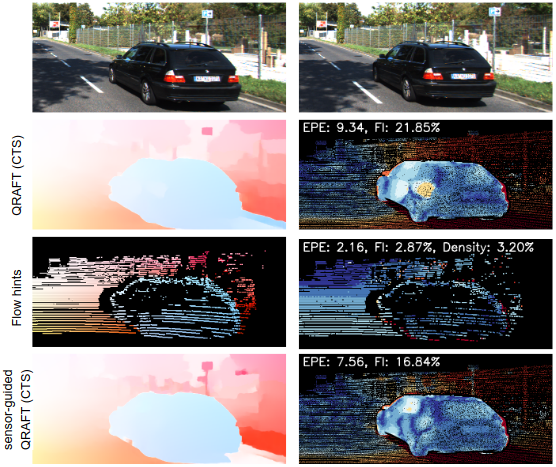
Sensor-Guided Optical Flow

Demo code for "Sensor-Guided Optical Flow", ICCV 2021

This code is provided to replicate results with flow hints obtained from LiDAR data.

At the moment, we do not plan to release training code.

[Project page] - [Paper] - [Supplementary]
Alt text

Reference

If you find this code useful, please cite our work:

@inproceedings{Poggi_ICCV_2021,
  title     = {Sensor-Guided Optical Flow},
  author    = {Poggi, Matteo and
               Aleotti, Filippo and
               Mattoccia, Stefano},
  booktitle = {IEEE/CVF International Conference on Computer Vision (ICCV)},
  year = {2021}
}

Contents

  1. Introduction
  2. Installation
  3. Data
  4. Weights
  5. Usage
  6. Contacts
  7. Acknowledgments

Introduction

This paper proposes a framework to guide an optical flow network with external cues to achieve superior accuracy either on known or unseen domains. Given the availability of sparse yet accurate optical flow hints from an external source, these are injected to modulate the correlation scores computed by a state-of-the-art optical flow network and guide it towards more accurate predictions. Although no real sensor can provide sparse flow hints, we show how these can be obtained by combining depth measurements from active sensors with geometry and hand-crafted optical flow algorithms, leading to accurate enough hints for our purpose. Experimental results with a state-of-the-art flow network on standard benchmarks support the effectiveness of our framework, both in simulated and real conditions.

Installation

Install the project requirements in a new python 3 environment:

virtualenv -p python3 guided_flow_env
source guided_flow_env/bin/activate
pip install -r requirements.txt

Compile the guided_flow module, written in C (required for guided flow modulation):

cd external/guided_flow
bash compile.sh
cd ../..

Data

Download KITTI 2015 optical flow training set and precomputed flow hints. Place them under the data folder as follows:

data
├──training
    ├──image_2
        ├── 000000_10.png
        ├── 000000_11.png
        ├── 000001_10.png
        ├── 000001_11.png
        ...
    ├──flow_occ
        ├── 000000_10.png
        ├── 000000_11.png
        ├── 000001_10.png
        ├── 000001_11.png
        ...
    ├──hints
        ├── 000002_10.png
        ├── 000002_11.png
        ├── 000003_10.png
        ├── 000003_11.png
        ...

Weights

We provide QRAFT models tested in Tab. 4. Download the weights and unzip them under weights as follows:

weights
├──raw
    ├── C.pth
    ├── CT.pth
    ...
├──guided
    ├── C.pth
    ├── CT.pth
    ...    

Usage

You are now ready to run the demo_kitti142.py script:

python demo_kitti142.py --model CTK --guided --out_dir results_CTK_guided/

Use --model to specify the weights you want to load among C, CT, CTS and CTK. By default, raw models are loaded, specify --guided to load guided weights and enable sensor-guided optical flow.

Note: Occasionally, the demo may run out of memory on ~12GB GPUs. The script saves intermediate results are saved in --out_dir. You can run again the script and it will skip all images for which intermediate results have been already saved in --out_dir, loading them from the folder. Remember to select a brand new --out_dir when you start an experiment from scratch.

In the end, the aforementioned command should print:

Validation KITTI: 2.08, 5.97

Numbers in Tab. 4 are obtained by running this code on a Titan Xp GPU, with PyTorch 1.7.0. We observed slight fluctuations in the numbers when running on different hardware (e.g., 3090 GPUs), mostly on raw models.

Contacts

m [dot] poggi [at] unibo [dot] it

Acknowledgments

Thanks to Zachary Teed for sharing RAFT code, used as codebase in our project.

(JMLR'19) A Python Toolbox for Scalable Outlier Detection (Anomaly Detection)

Python Outlier Detection (PyOD) Deployment & Documentation & Stats Build Status & Coverage & Maintainability & License PyOD is a comprehensive and sca

Yue Zhao 6.6k Jan 03, 2023
Cognate Detection Repository

Cognate Detection Repository Details This repository contains the data for two publications: Challenge Dataset of Cognates and False Friend Pairs from

Diptesh Kanojia 1 Apr 26, 2022
RSC-Net: 3D Human Pose, Shape and Texture from Low-Resolution Images and Videos

RSC-Net: 3D Human Pose, Shape and Texture from Low-Resolution Images and Videos Implementation for "3D Human Pose, Shape and Texture from Low-Resoluti

XiangyuXu 42 Nov 10, 2022
利用Tensorflow实现基于CNN的中文短文本分类

Text Classification with CNN 使用卷积神经网络进行中文文本分类 CNN做句子分类的论文可以参看: Convolutional Neural Networks for Sentence Classification 还可以去读dennybritz大牛的博客:Implemen

Jeremiah 4 Nov 08, 2022
Deep Occlusion-Aware Instance Segmentation with Overlapping BiLayers [CVPR 2021]

Deep Occlusion-Aware Instance Segmentation with Overlapping BiLayers [BCNet, CVPR 2021] This is the official pytorch implementation of BCNet built on

Lei Ke 434 Dec 01, 2022
DSEE: Dually Sparsity-embedded Efficient Tuning of Pre-trained Language Models

DSEE Codes for [Preprint] DSEE: Dually Sparsity-embedded Efficient Tuning of Pre-trained Language Models Xuxi Chen, Tianlong Chen, Yu Cheng, Weizhu Ch

VITA 4 Dec 27, 2021
CAST: Character labeling in Animation using Self-supervision by Tracking

CAST: Character labeling in Animation using Self-supervision by Tracking (Published as a conference paper at EuroGraphics 2022) Note: The CAST paper c

15 Nov 18, 2022
This repository contains notebook implementations of the following Neural Process variants: Conditional Neural Processes (CNPs), Neural Processes (NPs), Attentive Neural Processes (ANPs).

The Neural Process Family This repository contains notebook implementations of the following Neural Process variants: Conditional Neural Processes (CN

DeepMind 892 Dec 28, 2022
Benchmarking the robustness of Spatial-Temporal Models

Benchmarking the robustness of Spatial-Temporal Models This repositery contains the code for the paper Benchmarking the Robustness of Spatial-Temporal

Yi Chenyu Ian 15 Dec 16, 2022
PyTorch code for EMNLP 2021 paper: Don't be Contradicted with Anything! CI-ToD: Towards Benchmarking Consistency for Task-oriented Dialogue System

PyTorch code for EMNLP 2021 paper: Don't be Contradicted with Anything! CI-ToD: Towards Benchmarking Consistency for Task-oriented Dialogue System

Libo Qin 25 Sep 06, 2022
RCD: Relation Map Driven Cognitive Diagnosis for Intelligent Education Systems

RCD: Relation Map Driven Cognitive Diagnosis for Intelligent Education Systems This is our implementation for the paper: Weibo Gao, Qi Liu*, Zhenya Hu

BigData Lab @USTC 中科大大数据实验室 10 Oct 16, 2022
A simple rest api serving a deep learning model that classifies human gender based on their faces. (vgg16 transfare learning)

this is a simple rest api serving a deep learning model that classifies human gender based on their faces. (vgg16 transfare learning)

crispengari 5 Dec 09, 2021
NeuralDiff: Segmenting 3D objects that move in egocentric videos

NeuralDiff: Segmenting 3D objects that move in egocentric videos Project Page | Paper + Supplementary | Video About This repository contains the offic

Vadim Tschernezki 14 Dec 05, 2022
Rot-Pro: Modeling Transitivity by Projection in Knowledge Graph Embedding

Rot-Pro : Modeling Transitivity by Projection in Knowledge Graph Embedding This repository contains the source code for the Rot-Pro model, presented a

Tewi 9 Sep 28, 2022
KGDet: Keypoint-Guided Fashion Detection (AAAI 2021)

KGDet: Keypoint-Guided Fashion Detection (AAAI 2021) This is an official implementation of the AAAI-2021 paper "KGDet: Keypoint-Guided Fashion Detecti

Qian Shenhan 35 Dec 29, 2022
Pytorch implementation for the EMNLP 2020 (Findings) paper: Connecting the Dots: A Knowledgeable Path Generator for Commonsense Question Answering

Path-Generator-QA This is a Pytorch implementation for the EMNLP 2020 (Findings) paper: Connecting the Dots: A Knowledgeable Path Generator for Common

Peifeng Wang 33 Dec 05, 2022
PyTorch implementation for "Sharpness-aware Quantization for Deep Neural Networks".

Sharpness-aware Quantization for Deep Neural Networks Recent Update 2021.11.23: We release the source code of SAQ. Setup the environments Clone the re

Zhuang AI Group 30 Dec 19, 2022
MADE (Masked Autoencoder Density Estimation) implementation in PyTorch

pytorch-made This code is an implementation of "Masked AutoEncoder for Density Estimation" by Germain et al., 2015. The core idea is that you can turn

Andrej 498 Dec 30, 2022
Code of paper "Compositionally Generalizable 3D Structure Prediction"

Compositionally Generalizable 3D Structure Prediction In this work, We bring in the concept of compositional generalizability and factorizes the 3D sh

Songfang Han 30 Dec 17, 2022
Numerai tournament example scripts using NN and optuna

numerai_NN_example Numerai tournament example scripts using pytorch NN, lightGBM and optuna https://numer.ai/tournament Performance of my model based

Takahiro Maeda 12 Oct 10, 2022