AI4Animation: Deep Learning for Character Control
This project explores the opportunities of deep learning for character animation and control as part of my Ph.D. research at the University of Edinburgh in the School of Informatics, supervised by Taku Komura. Over the last couple years, this project has become a comprehensive framework for data-driven character animation, including data processing, network training and runtime control, developed in Unity3D / Tensorflow / PyTorch. This repository demonstrates using neural networks for animating biped locomotion, quadruped locomotion, and character-scene interactions with objects and the environment, plus sports and fighting games. Further advances on this research will continue being added to this project.

SIGGRAPH 2021
Neural Animation Layering for Synthesizing Martial Arts Movements
Sebastian Starke, Yiwei Zhao, Fabio Zinno, Taku Komura, ACM Trans. Graph. 40, 4, Article 92.


Interactively synthesizing novel combinations and variations of character movements from different motion skills is a key problem in computer animation. In this research, we propose a deep learning framework to produce a large variety of martial arts movements in a controllable manner from raw motion capture data. Our method imitates animation layering using neural networks with the aim to overcome typical challenges when mixing, blending and editing movements from unaligned motion sources. The system can be used for offline and online motion generation alike, provides an intuitive interface to integrate with animator workflows, and is relevant for real-time applications such as computer games.

SIGGRAPH 2020
Local Motion Phases for Learning Multi-Contact Character Movements
Sebastian Starke, Yiwei Zhao, Taku Komura, Kazi Zaman. ACM Trans. Graph. 39, 4, Article 54.

Not sure how to align complex character movements? Tired of phase labeling? Unclear how to squeeze everything into a single phase variable? Don't worry, a solution exists!

Controlling characters to perform a large variety of dynamic, fast-paced and quickly changing movements is a key challenge in character animation. In this research, we present a deep learning framework to interactively synthesize such animations in high quality, both from unstructured motion data and without any manual labeling. We introduce the concept of local motion phases, and show our system being able to produce various motion skills, such as ball dribbling and professional maneuvers in basketball plays, shooting, catching, avoidance, multiple locomotion modes as well as different character and object interactions, all generated under a unified framework.
- Video - Paper - Code - Windows Demo - ReadMe -

SIGGRAPH Asia 2019
Neural State Machine for Character-Scene Interactions
Sebastian Starke+, He Zhang+, Taku Komura, Jun Saito. ACM Trans. Graph. 38, 6, Article 178.
(+Joint First Authors)

Animating characters can be an easy or difficult task - interacting with objects is one of the latter. In this research, we present the Neural State Machine, a data-driven deep learning framework for character-scene interactions. The difficulty in such animations is that they require complex planning of periodic as well as aperiodic movements to complete a given task. Creating them in a production-ready quality is not straightforward and often very time-consuming. Instead, our system can synthesize different movements and scene interactions from motion capture data, and allows the user to seamlessly control the character in real-time from simple control commands. Since our model directly learns from the geometry, the motions can naturally adapt to variations in the scene. We show that our system can generate a large variety of movements, icluding locomotion, sitting on chairs, carrying boxes, opening doors and avoiding obstacles, all from a single model. The model is responsive, compact and scalable, and is the first of such frameworks to handle scene interaction tasks for data-driven character animation.
- Video - Paper - Code & Demo - Mocap Data - ReadMe -

SIGGRAPH 2018
Mode-Adaptive Neural Networks for Quadruped Motion Control
He Zhang+, Sebastian Starke+, Taku Komura, Jun Saito. ACM Trans. Graph. 37, 4, Article 145.
(+Joint First Authors)

Animating characters can be a pain, especially those four-legged monsters! This year, we will be presenting our recent research on quadruped animation and character control at the SIGGRAPH 2018 in Vancouver. The system can produce natural animations from real motion data using a novel neural network architecture, called Mode-Adaptive Neural Networks. Instead of optimising a fixed group of weights, the system learns to dynamically blend a group of weights into a further neural network, based on the current state of the character. That said, the system does not require labels for the phase or locomotion gaits, but can learn from unstructured motion capture data in an end-to-end fashion.
- Video - Paper - Code - Mocap Data - Windows Demo - Linux Demo - Mac Demo - ReadMe -


SIGGRAPH 2017
Phase-Functioned Neural Networks for Character Control
Daniel Holden, Taku Komura, Jun Saito. ACM Trans. Graph. 36, 4, Article 42.

This work continues the recent work on PFNN (Phase-Functioned Neural Networks) for character control. A demo in Unity3D using the original weights for terrain-adaptive locomotion is contained in the Assets/Demo/SIGGRAPH_2017/Original folder. Another demo on flat ground using the Adam character is contained in the Assets/Demo/SIGGRAPH_2017/Adam folder. In order to run them, you need to download the neural network weights from the link provided in the Link.txt file, extract them into the /NN folder, and store the parameters via the custom inspector button.
- Video - Paper - Code (Unity) - Windows Demo - Linux Demo - Mac Demo -
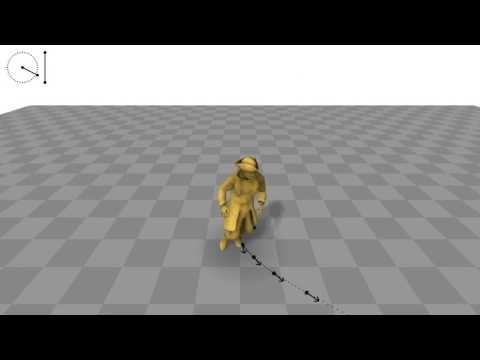
Processing Pipeline
In progress. More information will be added soon.

Copyright Information
This project is only for research or education purposes, and not freely available for commercial use or redistribution. The motion capture data is available only under the terms of the Attribution-NonCommercial 4.0 International (CC BY-NC 4.0) license.

 8 Oct 04, 2022
 82 Oct 13, 2022
 647 Dec 27, 2022
 2.1k Dec 28, 2022
 4 May 19, 2022
 2.9k Jan 08, 2023
 153 Nov 14, 2022
 1 Oct 27, 2022
 752 Nov 18, 2022
 82 Oct 22, 2022
 397 Dec 30, 2022
 30 Jan 01, 2023
 16 Nov 01, 2022
 5 Jul 14, 2022
 10 Dec 04, 2022
 16 Nov 19, 2022
 4 Mar 04, 2022
 9 Jun 06, 2022
 328 Jan 09, 2023
 101 Nov 13, 2022