An algorithm that handles large-scale aerial photo co-registration, based on SURF, RANSAC and PyTorch autograd.

Overview

Stitching Historical Aerial Photos

badge DOI

The Story

In a centuries-old library at the University of Oxford, millions of aerial photographs taken in the final decades of the British Empire may help us prepare for a potential 21st-century calamity: an exodus of people driven by climate change to places that are more livable — but politically inhospitable.

Our team is studying how climate change might set off mass migrations around the world, and looking back to history for inspiration. These century-old photos, some of which taken by the British Royal Air Force, are key to this analysis because they could reveal how populations responded to natural disasters in the past — specifically, a series of extreme droughts that plagued Africa, and hurricanes that wreaked havoc in the Caribbean islands. There were such little census or survey data back then, and the earliest record of satellite images started only in the 1970s. Apart from these boxes and boxes of black-and-white photos, scholars trying to study historical mass migrations have almost nothing to work with; but now, with modern computer vision and machine learning techniques, we can paint a complete picture of human settlement patterns and how they respond to extreme weather events.

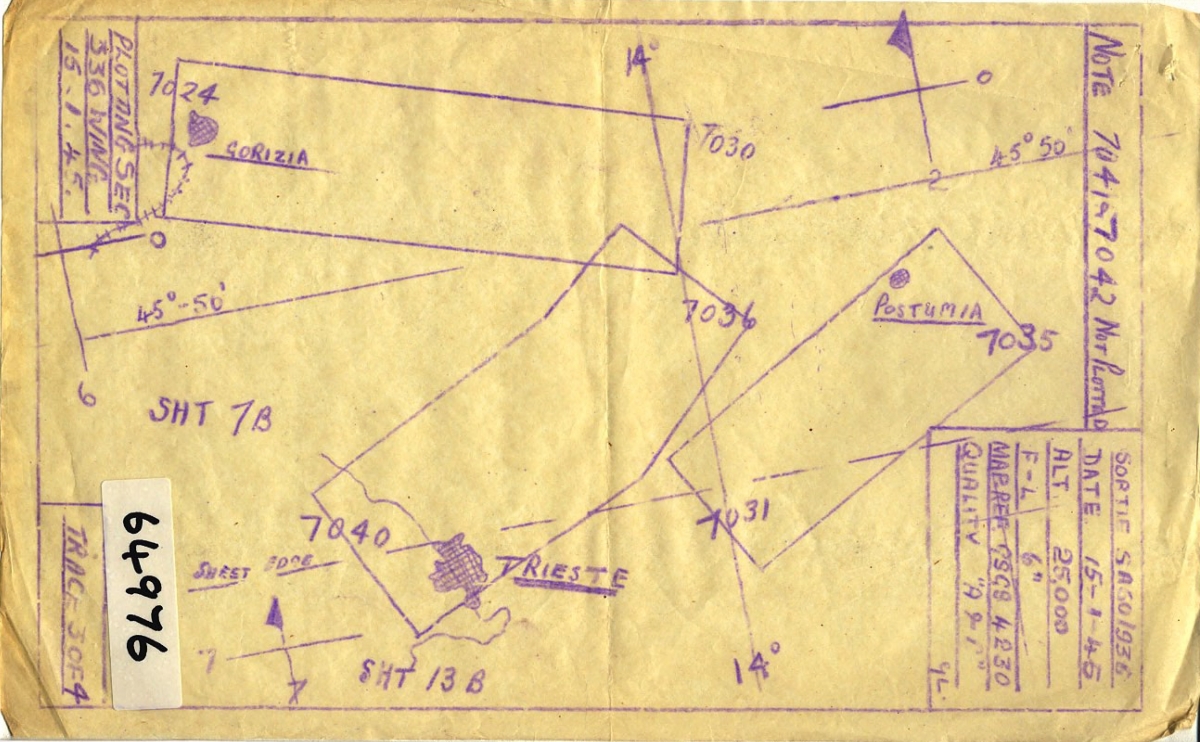
One of the first challenges in working with historical aerial photos is that it is difficult to georeference them (assigning the images to the geographical location that they cover). Unlike modern satellite imagery, historical images are not georeferenced at the time when they are collected, and the ways that experts record their locations can be pretty crude. Usually, they roughly outline the areas that the aerial photos cover by hand, and mark the image identifier numbers on them. As you can imagine, these hand-drawn maps tend to be inaccurate, and more importantly, georeferencing aerial photos solely based on hand-drawn maps is labor-intensive and quickly becomes impossible as the number of aerial photos grows. Other commercially available software such as Photoshop and OpenCV succeeded in automatically stitching a small number of images (<100), but failed miserably when scaled up.

Figure: An example sortie plot. Source: NCAP.

ExampleSortiePlot

In this project, I led a research team to develop an efficient and scalable data pipeline to digitize, process, stitch and georeference historical aerial photos; extract building footprints and road networks with deep learning models; and trace the changes in human settlement patterns over time. This repo contains codes for the image stitching process.

The Idea

We break this problem down to two steps -

  1. Given a pair of two images that overlap with each other, how do we overlay them? We take advantage of established methods in the computer vision literature - using SURF to detect features and RANSAC to estimate transformations from matched feature points robustly. These techniques were originally developed for panorama image stitching and work well in our context. This part of the codes is implemented mostly with opencv.

surf-ransac

  1. If we see all the images of interest as a graph (with each node being an image, and each edge being a relative transformation between a pair of images), how do we go from a collection of pairwise relationships to the absolute positions of all the images? We develop a "joint optimization" routine, which creates a differentiable loss given all the pairwise matches that are available, and uses back propagation to compute gradients and optimizes with Adam. This part of the codes is implemented mostly with pytorch. (No GPUs required for running the codes.)

joint-optim

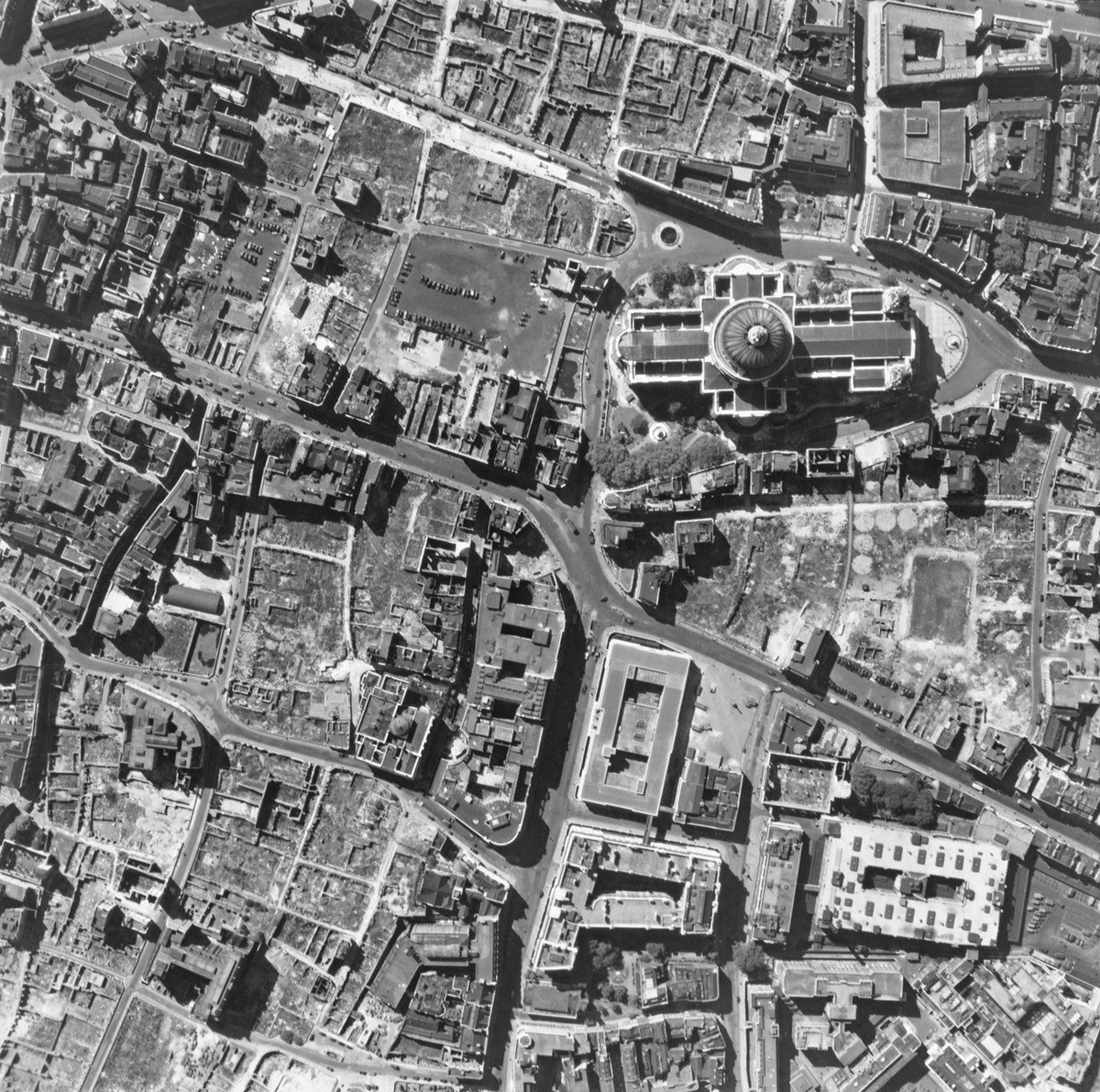
Source of the demo image: Historical England.

Play with our demo.ipynb!

In this repo, we release a simplified version of our core codebase. For legal reasons, we cannot share raw historical photos or sortie plots publicly; so we provide a "toy example" for demonstration. In practice, our codebase can handle complex scenes with tens of thousands of images. Play with our interactive demo in demo.ipynb! You can change the initialization positions for all the images, but they will always find their way back to each other.

To play with our demo, run

docker pull luna983/stitch-aerial-photos:latest
docker run -p 8888:8888 luna983/stitch-aerial-photos:latest

go to http://localhost:8888/?token=[REPLACE WITH TOKEN SHOWN] in a web browser, and open up demo.ipynb to start exploring!

demo

Note that the SURF functions are not included in the free OpenCV distributions (so pip install opencv-python would not be sufficient); the docker image contains a version of OpenCV compiled specifically for that environment.

You might also like...
DeepMetaHandles: Learning Deformation Meta-Handles of 3D Meshes with Biharmonic Coordinates

DeepMetaHandles (CVPR2021 Oral) [paper] [animations] DeepMetaHandles is a shape deformation technique. It learns a set of meta-handles for each given

Compute descriptors for 3D point cloud registration using a multi scale sparse voxel architecture

MS-SVConv : 3D Point Cloud Registration with Multi-Scale Architecture and Self-supervised Fine-tuning Compute features for 3D point cloud registration

A multi-scale unsupervised learning for deformable image registration

A multi-scale unsupervised learning for deformable image registration Shuwei Shao, Zhongcai Pei, Weihai Chen, Wentao Zhu, Xingming Wu and Baochang Zha

PyTorch reimplementation of the Smooth ReLU activation function proposed in the paper
PyTorch reimplementation of the Smooth ReLU activation function proposed in the paper "Real World Large Scale Recommendation Systems Reproducibility and Smooth Activations" [arXiv 2022].

Smooth ReLU in PyTorch Unofficial PyTorch reimplementation of the Smooth ReLU (SmeLU) activation function proposed in the paper Real World Large Scale

A 3D Dense mapping backend library of SLAM based on taichi-Lang designed for the aerial swarm.

TaichiSLAM This project is a 3D Dense mapping backend library of SLAM based Taichi-Lang, designed for the aerial swarm. Intro Taichi is an efficient d

Large-scale open domain KNOwledge grounded conVERsation system based on PaddlePaddle

Knover Knover is a toolkit for knowledge grounded dialogue generation based on PaddlePaddle. Knover allows researchers and developers to carry out eff

PointNetVLAD: Deep Point Cloud Based Retrieval for Large-Scale Place Recognition, CVPR 2018

PointNetVLAD: Deep Point Cloud Based Retrieval for Large-Scale Place Recognition PointNetVLAD: Deep Point Cloud Based Retrieval for Large-Scale Place

This is a Pytorch implementation of the paper: Self-Supervised Graph Transformer on Large-Scale Molecular Data.

This is a Pytorch implementation of the paper: Self-Supervised Graph Transformer on Large-Scale Molecular Data.

A pytorch implementation of the CVPR2021 paper "VSPW: A Large-scale Dataset for Video Scene Parsing in the Wild"

VSPW: A Large-scale Dataset for Video Scene Parsing in the Wild A pytorch implementation of the CVPR2021 paper "VSPW: A Large-scale Dataset for Video

Releases(v1.1)
  • v1.1(Aug 31, 2020)

    Two bug fixes from v1.0 for the docker environment

    1. src/optim.py: a float32 tensor was parsed as a float64 tensor in the docker environment
    2. src/graph.py: graph building relies on tuple indices; this is fixed by adding a new method that is agnostic to index types
    Source code(tar.gz)
    Source code(zip)
Owner
Luna Yue Huang
Economist + Data Scientist
Luna Yue Huang
Repository for the paper : Meta-FDMixup: Cross-Domain Few-Shot Learning Guided byLabeled Target Data

1 Meta-FDMIxup Repository for the paper : Meta-FDMixup: Cross-Domain Few-Shot Learning Guided byLabeled Target Data. (ACM MM 2021) paper News! the rep

Fu Yuqian 44 Nov 18, 2022
Pytorch implementation of our paper under review -- 1xN Pattern for Pruning Convolutional Neural Networks

1xN Pattern for Pruning Convolutional Neural Networks (paper) . This is Pytorch re-implementation of "1xN Pattern for Pruning Convolutional Neural Net

Mingbao Lin (林明宝) 29 Nov 29, 2022
Code repository for Semantic Terrain Classification for Off-Road Autonomous Driving

BEVNet Datasets Datasets should be put inside data/. For example, data/semantic_kitti_4class_100x100. Training BEVNet-S Example: cd experiments bash t

(Brian) JoonHo Lee 24 Dec 12, 2022
Python program that works as a contact list

Lista de Contatos Programa em Python que funciona como uma lista de contatos. Features Adicionar novo contato Remover contato Atualizar contato Pesqui

Victor B. Lino 3 Dec 16, 2021
LineBoard - Python+React+MySQL-白板即時系統改善人群行為

LineBoard-白板即時系統改善人群行為 即時顯示實驗室的使用狀況,並遠端預約排隊,以此來改善人們的工作效率 程式架構 運作流程 使用者先至該實驗室網站預約

Bo-Jyun Huang 1 Feb 22, 2022
NFNets and Adaptive Gradient Clipping for SGD implemented in PyTorch

PyTorch implementation of Normalizer-Free Networks and SGD - Adaptive Gradient Clipping Paper: https://arxiv.org/abs/2102.06171.pdf Original code: htt

Vaibhav Balloli 320 Jan 02, 2023
Over-the-Air Ensemble Inference with Model Privacy

Over-the-Air Ensemble Inference with Model Privacy This repository contains simulations for our private ensemble inference method. Installation Instal

Selim Firat Yilmaz 1 Jun 29, 2022
Repository for the paper "Online Domain Adaptation for Occupancy Mapping", RSS 2020

RSS 2020 - Online Domain Adaptation for Occupancy Mapping Repository for the paper "Online Domain Adaptation for Occupancy Mapping", Robotics: Science

Anthony 26 Sep 22, 2022
Illuminated3D This project participates in the Nasa Space Apps Challenge 2021.

Illuminated3D This project participates in the Nasa Space Apps Challenge 2021.

Eleftheriadis Emmanouil 1 Oct 09, 2021
Delving into Localization Errors for Monocular 3D Object Detection, CVPR'2021

Delving into Localization Errors for Monocular 3D Detection By Xinzhu Ma, Yinmin Zhang, Dan Xu, Dongzhan Zhou, Shuai Yi, Haojie Li, Wanli Ouyang. Intr

XINZHU.MA 124 Jan 04, 2023
Research code for the paper "Variational Gibbs inference for statistical estimation from incomplete data".

Variational Gibbs inference (VGI) This repository contains the research code for Simkus, V., Rhodes, B., Gutmann, M. U., 2021. Variational Gibbs infer

Vaidotas Šimkus 1 Apr 08, 2022
Capstone-Project-2 - A game program written in the Python language

Capstone-Project-2 My Pygame Game Information: Description This Pygame project i

Nhlakanipho Khulekani Hlophe 1 Jan 04, 2022
This package is for running the semantic SLAM algorithm using extracted planar surfaces from the received detection

Semantic SLAM This package can perform optimization of pose estimated from VO/VIO methods which tend to drift over time. It uses planar surfaces extra

Hriday Bavle 125 Dec 02, 2022
Tracking Progress in Question Answering over Knowledge Graphs

Tracking Progress in Question Answering over Knowledge Graphs Table of contents Question Answering Systems with Descriptions The QA Systems Table cont

Knowledge Graph Question Answering 47 Jan 02, 2023
Applying curriculum to meta-learning for few shot classification

Curriculum Meta-Learning for Few-shot Classification We propose an adaptation of the curriculum training framework, applicable to state-of-the-art met

Stergiadis Manos 3 Oct 25, 2022
Continual Learning of Electronic Health Records (EHR).

Continual Learning of Longitudinal Health Records Repo for reproducing the experiments in Continual Learning of Longitudinal Health Records (2021). Re

Jacob 7 Oct 21, 2022
Rohit Ingole 2 Mar 24, 2022
Improving Object Detection by Label Assignment Distillation

Improving Object Detection by Label Assignment Distillation This is the official implementation of the WACV 2022 paper Improving Object Detection by L

Cybercore Co. Ltd 51 Dec 08, 2022
The PyTorch implementation of paper REST: Debiased Social Recommendation via Reconstructing Exposure Strategies

REST The PyTorch implementation of paper REST: Debiased Social Recommendation via Reconstructing Exposure Strategies. Usage Download dataset Download

DMIRLAB 2 Mar 13, 2022
Code for "OctField: Hierarchical Implicit Functions for 3D Modeling (NeurIPS 2021)"

OctField(Jittor): Hierarchical Implicit Functions for 3D Modeling Introduction This repository is code release for OctField: Hierarchical Implicit Fun

55 Dec 08, 2022